Thomas K. Lameris, Michiel P. Boom, Rascha J. M. Nuijten, Nelleke H. Buitendijk, Götz Eichhorn, Bruno J. Ens, Klaus-Michael Exo, Petr M. Glazov, Sveinn Are Hanssen, Philip Hunke, Henk P. van der Jeugd, Margje E. de Jong, Andrea Kölzsch, Alexander Kondratyev, Helmut Kruckenberg, Olga Kulikova, Hans Linssen, Maarten J. J. E. Loonen, Julia A. Loshchagina, Jesper Madsen, Børge Moe, Sander Moonen, Gerhard J. D. M. Müskens, Bart A. Nolet, Ivan Pokrovsky, Jeroen Reneerkens, Isabella B. R. Scheiber, Hans Schekkerman, Kees H. T. Schreven, Tohar Tal, Ingrid Tulp, Mo A. Verhoeven, Tom S. L. Versluijs, Sergey Volkov, Martin Wikelski, Rob S. A. van Bemmelen
{"title":"Migratory Birds Advance Spring Arrival and Egg-Laying in the Arctic, Mostly by Travelling Faster","authors":"Thomas K. Lameris, Michiel P. Boom, Rascha J. M. Nuijten, Nelleke H. Buitendijk, Götz Eichhorn, Bruno J. Ens, Klaus-Michael Exo, Petr M. Glazov, Sveinn Are Hanssen, Philip Hunke, Henk P. van der Jeugd, Margje E. de Jong, Andrea Kölzsch, Alexander Kondratyev, Helmut Kruckenberg, Olga Kulikova, Hans Linssen, Maarten J. J. E. Loonen, Julia A. Loshchagina, Jesper Madsen, Børge Moe, Sander Moonen, Gerhard J. D. M. Müskens, Bart A. Nolet, Ivan Pokrovsky, Jeroen Reneerkens, Isabella B. R. Scheiber, Hans Schekkerman, Kees H. T. Schreven, Tohar Tal, Ingrid Tulp, Mo A. Verhoeven, Tom S. L. Versluijs, Sergey Volkov, Martin Wikelski, Rob S. A. van Bemmelen","doi":"10.1111/gcb.70158","DOIUrl":null,"url":null,"abstract":"<p>In the current warming climate, many organisms in seasonal environments advance their timing of reproduction to benefit from resource peaks earlier in spring. For migrants, the potential to advance reproduction may be constrained by their migration strategies, notably their ability to advance arrival at the breeding grounds. Recent studies show various changes in migration strategies, including wintering closer to the breeding grounds, earlier departure from the wintering grounds or faster travels by spending less time at stopover sites. However, whether such changes lead to earlier arrival or earlier breeding remains an open question. We studied changes in migration and reproduction timing in 12 populations of nine migratory birds, including seabirds, shorebirds, birds of prey and waterfowl breeding at Arctic sites bordering the Greenland and Barents Sea, a region undergoing rapid climate warming. The timing of migration and reproduction was derived from tracking and field data and analysed to study (1) how timing has changed in response to the changing moment of snowmelt at the breeding grounds and (2) what adjustments in migration strategies this involved. We found that in years with early snowmelt, egg-laying in multiple populations advanced, but only two waterfowl populations also advanced arrival in the Arctic. In contrast, arrival in the Arctic generally advanced with time, even when snowmelt or egg-laying dates did not advance. Earlier arrival with time was mostly explained by populations traveling to the Arctic faster, likely spending less time at stopover sites. Inability to forecast conditions in the Arctic may limit birds to adjust migration timing to annually varying snowmelt, but we show that several species, particularly waterfowl, are able to travel faster and advance the timing of migration over the years. The question remains whether this reflects adaptations to Arctic climate change or other factors, for example, environmental changes along the migratory route.</p>","PeriodicalId":175,"journal":{"name":"Global Change Biology","volume":"31 4","pages":""},"PeriodicalIF":12.0000,"publicationDate":"2025-04-09","publicationTypes":"Journal Article","fieldsOfStudy":null,"isOpenAccess":false,"openAccessPdf":"https://onlinelibrary.wiley.com/doi/epdf/10.1111/gcb.70158","citationCount":"0","resultStr":null,"platform":"Semanticscholar","paperid":null,"PeriodicalName":"Global Change Biology","FirstCategoryId":"93","ListUrlMain":"https://onlinelibrary.wiley.com/doi/10.1111/gcb.70158","RegionNum":1,"RegionCategory":"环境科学与生态学","ArticlePicture":[],"TitleCN":null,"AbstractTextCN":null,"PMCID":null,"EPubDate":"","PubModel":"","JCR":"Q1","JCRName":"BIODIVERSITY CONSERVATION","Score":null,"Total":0}
引用次数: 0
Abstract
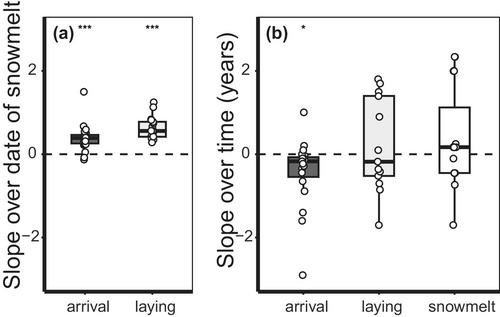
In the current warming climate, many organisms in seasonal environments advance their timing of reproduction to benefit from resource peaks earlier in spring. For migrants, the potential to advance reproduction may be constrained by their migration strategies, notably their ability to advance arrival at the breeding grounds. Recent studies show various changes in migration strategies, including wintering closer to the breeding grounds, earlier departure from the wintering grounds or faster travels by spending less time at stopover sites. However, whether such changes lead to earlier arrival or earlier breeding remains an open question. We studied changes in migration and reproduction timing in 12 populations of nine migratory birds, including seabirds, shorebirds, birds of prey and waterfowl breeding at Arctic sites bordering the Greenland and Barents Sea, a region undergoing rapid climate warming. The timing of migration and reproduction was derived from tracking and field data and analysed to study (1) how timing has changed in response to the changing moment of snowmelt at the breeding grounds and (2) what adjustments in migration strategies this involved. We found that in years with early snowmelt, egg-laying in multiple populations advanced, but only two waterfowl populations also advanced arrival in the Arctic. In contrast, arrival in the Arctic generally advanced with time, even when snowmelt or egg-laying dates did not advance. Earlier arrival with time was mostly explained by populations traveling to the Arctic faster, likely spending less time at stopover sites. Inability to forecast conditions in the Arctic may limit birds to adjust migration timing to annually varying snowmelt, but we show that several species, particularly waterfowl, are able to travel faster and advance the timing of migration over the years. The question remains whether this reflects adaptations to Arctic climate change or other factors, for example, environmental changes along the migratory route.
期刊介绍:
Global Change Biology is an environmental change journal committed to shaping the future and addressing the world's most pressing challenges, including sustainability, climate change, environmental protection, food and water safety, and global health.
Dedicated to fostering a profound understanding of the impacts of global change on biological systems and offering innovative solutions, the journal publishes a diverse range of content, including primary research articles, technical advances, research reviews, reports, opinions, perspectives, commentaries, and letters. Starting with the 2024 volume, Global Change Biology will transition to an online-only format, enhancing accessibility and contributing to the evolution of scholarly communication.



 京公网安备 11010802042870号
京ICP备2023020795号-1
京公网安备 11010802042870号
京ICP备2023020795号-1

 分享
分享
 求助内容:
求助内容: 应助结果提醒方式:
 扫码关注我们
