{"title":"Ketogenic diet attenuates neuroinflammation and restores hippocampal neurogenesis to improve CUMS induced depression-like behavior in mice","authors":"Jinyuan Liang, Jingxi Zhang, Jingyu Sun, Qingsheng Liang, Yingtong Zhan, Zhiyou Yang, Yongping Zhang, Leigang Jin, Chuanyin Hu and Yun-Tao Zhao","doi":"10.1039/D5FO00226E","DOIUrl":null,"url":null,"abstract":"<p >The ketogenic diet (KD) has been proposed as a potential treatment for depression. However, the underlying mechanisms remain poorly understood. This study aimed to evaluate further the effects of KD on chronic unpredictable mild stress (CUMS)-induced depression in mice and investigate the underlying mechanisms. The results demonstrated that KD intervention significantly alleviated CUMS-induced depression-like behaviors, as evidenced by a decrease in immobility time in the forced swimming test and tail suspension test, an increase in distance traveled in the open field test, and a greater preference for sucrose in the sucrose preference test. KD alleviated neuroinflammation by reducing the levels of glial cell activation markers Iba-1 and GFAP, inhibiting the expression of inflammatory factors IL-1β, TNF-α, and COX-2, and suppressing the overactivation of the TLR4/MyD88/NF-κB signaling pathway. Furthermore, KD increased the number of DCX-, BrdU-, and PSD95-positive cells in the hippocampus and enhanced the BDNF/TrkB/CREB and Wnt/β-catenin signaling pathways, thereby promoting hippocampal neurogenesis. These findings suggested that KD alleviated CUMS-induced depression-like behaviors in mice by reducing neuroinflammation, enhancing neurotrophic signaling, and promoting hippocampal neurogenesis, thereby providing a mechanistic basis for its potential as a novel dietary antidepressant therapy.</p>","PeriodicalId":77,"journal":{"name":"Food & Function","volume":" 9","pages":" 3408-3422"},"PeriodicalIF":5.4000,"publicationDate":"2025-03-29","publicationTypes":"Journal Article","fieldsOfStudy":null,"isOpenAccess":false,"openAccessPdf":"","citationCount":"0","resultStr":null,"platform":"Semanticscholar","paperid":null,"PeriodicalName":"Food & Function","FirstCategoryId":"97","ListUrlMain":"https://pubs.rsc.org/en/content/articlelanding/2025/fo/d5fo00226e","RegionNum":1,"RegionCategory":"农林科学","ArticlePicture":[],"TitleCN":null,"AbstractTextCN":null,"PMCID":null,"EPubDate":"","PubModel":"","JCR":"Q1","JCRName":"BIOCHEMISTRY & MOLECULAR BIOLOGY","Score":null,"Total":0}
引用次数: 0
Abstract
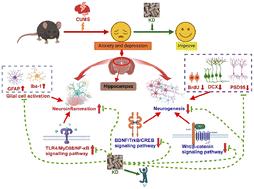
The ketogenic diet (KD) has been proposed as a potential treatment for depression. However, the underlying mechanisms remain poorly understood. This study aimed to evaluate further the effects of KD on chronic unpredictable mild stress (CUMS)-induced depression in mice and investigate the underlying mechanisms. The results demonstrated that KD intervention significantly alleviated CUMS-induced depression-like behaviors, as evidenced by a decrease in immobility time in the forced swimming test and tail suspension test, an increase in distance traveled in the open field test, and a greater preference for sucrose in the sucrose preference test. KD alleviated neuroinflammation by reducing the levels of glial cell activation markers Iba-1 and GFAP, inhibiting the expression of inflammatory factors IL-1β, TNF-α, and COX-2, and suppressing the overactivation of the TLR4/MyD88/NF-κB signaling pathway. Furthermore, KD increased the number of DCX-, BrdU-, and PSD95-positive cells in the hippocampus and enhanced the BDNF/TrkB/CREB and Wnt/β-catenin signaling pathways, thereby promoting hippocampal neurogenesis. These findings suggested that KD alleviated CUMS-induced depression-like behaviors in mice by reducing neuroinflammation, enhancing neurotrophic signaling, and promoting hippocampal neurogenesis, thereby providing a mechanistic basis for its potential as a novel dietary antidepressant therapy.
期刊介绍:
Food & Function provides a unique venue for physicists, chemists, biochemists, nutritionists and other food scientists to publish work at the interface of the chemistry, physics and biology of food. The journal focuses on food and the functions of food in relation to health.




 京公网安备 11010802042870号
京ICP备2023020795号-1
京公网安备 11010802042870号
京ICP备2023020795号-1

 分享
分享
 求助内容:
求助内容: 应助结果提醒方式:
 扫码关注我们
