The Bodily Appearance of a Virtual Partner Affects the Activity of the Action Observation and Action Monitoring Systems in a Minimally Interactive Task.
{"title":"The Bodily Appearance of a Virtual Partner Affects the Activity of the Action Observation and Action Monitoring Systems in a Minimally Interactive Task.","authors":"Ugo Giulio Pesci, Quentin Moreau, Vanessa Era, Matteo Candidi","doi":"10.1523/ENEURO.0390-24.2025","DOIUrl":null,"url":null,"abstract":"<p><p>One pending question in social neuroscience is whether interpersonal interactions are processed differently by the brain depending on the bodily characteristics of the interactor, i.e., their physical appearance. To address this issue, we engaged participants in a minimally interactive task with an avatar either showing bodily features or not while recording their brain activity using electroencephalography (EEG) in order to investigate indices of action observation and action monitoring processing. Multivariate results showed that bodily compared with nonbodily appearance modulated parieto-occipital neural patterns throughout the entire duration of the observed movement and that, importantly, such patterns differ from the ones related to initial shape processing. Furthermore, among the electrocortical indices of action monitoring, only the early observational positivity (oPe) was responsive to the bodily appearance of the observed agent under the specific task requirement to predict the partner movement. Taken together, these findings broaden the understanding of how bodily appearance shapes the spatiotemporal processing of an interactor's movements. This holds particular relevance in our modern society, where human-artificial (virtual or robotic) agent interactions are rapidly becoming ubiquitous.</p>","PeriodicalId":11617,"journal":{"name":"eNeuro","volume":" ","pages":""},"PeriodicalIF":2.7000,"publicationDate":"2025-04-17","publicationTypes":"Journal Article","fieldsOfStudy":null,"isOpenAccess":false,"openAccessPdf":"https://www.ncbi.nlm.nih.gov/pmc/articles/PMC12005894/pdf/","citationCount":"0","resultStr":null,"platform":"Semanticscholar","paperid":null,"PeriodicalName":"eNeuro","FirstCategoryId":"3","ListUrlMain":"https://doi.org/10.1523/ENEURO.0390-24.2025","RegionNum":3,"RegionCategory":"医学","ArticlePicture":[],"TitleCN":null,"AbstractTextCN":null,"PMCID":null,"EPubDate":"2025/4/1 0:00:00","PubModel":"Print","JCR":"Q3","JCRName":"NEUROSCIENCES","Score":null,"Total":0}
引用次数: 0
Abstract
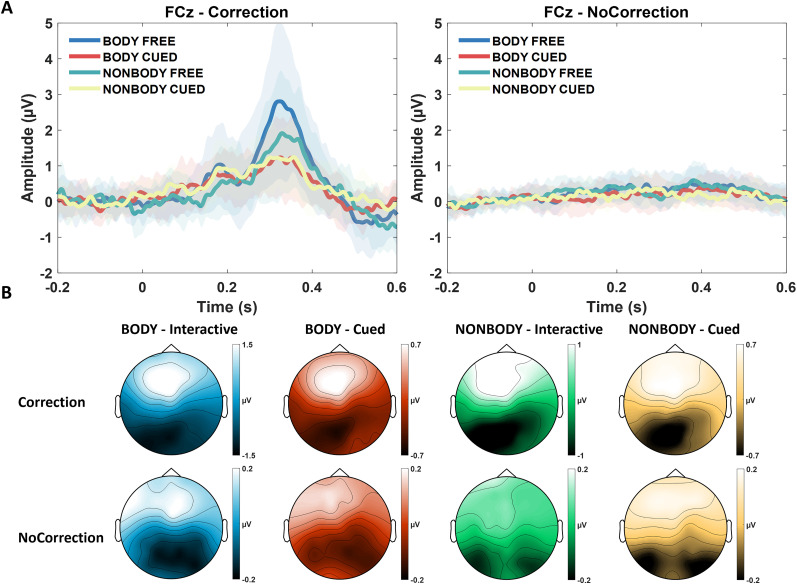
One pending question in social neuroscience is whether interpersonal interactions are processed differently by the brain depending on the bodily characteristics of the interactor, i.e., their physical appearance. To address this issue, we engaged participants in a minimally interactive task with an avatar either showing bodily features or not while recording their brain activity using electroencephalography (EEG) in order to investigate indices of action observation and action monitoring processing. Multivariate results showed that bodily compared with nonbodily appearance modulated parieto-occipital neural patterns throughout the entire duration of the observed movement and that, importantly, such patterns differ from the ones related to initial shape processing. Furthermore, among the electrocortical indices of action monitoring, only the early observational positivity (oPe) was responsive to the bodily appearance of the observed agent under the specific task requirement to predict the partner movement. Taken together, these findings broaden the understanding of how bodily appearance shapes the spatiotemporal processing of an interactor's movements. This holds particular relevance in our modern society, where human-artificial (virtual or robotic) agent interactions are rapidly becoming ubiquitous.
期刊介绍:
An open-access journal from the Society for Neuroscience, eNeuro publishes high-quality, broad-based, peer-reviewed research focused solely on the field of neuroscience. eNeuro embodies an emerging scientific vision that offers a new experience for authors and readers, all in support of the Society’s mission to advance understanding of the brain and nervous system.






 京公网安备 11010802042870号
京ICP备2023020795号-1
京公网安备 11010802042870号
京ICP备2023020795号-1

 分享
分享
 求助内容:
求助内容: 应助结果提醒方式:
 扫码关注我们
