{"title":"Connecting self-esteem to problematic AI chatbot use: the multiple mediating roles of positive and negative psychological states.","authors":"Ruiqi Yao, Guijie Qi, Dongfang Sheng, Hua Sun, Jiacheng Zhang","doi":"10.3389/fpsyg.2025.1453072","DOIUrl":null,"url":null,"abstract":"<p><p>The emergence of AI chatbot products has ushered in a new era of human-AI interaction, yet scholars and practitioners have expressed concerns about their use due to potential addictive and adverse effects. Currently, the understanding of problematic AI chatbot use (PACU) remains incomplete and inconclusive. Despite previous findings that indicate negative outcomes associated with the use of AI products, limited studies have explored the underlying factors that drive the complex process leading to the formation of PACU. Furthermore, while existing literature highlights how personal traits influences problematic IT use via evoked psychological states, it largely overlooks that the positive psychological experience may also have a potential influence on problematic outcomes. Incorporating flow experience into the compensatory internet use theory, this study presents a multiple mediation model to investigate how social anxiety, escapism, and AI chatbot flow influence the relationship between self-esteem and PACU. We examine the model using Partial Least Squares Structural Equation Modeling (PLS-SEM) with cross-sectional data collected from 563 online users who have engaged with AI chatbots. Our findings indicate that users with low self-esteem are more likely to conduct problematic behavior when using AI chatbots. This relationship can be mediated by social anxiety, escapism and AI chatbot flow. This study sheds light on how self-esteem negatively affects PACU, unraveling the underlying psychological processes experienced by users with low self-esteem in their interactions with AI chatbots. Also, we provide practical insights for online users and practitioners to mitigate the potential negative impacts of AI product usage.</p>","PeriodicalId":12525,"journal":{"name":"Frontiers in Psychology","volume":"16 ","pages":"1453072"},"PeriodicalIF":2.9000,"publicationDate":"2025-03-24","publicationTypes":"Journal Article","fieldsOfStudy":null,"isOpenAccess":false,"openAccessPdf":"https://www.ncbi.nlm.nih.gov/pmc/articles/PMC11973363/pdf/","citationCount":"0","resultStr":null,"platform":"Semanticscholar","paperid":null,"PeriodicalName":"Frontiers in Psychology","FirstCategoryId":"102","ListUrlMain":"https://doi.org/10.3389/fpsyg.2025.1453072","RegionNum":3,"RegionCategory":"心理学","ArticlePicture":[],"TitleCN":null,"AbstractTextCN":null,"PMCID":null,"EPubDate":"2025/1/1 0:00:00","PubModel":"eCollection","JCR":"Q2","JCRName":"PSYCHOLOGY, MULTIDISCIPLINARY","Score":null,"Total":0}
引用次数: 0
Abstract
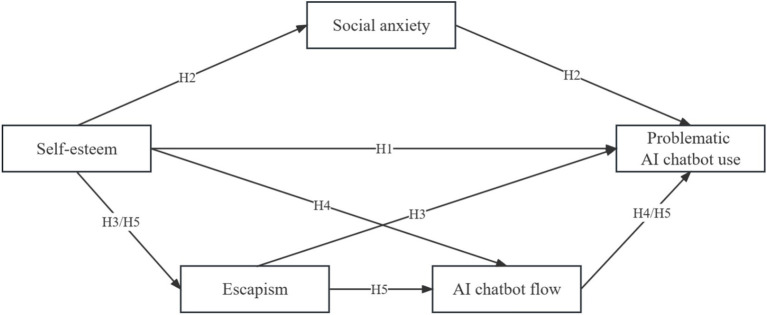
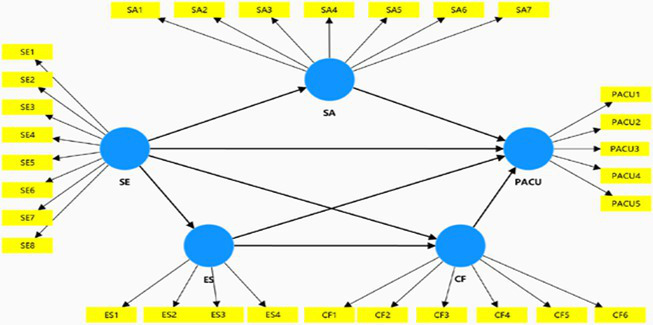
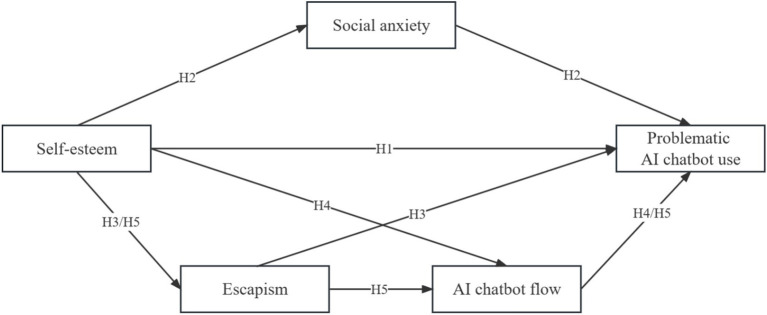
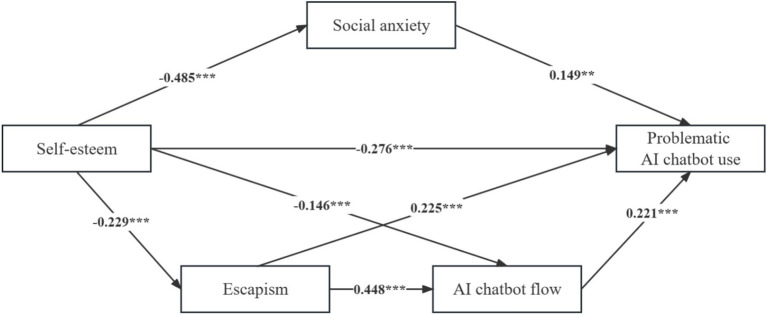
The emergence of AI chatbot products has ushered in a new era of human-AI interaction, yet scholars and practitioners have expressed concerns about their use due to potential addictive and adverse effects. Currently, the understanding of problematic AI chatbot use (PACU) remains incomplete and inconclusive. Despite previous findings that indicate negative outcomes associated with the use of AI products, limited studies have explored the underlying factors that drive the complex process leading to the formation of PACU. Furthermore, while existing literature highlights how personal traits influences problematic IT use via evoked psychological states, it largely overlooks that the positive psychological experience may also have a potential influence on problematic outcomes. Incorporating flow experience into the compensatory internet use theory, this study presents a multiple mediation model to investigate how social anxiety, escapism, and AI chatbot flow influence the relationship between self-esteem and PACU. We examine the model using Partial Least Squares Structural Equation Modeling (PLS-SEM) with cross-sectional data collected from 563 online users who have engaged with AI chatbots. Our findings indicate that users with low self-esteem are more likely to conduct problematic behavior when using AI chatbots. This relationship can be mediated by social anxiety, escapism and AI chatbot flow. This study sheds light on how self-esteem negatively affects PACU, unraveling the underlying psychological processes experienced by users with low self-esteem in their interactions with AI chatbots. Also, we provide practical insights for online users and practitioners to mitigate the potential negative impacts of AI product usage.
期刊介绍:
Frontiers in Psychology is the largest journal in its field, publishing rigorously peer-reviewed research across the psychological sciences, from clinical research to cognitive science, from perception to consciousness, from imaging studies to human factors, and from animal cognition to social psychology. Field Chief Editor Axel Cleeremans at the Free University of Brussels is supported by an outstanding Editorial Board of international researchers. This multidisciplinary open-access journal is at the forefront of disseminating and communicating scientific knowledge and impactful discoveries to researchers, academics, clinicians and the public worldwide. The journal publishes the best research across the entire field of psychology. Today, psychological science is becoming increasingly important at all levels of society, from the treatment of clinical disorders to our basic understanding of how the mind works. It is highly interdisciplinary, borrowing questions from philosophy, methods from neuroscience and insights from clinical practice - all in the goal of furthering our grasp of human nature and society, as well as our ability to develop new intervention methods.






 京公网安备 11010802042870号
京ICP备2023020795号-1
京公网安备 11010802042870号
京ICP备2023020795号-1

 分享
分享
 求助内容:
求助内容: 应助结果提醒方式:
 扫码关注我们
