Yang Liu, Yaqing Huang, Lan Wen, Peng Chen, Shuyue Zhang
{"title":"Temporal focus, dual-system self-control, and college students' short-video addiction: a variable-centered and person-centered approach.","authors":"Yang Liu, Yaqing Huang, Lan Wen, Peng Chen, Shuyue Zhang","doi":"10.3389/fpsyg.2025.1538948","DOIUrl":null,"url":null,"abstract":"<p><strong>Background: </strong>Short video addiction has become increasingly prevalent among college students. It can negatively impact their physical and mental health, yet its influencing factors and underlying mechanisms require further exploration. Time focus and self-control are recognized as critical determinants in shaping addictive behaviors.</p><p><strong>Objective: </strong>Grounded in the I-PACE theory, this study examines the relationship between emotional and cognitive responses (various temporal focuses and dual systems of self-control) and short video addiction, while also investigating the mediating roles of inhibitory and initiation control.</p><p><strong>Methods: </strong>Methodologically, it integrates both variable-centered and person-centered approaches, utilizing the Time Focus Scale, Multidimensional Self-Control Scale, and Short Video Addiction Scale. A total of 2,239 university students participated in the survey.</p><p><strong>Results: </strong>The results revealed the following: (1) Past and present time focus were positively correlated with short video addiction, while future time focus showed a negative correlation. Inhibitory self-control was positively associated with short video addiction, whereas initiatory self-control was negatively correlated. Variable-centered analysis demonstrated that past and present time focus positively predicted short video addiction, with inhibitory self-control mediating the relationship between these time orientations and addiction. Conversely, initiatory self-control played a mediating role between future time focus and addiction risk, with a negative predictive effect on the likelihood of short video addiction. (2) Person-centered analysis identified four categories of short video addiction: non-addicted (12.68%), low-risk addiction (34.21%), moderate-risk addiction (42.20%), and high-risk addiction (10.89%). (3) Logistic regression analysis indicated that students with excessive past and present time focus were more likely to fall into the high-risk addiction category, while those employing inhibitory self-control strategies were more likely to be categorized into low, moderate, or high-risk addiction groups. Students utilizing initiatory self-control were less likely to develop high-risk addiction. Female students were more likely than male students to fall into the low, moderate, or high addiction categories, and only children were more likely to belong to the moderate or high-risk addiction categories than non-only children.</p><p><strong>Conclusion: </strong>This study emphasizes the pivotal role of time focus and dual-system self-control in the intervention and prevention of short video addiction,further highlighting the role of emotional and cognitive responses in the development of short-video addiction. The implications of the findings, as well as the limitations of the study, are also discussed.</p>","PeriodicalId":12525,"journal":{"name":"Frontiers in Psychology","volume":"16 ","pages":"1538948"},"PeriodicalIF":2.9000,"publicationDate":"2025-03-24","publicationTypes":"Journal Article","fieldsOfStudy":null,"isOpenAccess":false,"openAccessPdf":"https://www.ncbi.nlm.nih.gov/pmc/articles/PMC11973371/pdf/","citationCount":"0","resultStr":null,"platform":"Semanticscholar","paperid":null,"PeriodicalName":"Frontiers in Psychology","FirstCategoryId":"102","ListUrlMain":"https://doi.org/10.3389/fpsyg.2025.1538948","RegionNum":3,"RegionCategory":"心理学","ArticlePicture":[],"TitleCN":null,"AbstractTextCN":null,"PMCID":null,"EPubDate":"2025/1/1 0:00:00","PubModel":"eCollection","JCR":"Q2","JCRName":"PSYCHOLOGY, MULTIDISCIPLINARY","Score":null,"Total":0}
引用次数: 0
Abstract
Background: Short video addiction has become increasingly prevalent among college students. It can negatively impact their physical and mental health, yet its influencing factors and underlying mechanisms require further exploration. Time focus and self-control are recognized as critical determinants in shaping addictive behaviors.
Objective: Grounded in the I-PACE theory, this study examines the relationship between emotional and cognitive responses (various temporal focuses and dual systems of self-control) and short video addiction, while also investigating the mediating roles of inhibitory and initiation control.
Methods: Methodologically, it integrates both variable-centered and person-centered approaches, utilizing the Time Focus Scale, Multidimensional Self-Control Scale, and Short Video Addiction Scale. A total of 2,239 university students participated in the survey.
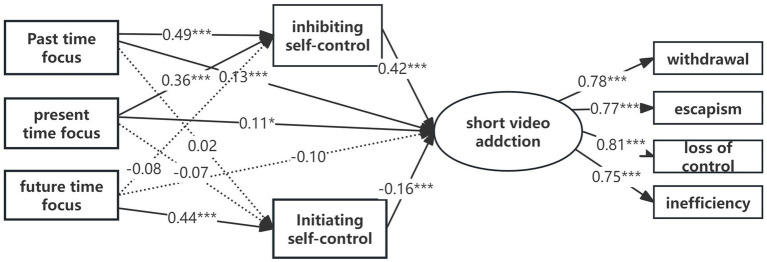
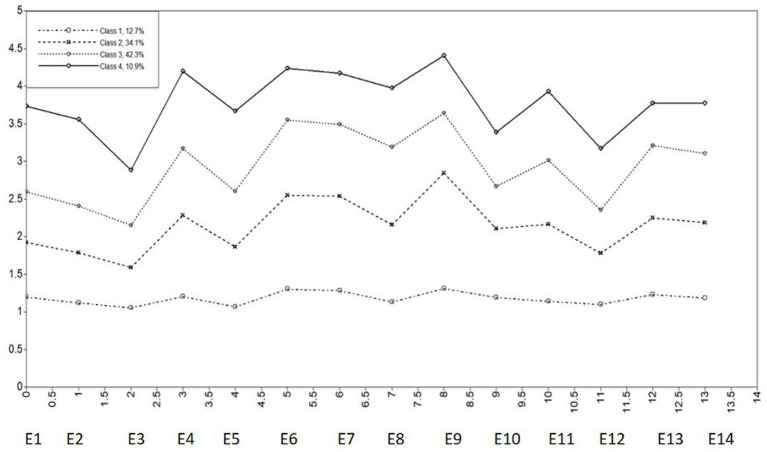
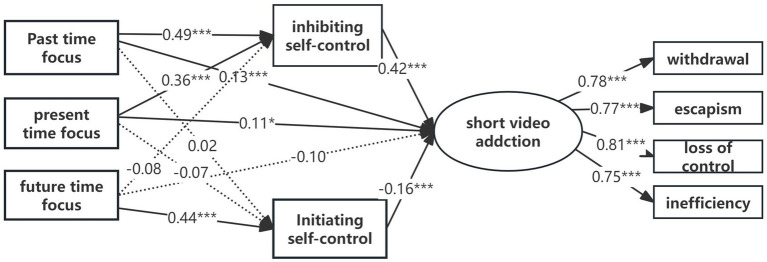
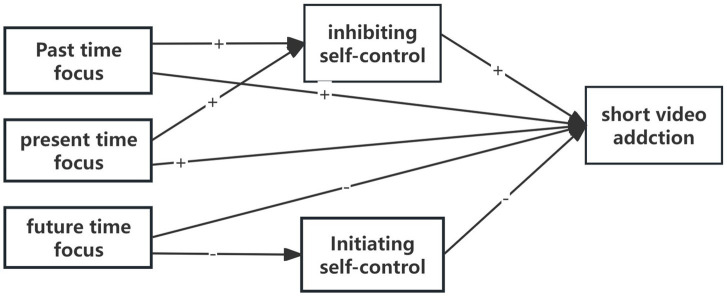
Results: The results revealed the following: (1) Past and present time focus were positively correlated with short video addiction, while future time focus showed a negative correlation. Inhibitory self-control was positively associated with short video addiction, whereas initiatory self-control was negatively correlated. Variable-centered analysis demonstrated that past and present time focus positively predicted short video addiction, with inhibitory self-control mediating the relationship between these time orientations and addiction. Conversely, initiatory self-control played a mediating role between future time focus and addiction risk, with a negative predictive effect on the likelihood of short video addiction. (2) Person-centered analysis identified four categories of short video addiction: non-addicted (12.68%), low-risk addiction (34.21%), moderate-risk addiction (42.20%), and high-risk addiction (10.89%). (3) Logistic regression analysis indicated that students with excessive past and present time focus were more likely to fall into the high-risk addiction category, while those employing inhibitory self-control strategies were more likely to be categorized into low, moderate, or high-risk addiction groups. Students utilizing initiatory self-control were less likely to develop high-risk addiction. Female students were more likely than male students to fall into the low, moderate, or high addiction categories, and only children were more likely to belong to the moderate or high-risk addiction categories than non-only children.
Conclusion: This study emphasizes the pivotal role of time focus and dual-system self-control in the intervention and prevention of short video addiction,further highlighting the role of emotional and cognitive responses in the development of short-video addiction. The implications of the findings, as well as the limitations of the study, are also discussed.
期刊介绍:
Frontiers in Psychology is the largest journal in its field, publishing rigorously peer-reviewed research across the psychological sciences, from clinical research to cognitive science, from perception to consciousness, from imaging studies to human factors, and from animal cognition to social psychology. Field Chief Editor Axel Cleeremans at the Free University of Brussels is supported by an outstanding Editorial Board of international researchers. This multidisciplinary open-access journal is at the forefront of disseminating and communicating scientific knowledge and impactful discoveries to researchers, academics, clinicians and the public worldwide. The journal publishes the best research across the entire field of psychology. Today, psychological science is becoming increasingly important at all levels of society, from the treatment of clinical disorders to our basic understanding of how the mind works. It is highly interdisciplinary, borrowing questions from philosophy, methods from neuroscience and insights from clinical practice - all in the goal of furthering our grasp of human nature and society, as well as our ability to develop new intervention methods.






 京公网安备 11010802042870号
京ICP备2023020795号-1
京公网安备 11010802042870号
京ICP备2023020795号-1

 分享
分享
 求助内容:
求助内容: 应助结果提醒方式:
 扫码关注我们
