Fernanda Cristina de Oliveira Luna Barbosa, Ana Cristina de Albuquerque Montenegro, Bianca Arruda Manchester de Queiroga
{"title":"The effects of the DHACA method on expressive communication in children with autism spectrum disorder.","authors":"Fernanda Cristina de Oliveira Luna Barbosa, Ana Cristina de Albuquerque Montenegro, Bianca Arruda Manchester de Queiroga","doi":"10.1590/2317-1782/e20240148pt","DOIUrl":null,"url":null,"abstract":"<p><strong>Purpose: </strong>This study aimed to assess the contributions of the DHACA method to expressive communication development in children with autism spectrum disorder (ASD).</p><p><strong>Methods: </strong>This longitudinal case series study had a sample of 12 children with ASD, nonverbal or minimally verbal communication, and support level one or two. Data were collected by applying the ACOTEA-R Protocol by analyzing videos recorded during intervention sessions before and after using the DHACA. Participants underwent 20 individual speech-language-hearing sessions with the DHACA.</p><p><strong>Results: </strong>After the intervention with the ACOTEA-R, 10 of the 12 children improved their overall expressive communication skills. Concerning the communicative profile, initially, 10 children were nonverbal and 2 were minimally verbal. After the intervention, 7 evolved to a verbal pattern, whereas 5 remained nonverbal. The progress of the following communication skills stands out: use of sentences with four or more words, naming objects, social expressions, greeting people, and making comments. Moreover, 8 of the 12 participants advanced to the third skill in the DHACA, characterized by request with lexical and morphosyntactic expansion.</p><p><strong>Conclusion: </strong>The children's speech and use of the communication book indicated progress in their expressive communication development after intervention with the DHACA.</p>","PeriodicalId":46547,"journal":{"name":"CoDAS","volume":"37 3","pages":"e20240148"},"PeriodicalIF":0.8000,"publicationDate":"2025-04-07","publicationTypes":"Journal Article","fieldsOfStudy":null,"isOpenAccess":false,"openAccessPdf":"https://www.ncbi.nlm.nih.gov/pmc/articles/PMC11991719/pdf/","citationCount":"0","resultStr":null,"platform":"Semanticscholar","paperid":null,"PeriodicalName":"CoDAS","FirstCategoryId":"1085","ListUrlMain":"https://doi.org/10.1590/2317-1782/e20240148pt","RegionNum":0,"RegionCategory":null,"ArticlePicture":[],"TitleCN":null,"AbstractTextCN":null,"PMCID":null,"EPubDate":"2025/1/1 0:00:00","PubModel":"eCollection","JCR":"Q4","JCRName":"AUDIOLOGY & SPEECH-LANGUAGE PATHOLOGY","Score":null,"Total":0}
引用次数: 0
Abstract
Purpose: This study aimed to assess the contributions of the DHACA method to expressive communication development in children with autism spectrum disorder (ASD).
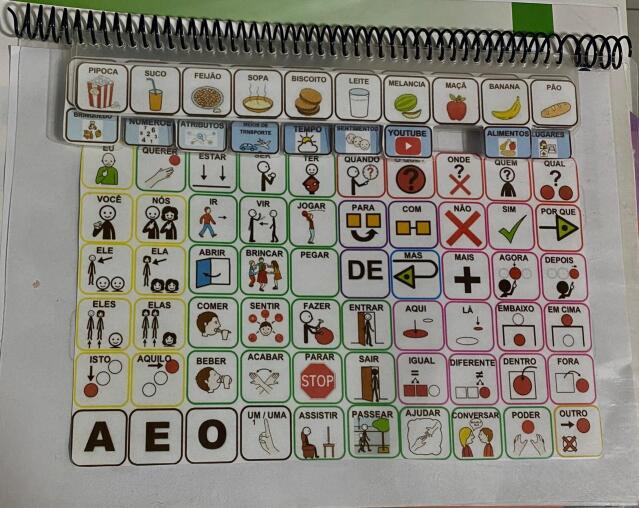
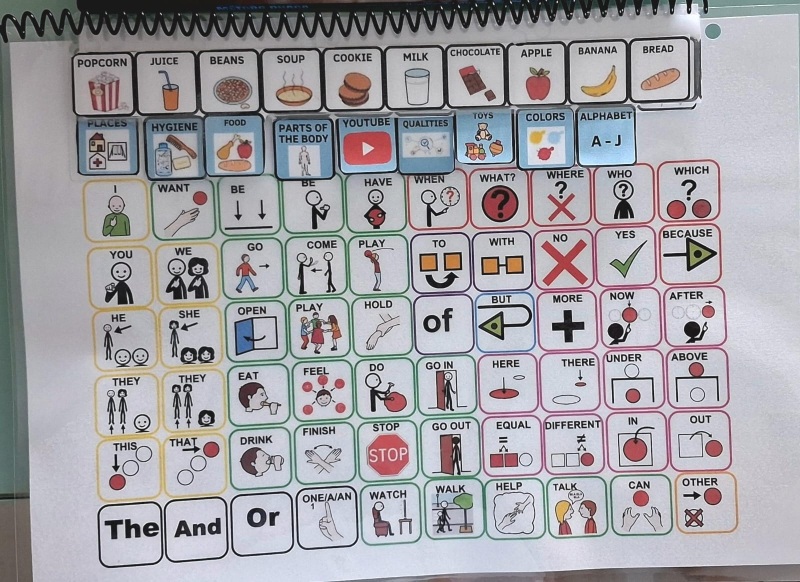
Methods: This longitudinal case series study had a sample of 12 children with ASD, nonverbal or minimally verbal communication, and support level one or two. Data were collected by applying the ACOTEA-R Protocol by analyzing videos recorded during intervention sessions before and after using the DHACA. Participants underwent 20 individual speech-language-hearing sessions with the DHACA.
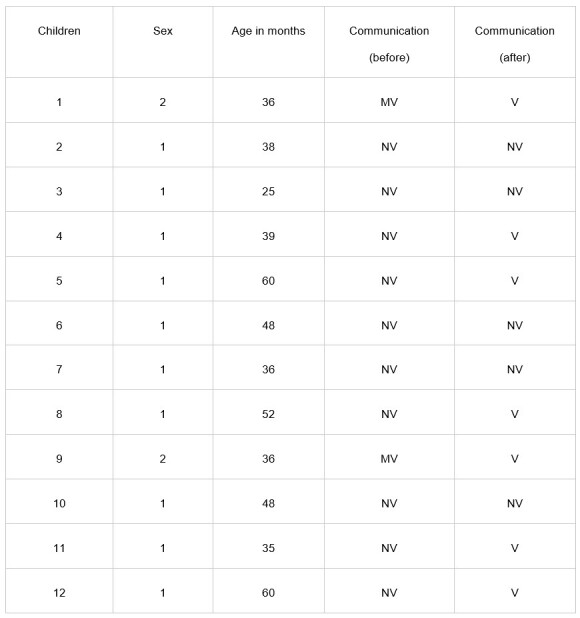
Results: After the intervention with the ACOTEA-R, 10 of the 12 children improved their overall expressive communication skills. Concerning the communicative profile, initially, 10 children were nonverbal and 2 were minimally verbal. After the intervention, 7 evolved to a verbal pattern, whereas 5 remained nonverbal. The progress of the following communication skills stands out: use of sentences with four or more words, naming objects, social expressions, greeting people, and making comments. Moreover, 8 of the 12 participants advanced to the third skill in the DHACA, characterized by request with lexical and morphosyntactic expansion.
Conclusion: The children's speech and use of the communication book indicated progress in their expressive communication development after intervention with the DHACA.




 京公网安备 11010802042870号
京ICP备2023020795号-1
京公网安备 11010802042870号
京ICP备2023020795号-1

 分享
分享
 求助内容:
求助内容: 应助结果提醒方式:
 扫码关注我们
