Ming-Yu Wang, Ke-Liang Chen, Yu-Yuan Huang, Shu-Fen Chen, Rong-Ze Wang, Yi Zhang, He-Ying Hu, Ling-Zhi Ma, Wei-Shi Liu, Jun Wang, Jia-Wei Xin, Xue Zhang, Meng-Meng Li, Yu Guo, Qiang Dong, Wei Cheng, Lan Tan, Mei Cui, Ya-Ru Zhang, Jin-Tai Yu
{"title":"Clinical utility of cerebrospinal fluid Alzheimer's disease biomarkers in the diagnostic workup of complex patients with cognitive impairment.","authors":"Ming-Yu Wang, Ke-Liang Chen, Yu-Yuan Huang, Shu-Fen Chen, Rong-Ze Wang, Yi Zhang, He-Ying Hu, Ling-Zhi Ma, Wei-Shi Liu, Jun Wang, Jia-Wei Xin, Xue Zhang, Meng-Meng Li, Yu Guo, Qiang Dong, Wei Cheng, Lan Tan, Mei Cui, Ya-Ru Zhang, Jin-Tai Yu","doi":"10.1038/s41398-025-03345-z","DOIUrl":null,"url":null,"abstract":"<p><p>Cerebrospinal fluid (CSF) biomarkers have been widely adopted in Alzheimer's disease (AD) diagnosis. However, no studies focused on the application of CSF biomarkers in the clinical practice of complex and atypical patients with cognitive impairment in China. This study aimed to evaluate the added value of CSF AD biomarkers in cognitively impaired patients with complex conditions in a memory clinical setting. A total of 633 participants were included from the National Center for Neurological Disorders in Shanghai, China. The CSF AD biomarkers were measured with ELISA. Cutoff values were firstly identified using Youden's index. The neurologists proposed etiology diagnosis with a percentage estimate of their confidence and prescribed medication before and after CSF disclosure. Changes in etiological diagnosis, diagnostic confidence, and management plan were compared across the groups. Of the 633 patients (mean [SD] age, 61.1 [11.3] years; 295 males [46.6%]), 372 (58.8%) were diagnosed with dementia, 103 (16.3%) with mild cognitive impairment, and 158 (24.9%) with subjective cognitive decline. Using those pre-defined cutoffs, we categorized patients into 3 groups: Alzheimer's continuum (68.1%), non-AD pathologic change (11.1%), and normal AD biomarkers (20.8%). After CSF disclosure, the proposed etiology changed in 158 (25.0%) participants and the prescribed medication changed in 200 (31.6%) patients. Mean diagnostic confidence increased from 69.5-83.0% (+13.5%; P < 0.001). In conclusion, CSF AD biomarkers significantly impacted the diagnosis, diagnostic confidence, and treatment plans for Chinese patients with complex cognitive impairment. CSF AD biomarkers are a useful tool for clinicians beyond routine clinical assessment.</p>","PeriodicalId":23278,"journal":{"name":"Translational Psychiatry","volume":"15 1","pages":"130"},"PeriodicalIF":6.2000,"publicationDate":"2025-04-07","publicationTypes":"Journal Article","fieldsOfStudy":null,"isOpenAccess":false,"openAccessPdf":"https://www.ncbi.nlm.nih.gov/pmc/articles/PMC11976989/pdf/","citationCount":"0","resultStr":null,"platform":"Semanticscholar","paperid":null,"PeriodicalName":"Translational Psychiatry","FirstCategoryId":"3","ListUrlMain":"https://doi.org/10.1038/s41398-025-03345-z","RegionNum":1,"RegionCategory":"医学","ArticlePicture":[],"TitleCN":null,"AbstractTextCN":null,"PMCID":null,"EPubDate":"","PubModel":"","JCR":"Q1","JCRName":"PSYCHIATRY","Score":null,"Total":0}
引用次数: 0
Abstract
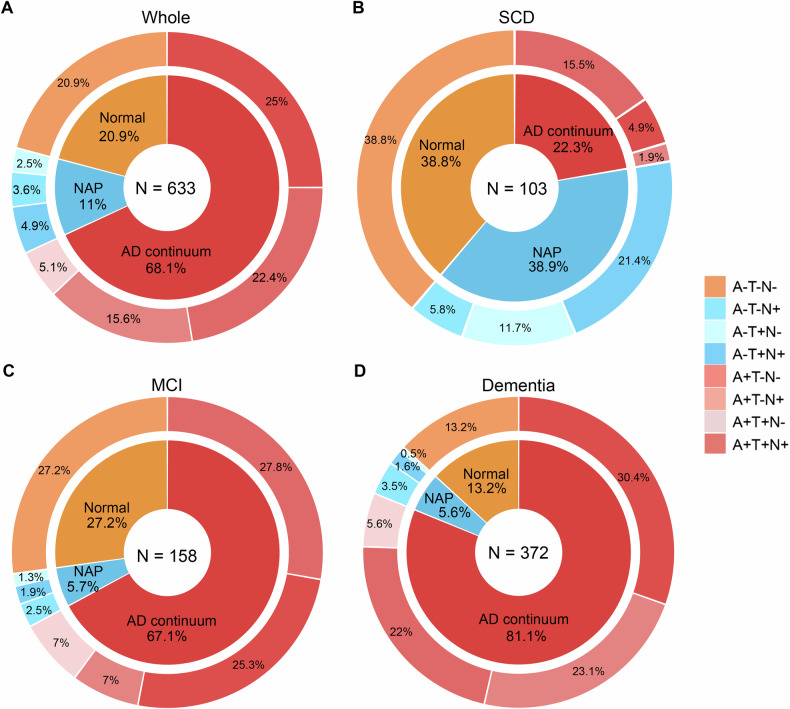
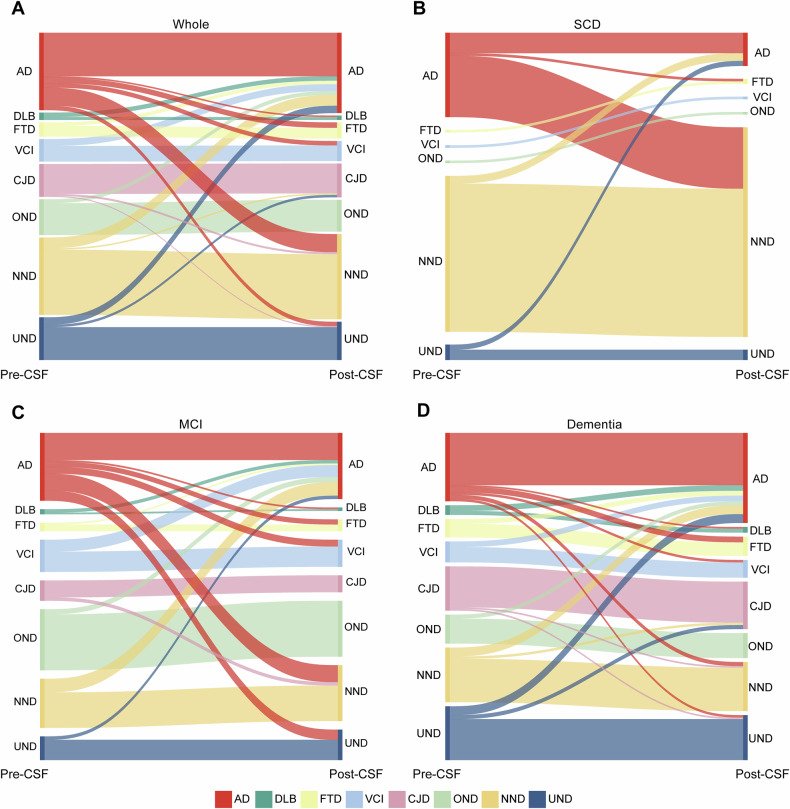
Cerebrospinal fluid (CSF) biomarkers have been widely adopted in Alzheimer's disease (AD) diagnosis. However, no studies focused on the application of CSF biomarkers in the clinical practice of complex and atypical patients with cognitive impairment in China. This study aimed to evaluate the added value of CSF AD biomarkers in cognitively impaired patients with complex conditions in a memory clinical setting. A total of 633 participants were included from the National Center for Neurological Disorders in Shanghai, China. The CSF AD biomarkers were measured with ELISA. Cutoff values were firstly identified using Youden's index. The neurologists proposed etiology diagnosis with a percentage estimate of their confidence and prescribed medication before and after CSF disclosure. Changes in etiological diagnosis, diagnostic confidence, and management plan were compared across the groups. Of the 633 patients (mean [SD] age, 61.1 [11.3] years; 295 males [46.6%]), 372 (58.8%) were diagnosed with dementia, 103 (16.3%) with mild cognitive impairment, and 158 (24.9%) with subjective cognitive decline. Using those pre-defined cutoffs, we categorized patients into 3 groups: Alzheimer's continuum (68.1%), non-AD pathologic change (11.1%), and normal AD biomarkers (20.8%). After CSF disclosure, the proposed etiology changed in 158 (25.0%) participants and the prescribed medication changed in 200 (31.6%) patients. Mean diagnostic confidence increased from 69.5-83.0% (+13.5%; P < 0.001). In conclusion, CSF AD biomarkers significantly impacted the diagnosis, diagnostic confidence, and treatment plans for Chinese patients with complex cognitive impairment. CSF AD biomarkers are a useful tool for clinicians beyond routine clinical assessment.
期刊介绍:
Psychiatry has suffered tremendously by the limited translational pipeline. Nobel laureate Julius Axelrod''s discovery in 1961 of monoamine reuptake by pre-synaptic neurons still forms the basis of contemporary antidepressant treatment. There is a grievous gap between the explosion of knowledge in neuroscience and conceptually novel treatments for our patients. Translational Psychiatry bridges this gap by fostering and highlighting the pathway from discovery to clinical applications, healthcare and global health. We view translation broadly as the full spectrum of work that marks the pathway from discovery to global health, inclusive. The steps of translation that are within the scope of Translational Psychiatry include (i) fundamental discovery, (ii) bench to bedside, (iii) bedside to clinical applications (clinical trials), (iv) translation to policy and health care guidelines, (v) assessment of health policy and usage, and (vi) global health. All areas of medical research, including — but not restricted to — molecular biology, genetics, pharmacology, imaging and epidemiology are welcome as they contribute to enhance the field of translational psychiatry.




 京公网安备 11010802042870号
京ICP备2023020795号-1
京公网安备 11010802042870号
京ICP备2023020795号-1

 分享
分享
 求助内容:
求助内容: 应助结果提醒方式:
 扫码关注我们
