{"title":"Correlation between SWE parameters and histopathological features and immunohistochemical biomarkers in invasive breast cancer.","authors":"Xu Liu, Jigang Li, Ying He, Zhiyuan Wang","doi":"10.11817/j.issn.1672-7347.2024.240398","DOIUrl":null,"url":null,"abstract":"<p><strong>Objectives: </strong>Shear wave elastography (SWE) is a novel quantitative elastography technique that can assess the hardness of different tissues. This study introduces a novel shear wave parameter-frequency of mass characteristic (<i>f</i><sub>mass</sub>)-and investigates its correlation, along with other shear wave parameters, with the histopathological features and immunohistochemical (IHC) biomarkers of invasive breast cancer (IBC). The study aims to explore whether SWE can provide useful information for IBC treatment and prognosis.</p><p><strong>Methods: </strong>With the pathological results as the gold standard, 258 malignant breast lesions were collected, and all patients underwent conventional ultrasound and SWE examinations. The SWE parameters [maximum elastic value (E<sub>max</sub>), minimum elastic value (E<sub>min</sub>), mean elastic value (E<sub>mean</sub>), standard deviation of elastic value of the whole lesion (E<sub>sd</sub>)] and <i>f</i><sub>mass</sub>] in the transverse and longitudinal orthogonal sections were measured, and their correlations with the prognostic factors of IBC [including tumor diameters, axillary lymph node (ALN) metastasis, lymphatic vessel invasion (LVI), calcification, histological type, histological grade, and IHC biomarkers (ER, PR, HER-2, Ki-67), and molecular subtypes] were analyzed. The correlations between the SWE parameters of the transverse and longitudinal sections of the tumors with different prognostic factors and the above indicators were analyzed. At the same time, the receiver operating characteristic (ROC) curve was used to analyze the efficacy of <i>f</i><sub>mass</sub> in predicting ER and PR expression.</p><p><strong>Results: </strong>E<sub>mean</sub>, E<sub>max</sub>, E<sub>sd</sub>, and <i>f</i><sub>mass</sub> were correlated with tumor diameters; E<sub>mean</sub>, E<sub>max</sub> and E<sub>sd</sub> were correlated with histological types and histological grades. E<sub>max</sub> and E<sub>sd</sub> were correlated with ALN metastasis, LVI and pathological types. In the IHC biomarker-labeled masses, <i>f</i><sub>mass</sub> was correlated with ER and PR (both <i>P</i><0.05), and E<sub>mean</sub>, E<sub>max</sub>, and E<sub>sd</sub> were correlated with HER-2 and Ki-67 (all <i>P</i><0.05). E<sub>mean</sub>, E<sub>max</sub>, and <i>f</i><sub>mass</sub> were all correlated with breast cancer subtypes (all <i>P</i><0.05), and E<sub>mean</sub> and E<sub>max</sub> were higher in Luminal B [HER-2(+)] breast cancer, while <i>f</i><sub>mass</sub> was lower in HER-2(+) and triple-negative breast cancer. Among the statistically significant prognostic factors, the <i>P</i> values of the transverse sections of the masses were all less than or equal to those of the longitudinal sections. The AUC of <i>f</i><sub>mass</sub> in the transverse sections of the masses for predicting ER and PR expression were 0.73 (95% <i>CI</i> 0.65 to 0.80) and 0.67 (95% <i>CI</i> 0.60 to 0.74), respectively, with the optimal cut-off values being 76.50 and 60.66, the sensitivities being 72.45% and 81.98%, the specificities being 66.13% and 45.35%, and the accuracies being 70.93% and 69.77%, respectively. The AUC of <i>f</i><sub>mass</sub> in the longitudinal sections of the masses for predicting ER and PR expression were 0.74 (95% <i>CI</i> 0.67 to 0.81) and 0.65 (95% <i>CI</i> 0.58 to 0.72), respectively, with the optimal cut-off values being 131.8 and 137.5, the sensitivities being 69.90% and 66.28%, the specificities being 72.58% and 60.47%, and the accuracies being 70.54% and 64.34%, respectively. The <i>f</i><sub>mass</sub> in the transverse sections of the masses was more statistically significant.</p><p><strong>Conclusions: </strong>The poor prognosis factors of IBC are related to high E<sub>mean</sub>, E<sub>min</sub>, E<sub>max</sub>, E<sub>sd</sub>, and low <i>f</i><sub>mass</sub>. The <i>f</i><sub>mass</sub> can predict the expression of ER and PR, and the transverse cut data are more meaningful. SWE is helpful for predicting the invasiveness of IBC.</p>","PeriodicalId":39801,"journal":{"name":"中南大学学报(医学版)","volume":"49 12","pages":"1941-1952"},"PeriodicalIF":0.0000,"publicationDate":"2024-12-28","publicationTypes":"Journal Article","fieldsOfStudy":null,"isOpenAccess":false,"openAccessPdf":"https://www.ncbi.nlm.nih.gov/pmc/articles/PMC11975528/pdf/","citationCount":"0","resultStr":null,"platform":"Semanticscholar","paperid":null,"PeriodicalName":"中南大学学报(医学版)","FirstCategoryId":"3","ListUrlMain":"https://doi.org/10.11817/j.issn.1672-7347.2024.240398","RegionNum":0,"RegionCategory":null,"ArticlePicture":[],"TitleCN":null,"AbstractTextCN":null,"PMCID":null,"EPubDate":"","PubModel":"","JCR":"Q3","JCRName":"Medicine","Score":null,"Total":0}
引用次数: 0
Abstract
Objectives: Shear wave elastography (SWE) is a novel quantitative elastography technique that can assess the hardness of different tissues. This study introduces a novel shear wave parameter-frequency of mass characteristic (fmass)-and investigates its correlation, along with other shear wave parameters, with the histopathological features and immunohistochemical (IHC) biomarkers of invasive breast cancer (IBC). The study aims to explore whether SWE can provide useful information for IBC treatment and prognosis.
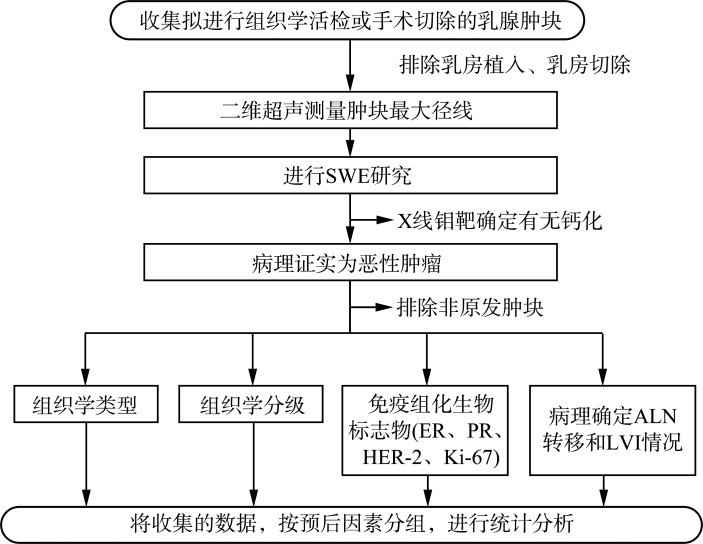
Methods: With the pathological results as the gold standard, 258 malignant breast lesions were collected, and all patients underwent conventional ultrasound and SWE examinations. The SWE parameters [maximum elastic value (Emax), minimum elastic value (Emin), mean elastic value (Emean), standard deviation of elastic value of the whole lesion (Esd)] and fmass] in the transverse and longitudinal orthogonal sections were measured, and their correlations with the prognostic factors of IBC [including tumor diameters, axillary lymph node (ALN) metastasis, lymphatic vessel invasion (LVI), calcification, histological type, histological grade, and IHC biomarkers (ER, PR, HER-2, Ki-67), and molecular subtypes] were analyzed. The correlations between the SWE parameters of the transverse and longitudinal sections of the tumors with different prognostic factors and the above indicators were analyzed. At the same time, the receiver operating characteristic (ROC) curve was used to analyze the efficacy of fmass in predicting ER and PR expression.
Results: Emean, Emax, Esd, and fmass were correlated with tumor diameters; Emean, Emax and Esd were correlated with histological types and histological grades. Emax and Esd were correlated with ALN metastasis, LVI and pathological types. In the IHC biomarker-labeled masses, fmass was correlated with ER and PR (both P<0.05), and Emean, Emax, and Esd were correlated with HER-2 and Ki-67 (all P<0.05). Emean, Emax, and fmass were all correlated with breast cancer subtypes (all P<0.05), and Emean and Emax were higher in Luminal B [HER-2(+)] breast cancer, while fmass was lower in HER-2(+) and triple-negative breast cancer. Among the statistically significant prognostic factors, the P values of the transverse sections of the masses were all less than or equal to those of the longitudinal sections. The AUC of fmass in the transverse sections of the masses for predicting ER and PR expression were 0.73 (95% CI 0.65 to 0.80) and 0.67 (95% CI 0.60 to 0.74), respectively, with the optimal cut-off values being 76.50 and 60.66, the sensitivities being 72.45% and 81.98%, the specificities being 66.13% and 45.35%, and the accuracies being 70.93% and 69.77%, respectively. The AUC of fmass in the longitudinal sections of the masses for predicting ER and PR expression were 0.74 (95% CI 0.67 to 0.81) and 0.65 (95% CI 0.58 to 0.72), respectively, with the optimal cut-off values being 131.8 and 137.5, the sensitivities being 69.90% and 66.28%, the specificities being 72.58% and 60.47%, and the accuracies being 70.54% and 64.34%, respectively. The fmass in the transverse sections of the masses was more statistically significant.
Conclusions: The poor prognosis factors of IBC are related to high Emean, Emin, Emax, Esd, and low fmass. The fmass can predict the expression of ER and PR, and the transverse cut data are more meaningful. SWE is helpful for predicting the invasiveness of IBC.
目的:横波弹性成像(SWE)是一种新的定量弹性成像技术,可以评估不同组织的硬度。本研究引入了一种新的剪切波参数-质量特征频率(fmass),并研究了其与其他剪切波参数与浸润性乳腺癌(IBC)的组织病理学特征和免疫组化(IHC)生物标志物的相关性。本研究旨在探讨SWE是否可以为IBC的治疗和预后提供有用的信息。方法:以病理结果为金标准,收集乳腺恶性病变258例,所有患者均行常规超声及SWE检查。测量横向和纵向正交切片的SWE参数[最大弹性值(Emax)、最小弹性值(Emin)、平均弹性值(Emean)、整个病变弹性值标准差(Esd)]和fmass],以及它们与IBC预后因素的相关性[包括肿瘤直径、腋窝淋巴结(ALN)转移、淋巴管侵犯(LVI)、钙化、组织学类型、组织学分级、IHC生物标志物(ER、PR、HER-2、Ki-67),分子亚型分析]。分析不同预后因素肿瘤横切面和纵切面SWE参数与上述指标的相关性。同时,采用受试者工作特征(ROC)曲线分析fmass对ER和PR表达的预测效果。结果:Emean、Emax、Esd、fmass与肿瘤直径相关;Emean、Emax和Esd与组织学类型和组织学分级相关。Emax和Esd与ALN转移、LVI及病理类型相关。在IHC生物标志物标记的肿块中,fmass与ER和PR相关(Pmean、Emax和Esd均与HER-2和Ki-67相关)(Pmean、Emax和fmass均与乳腺癌亚型相关(Luminal B [HER-2(+)]乳腺癌中Pmean和Emax均较高,而HER-2(+)和三阴性乳腺癌中fmass较低)。在具有统计学意义的预后因素中,肿块横切面的P值均小于或等于纵切面的P值。肿块横切面fmass预测ER和PR表达的AUC分别为0.73 (95% CI 0.65 ~ 0.80)和0.67 (95% CI 0.60 ~ 0.74),最佳临界值分别为76.50和60.66,敏感性分别为72.45%和81.98%,特异性分别为66.13%和45.35%,准确性分别为70.93%和69.77%。肿块纵切面fmass预测ER和PR表达的AUC分别为0.74 (95% CI 0.67 ~ 0.81)和0.65 (95% CI 0.58 ~ 0.72),最佳临界值分别为131.8和137.5,敏感性分别为69.90%和66.28%,特异性分别为72.58%和60.47%,准确性分别为70.54%和64.34%。肿块横切面上的fmass更具有统计学意义。结论:IBC预后不良因素与高Emean、Emin、Emax、Esd及低fmass有关。fmass可以预测ER和PR的表达,而横切数据更有意义。SWE有助于预测IBC的侵袭性。
期刊介绍:
Journal of Central South University (Medical Sciences), founded in 1958, is a comprehensive academic journal of medicine and health sponsored by the Ministry of Education and Central South University. The journal has been included in many important databases and authoritative abstract journals at home and abroad, such as the American Medline, Pubmed and its Index Medicus (IM), the Netherlands Medical Abstracts (EM), the American Chemical Abstracts (CA), the WHO Western Pacific Region Medical Index (WPRIM), and the Chinese Science Citation Database (Core Database) (CSCD); it is a statistical source journal of Chinese scientific and technological papers, a Chinese core journal, and a "double-effect" journal of the Chinese Journal Matrix; it is the "2nd, 3rd, and 4th China University Excellent Science and Technology Journal", "2008 China Excellent Science and Technology Journal", "RCCSE China Authoritative Academic Journal (A+)" and Hunan Province's "Top Ten Science and Technology Journals". The purpose of the journal is to reflect the new achievements, new technologies, and new experiences in medical research, medical treatment, and teaching, report new medical trends at home and abroad, promote academic exchanges, improve academic standards, and promote scientific and technological progress.





 京公网安备 11010802042870号
京ICP备2023020795号-1
京公网安备 11010802042870号
京ICP备2023020795号-1

 分享
分享
 求助内容:
求助内容: 应助结果提醒方式:
 扫码关注我们
