{"title":"In vivo study on IL-37 inhibition of malignant melanoma metastasis.","authors":"Jiantang Yang, Lili Fu, Yanmiao Yang, Lin Lin","doi":"10.11817/j.issn.1672-7347.2024.230570","DOIUrl":null,"url":null,"abstract":"<p><strong>Objectives: </strong>Malignant melanoma is highly aggressive, prone to early metastasis, and associated with extremely poor prognosis, posing a serious threat to human health. Identifying molecular mechanisms that inhibit metastasis is of great significance for improving treatment and prognosis. Interleukin-37 (IL-37), an anti-inflammatory cytokine, has not only been linked to various inflammatory diseases but also exhibits anti-tumor properties. This study aims to explore the effect of IL-37 on melanoma metastasis in vivo by establishing a murine model of pulmonary metastasis.</p><p><strong>Methods: </strong>Mouse melanoma B16F1 cells were transfected with either IL-37 overexpression plasmid (IL-37 oe) or empty vector. Three groups were set: An IL-37 oe group (transfection reagent+IL-37 oe plasmid), a Vector group (transfection reagent+vector plasmid), and a Blank group (transfection reagent only). C57 mice were randomly divided into 3 groups (<i>n</i>=3 per group) and injected intravenously with logarithmic-phase B16F1 cells under sterile conditions. Mice were weighed every 3 days. After 1 month, mice were euthanized by cervical dislocation, and organs including lungs, heart, liver, spleen, and kidneys were harvested. Lung metastases were photographed and counted. Organs were fixed in 4% paraformaldehyde, embedded in paraffin, and stained with hematoxylin and eosin (HE).</p><p><strong>Results: </strong>Western blotting confirmed successful plasmid transfection. There were no significant differences in body weight among the 3 groups over the 28-day period (<i>P</i>>0.05). Lung tumors were observed upon dissection, indicating successful metastasis modeling. HE staining showed no morphological differences in the heart, liver, spleen, and kidneys between groups. The numbers of lung metastases in the Blank, Vector, and IL-37 oe groups were (24.00±2.08), (24.67±0.88), and (5.33±1.45), respectively. The IL-37 oe group had significantly fewer lung metastases than the other 2 groups (<i>P</i><0.05), while no difference was observed between the Blank and Vector groups.</p><p><strong>Conclusions: </strong>IL-37 significantly inhibits lung metastasis of malignant melanoma cells in mice without affecting body weight or major organs. It may serve as a potential molecular target for gene therapy or immunotherapy of malignant melanoma.</p>","PeriodicalId":39801,"journal":{"name":"中南大学学报(医学版)","volume":"49 12","pages":"1885-1890"},"PeriodicalIF":0.0000,"publicationDate":"2024-12-28","publicationTypes":"Journal Article","fieldsOfStudy":null,"isOpenAccess":false,"openAccessPdf":"https://www.ncbi.nlm.nih.gov/pmc/articles/PMC11975520/pdf/","citationCount":"0","resultStr":null,"platform":"Semanticscholar","paperid":null,"PeriodicalName":"中南大学学报(医学版)","FirstCategoryId":"3","ListUrlMain":"https://doi.org/10.11817/j.issn.1672-7347.2024.230570","RegionNum":0,"RegionCategory":null,"ArticlePicture":[],"TitleCN":null,"AbstractTextCN":null,"PMCID":null,"EPubDate":"","PubModel":"","JCR":"Q3","JCRName":"Medicine","Score":null,"Total":0}
引用次数: 0
Abstract
Objectives: Malignant melanoma is highly aggressive, prone to early metastasis, and associated with extremely poor prognosis, posing a serious threat to human health. Identifying molecular mechanisms that inhibit metastasis is of great significance for improving treatment and prognosis. Interleukin-37 (IL-37), an anti-inflammatory cytokine, has not only been linked to various inflammatory diseases but also exhibits anti-tumor properties. This study aims to explore the effect of IL-37 on melanoma metastasis in vivo by establishing a murine model of pulmonary metastasis.
Methods: Mouse melanoma B16F1 cells were transfected with either IL-37 overexpression plasmid (IL-37 oe) or empty vector. Three groups were set: An IL-37 oe group (transfection reagent+IL-37 oe plasmid), a Vector group (transfection reagent+vector plasmid), and a Blank group (transfection reagent only). C57 mice were randomly divided into 3 groups (n=3 per group) and injected intravenously with logarithmic-phase B16F1 cells under sterile conditions. Mice were weighed every 3 days. After 1 month, mice were euthanized by cervical dislocation, and organs including lungs, heart, liver, spleen, and kidneys were harvested. Lung metastases were photographed and counted. Organs were fixed in 4% paraformaldehyde, embedded in paraffin, and stained with hematoxylin and eosin (HE).
Results: Western blotting confirmed successful plasmid transfection. There were no significant differences in body weight among the 3 groups over the 28-day period (P>0.05). Lung tumors were observed upon dissection, indicating successful metastasis modeling. HE staining showed no morphological differences in the heart, liver, spleen, and kidneys between groups. The numbers of lung metastases in the Blank, Vector, and IL-37 oe groups were (24.00±2.08), (24.67±0.88), and (5.33±1.45), respectively. The IL-37 oe group had significantly fewer lung metastases than the other 2 groups (P<0.05), while no difference was observed between the Blank and Vector groups.
Conclusions: IL-37 significantly inhibits lung metastasis of malignant melanoma cells in mice without affecting body weight or major organs. It may serve as a potential molecular target for gene therapy or immunotherapy of malignant melanoma.
期刊介绍:
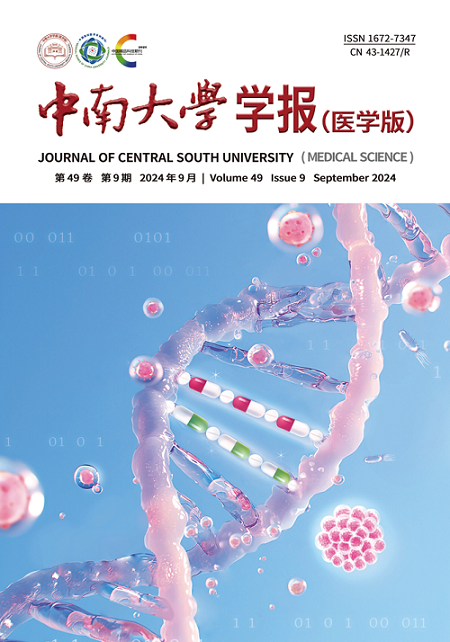
Journal of Central South University (Medical Sciences), founded in 1958, is a comprehensive academic journal of medicine and health sponsored by the Ministry of Education and Central South University. The journal has been included in many important databases and authoritative abstract journals at home and abroad, such as the American Medline, Pubmed and its Index Medicus (IM), the Netherlands Medical Abstracts (EM), the American Chemical Abstracts (CA), the WHO Western Pacific Region Medical Index (WPRIM), and the Chinese Science Citation Database (Core Database) (CSCD); it is a statistical source journal of Chinese scientific and technological papers, a Chinese core journal, and a "double-effect" journal of the Chinese Journal Matrix; it is the "2nd, 3rd, and 4th China University Excellent Science and Technology Journal", "2008 China Excellent Science and Technology Journal", "RCCSE China Authoritative Academic Journal (A+)" and Hunan Province's "Top Ten Science and Technology Journals". The purpose of the journal is to reflect the new achievements, new technologies, and new experiences in medical research, medical treatment, and teaching, report new medical trends at home and abroad, promote academic exchanges, improve academic standards, and promote scientific and technological progress.





 京公网安备 11010802042870号
京ICP备2023020795号-1
京公网安备 11010802042870号
京ICP备2023020795号-1

 分享
分享
 求助内容:
求助内容: 应助结果提醒方式:
 扫码关注我们
