{"title":"Role of AMPK<b>α</b>2 in regulating the IRE1<b>α-</b>JNK pathway in metabolic dysfunction<b>-</b>associated fatty liver disease.","authors":"Shujie Zhao, Weilun Fang, Yu Wei, Jiahui Meng, Qiao Jin, Weijin Fang","doi":"10.11817/j.issn.1672-7347.2024.240474","DOIUrl":null,"url":null,"abstract":"<p><strong>Objectives: </strong>Over 25% of the global population is affected by metabolic dysfunction-associated fatty liver disease (MAFLD), yet its pathogenesis remains unclear. Endoplasmic reticulum stress (ERS) may be involved in the onset and progression of MAFLD. Adenosine 5'-monophosphate-activated protein kinase α2 (AMPKα2), a key regulator of hepatic energy metabolism, may influence MAFLD development via ERS modulation. This study aims to investigate the role of AMPKα2 in a high-fat diet-induced MAFLD mouse model and its regulatory effect on the inositol-requiring enzyme 1 alpha (IRE1α)-c-Jun N-terminal kinase (JNK) signaling pathway.</p><p><strong>Methods: </strong>Liver-specific AMPKα2 knockout mice on a C57BL/6 background were generated and subjected to MAFLD induction. Mice were divided into four groups: wild-type control (WT+Chow, basic diet for 12 weeks), wild-type high-fat diet (WT+HFD, high-fat diet for 12 weeks), AMPKα2 knockout control (AMPKα2 KO+Chow), and AMPKα2 knockout high-fat diet (AMPKα2 KO+HFD). Blood glucose, lipid levels, and liver function were assessed post-treatment. Liver histology was analyzed using Oil Red O, hematoxylin-eosin, Masson, and Sirius Red staining. Western blotting was used to evaluate the expression of AMPKα2, ERS markers, autophagy, apoptosis, and ferroptosis-related proteins.</p><p><strong>Results: </strong>Compared with the WT+Chow group, the WT+HFD group showed significantly elevated blood glucose, alanine aminotransferase (ALT), and aspartate aminotransferase (AST) levels (all <i>P</i><0.01); histological analyses revealed hepatic steatosis, vacuolization, and fibrosis, with a significantly increased non-alcoholic steatohepatitis activity score (NAS) (<i>P</i><0.001). Phosphorylated IRE1α and the autophagy marker microtubule-associated protein light chain (LC) 3II/LC3I were markedly upregulated, while apoptotic proteins (Cleaved-Caspase 3, BAX, Bcl-2) and ferroptosis markers (SLC7A11, GPX4) showed no significant change (<i>P</i>>0.05). In the AMPKα2 KO+HFD group, blood glucose, ALT, and AST levels were significantly reduced compared to the WT+HFD group. Histological improvements were observed with reduced vacuolization and lipid accumulation. Expression of p-IRE1α, JNK, and LC3II/LC3I was significantly decreased (<i>P</i><0.05).</p><p><strong>Conclusions: </strong>Hepatic AMPKα2 knockout alleviates high-fat induced MAFLD, potentially by inhibiting the IRE1α-JNK pathway and reducing autophagy.</p>","PeriodicalId":39801,"journal":{"name":"中南大学学报(医学版)","volume":"49 12","pages":"1891-1901"},"PeriodicalIF":0.0000,"publicationDate":"2024-12-28","publicationTypes":"Journal Article","fieldsOfStudy":null,"isOpenAccess":false,"openAccessPdf":"https://www.ncbi.nlm.nih.gov/pmc/articles/PMC11975527/pdf/","citationCount":"0","resultStr":null,"platform":"Semanticscholar","paperid":null,"PeriodicalName":"中南大学学报(医学版)","FirstCategoryId":"3","ListUrlMain":"https://doi.org/10.11817/j.issn.1672-7347.2024.240474","RegionNum":0,"RegionCategory":null,"ArticlePicture":[],"TitleCN":null,"AbstractTextCN":null,"PMCID":null,"EPubDate":"","PubModel":"","JCR":"Q3","JCRName":"Medicine","Score":null,"Total":0}
引用次数: 0
Abstract
Objectives: Over 25% of the global population is affected by metabolic dysfunction-associated fatty liver disease (MAFLD), yet its pathogenesis remains unclear. Endoplasmic reticulum stress (ERS) may be involved in the onset and progression of MAFLD. Adenosine 5'-monophosphate-activated protein kinase α2 (AMPKα2), a key regulator of hepatic energy metabolism, may influence MAFLD development via ERS modulation. This study aims to investigate the role of AMPKα2 in a high-fat diet-induced MAFLD mouse model and its regulatory effect on the inositol-requiring enzyme 1 alpha (IRE1α)-c-Jun N-terminal kinase (JNK) signaling pathway.
Methods: Liver-specific AMPKα2 knockout mice on a C57BL/6 background were generated and subjected to MAFLD induction. Mice were divided into four groups: wild-type control (WT+Chow, basic diet for 12 weeks), wild-type high-fat diet (WT+HFD, high-fat diet for 12 weeks), AMPKα2 knockout control (AMPKα2 KO+Chow), and AMPKα2 knockout high-fat diet (AMPKα2 KO+HFD). Blood glucose, lipid levels, and liver function were assessed post-treatment. Liver histology was analyzed using Oil Red O, hematoxylin-eosin, Masson, and Sirius Red staining. Western blotting was used to evaluate the expression of AMPKα2, ERS markers, autophagy, apoptosis, and ferroptosis-related proteins.
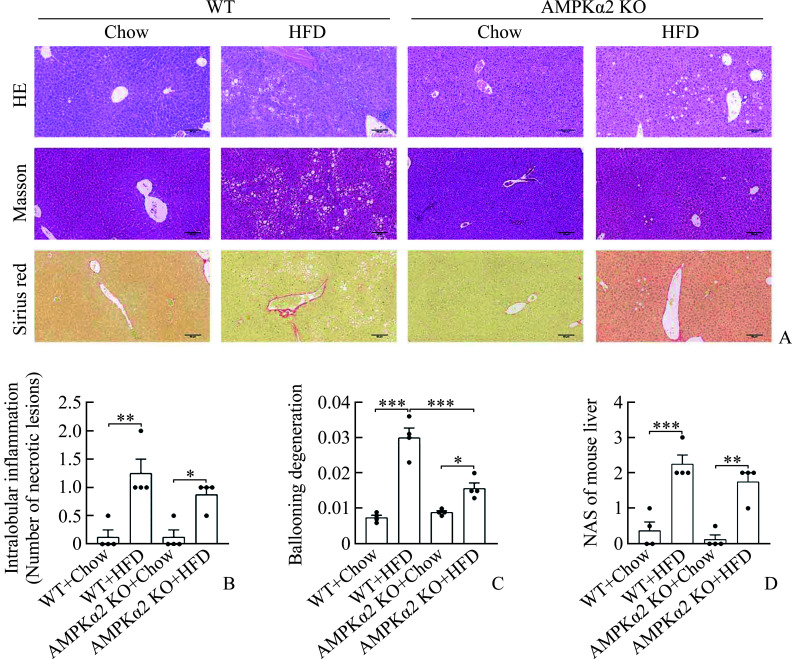
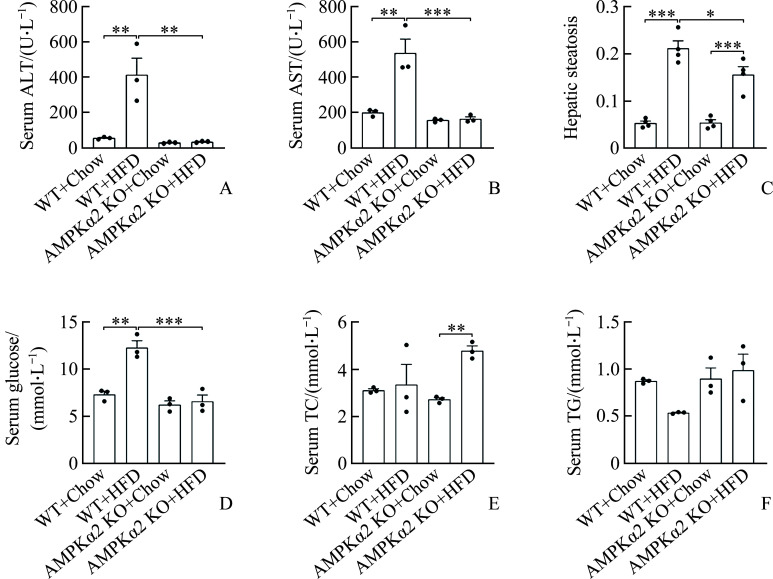
Results: Compared with the WT+Chow group, the WT+HFD group showed significantly elevated blood glucose, alanine aminotransferase (ALT), and aspartate aminotransferase (AST) levels (all P<0.01); histological analyses revealed hepatic steatosis, vacuolization, and fibrosis, with a significantly increased non-alcoholic steatohepatitis activity score (NAS) (P<0.001). Phosphorylated IRE1α and the autophagy marker microtubule-associated protein light chain (LC) 3II/LC3I were markedly upregulated, while apoptotic proteins (Cleaved-Caspase 3, BAX, Bcl-2) and ferroptosis markers (SLC7A11, GPX4) showed no significant change (P>0.05). In the AMPKα2 KO+HFD group, blood glucose, ALT, and AST levels were significantly reduced compared to the WT+HFD group. Histological improvements were observed with reduced vacuolization and lipid accumulation. Expression of p-IRE1α, JNK, and LC3II/LC3I was significantly decreased (P<0.05).
Conclusions: Hepatic AMPKα2 knockout alleviates high-fat induced MAFLD, potentially by inhibiting the IRE1α-JNK pathway and reducing autophagy.
期刊介绍:
Journal of Central South University (Medical Sciences), founded in 1958, is a comprehensive academic journal of medicine and health sponsored by the Ministry of Education and Central South University. The journal has been included in many important databases and authoritative abstract journals at home and abroad, such as the American Medline, Pubmed and its Index Medicus (IM), the Netherlands Medical Abstracts (EM), the American Chemical Abstracts (CA), the WHO Western Pacific Region Medical Index (WPRIM), and the Chinese Science Citation Database (Core Database) (CSCD); it is a statistical source journal of Chinese scientific and technological papers, a Chinese core journal, and a "double-effect" journal of the Chinese Journal Matrix; it is the "2nd, 3rd, and 4th China University Excellent Science and Technology Journal", "2008 China Excellent Science and Technology Journal", "RCCSE China Authoritative Academic Journal (A+)" and Hunan Province's "Top Ten Science and Technology Journals". The purpose of the journal is to reflect the new achievements, new technologies, and new experiences in medical research, medical treatment, and teaching, report new medical trends at home and abroad, promote academic exchanges, improve academic standards, and promote scientific and technological progress.




 京公网安备 11010802042870号
京ICP备2023020795号-1
京公网安备 11010802042870号
京ICP备2023020795号-1

 分享
分享
 求助内容:
求助内容: 应助结果提醒方式:
 扫码关注我们
