{"title":"Polymer-Halogen Pockets Steering *CO Adsorption Configurations for Highly Selective CO2 Electroreduction","authors":"Mao Wu, Ruoou Yang, Junyuan Duan, Shicheng Zhu, Bowen Chen, Zhaoyang Shi, Youwen Liu, Huiqiao Li, Bao Yu Xia, Tianyou Zhai","doi":"10.1002/adma.202504292","DOIUrl":null,"url":null,"abstract":"<p>The selective CO<sub>2</sub> electroreduction (CO<sub>2</sub>R) toward specific C<sub>2</sub> products represents a critical challenge for practical applicability, requiring precise control over <sup>*</sup>CO intermediates. Herein, a “polymer-halogen” pocketed Cu catalyst is proposed, wherein the adjustable concentration of Iodide ion (I<sup>−</sup>) within the pocket enables continuous modulation of <sup>*</sup>CO adsorption configurations on the Cu, thereby enabling tailored CO<sub>2</sub>R toward ethylene or ethanol production. A perfluorosulfonic acid (PFSA)-modified CuI catalyst is constructed, where I<sup>−</sup> is in situ leaching from CuI and subsequently confined by PFSA as an anion shielding layer to form polymer-halogen pockets. By tuning the thickness of PFSA shell, the amount of I<sup>−</sup> in the pocket can be controlled. The surface-enhanced in situ Raman spectroscopy demonstrates that the coverage of <sup>*</sup>CO intermediates on Cu surface increases and tends to adsorb at low coordination Cu sites in catalyst granule for dimerization reaction as the I<sup>−</sup> concentration in the pocket increases. Furthermore, the coordination environment exhibits distinct product selectivity. <sup>*</sup>CO at medium-coordinated sites favor ethanol production, while those at low-coordinated sites are conducive to ethylene formation. This strategy enables wide modulation of ethylene-to-ethanol ratios from 0.65 to 3.96, achieving peak Faradaic efficiencies (FE) of 60.3 ± 2.1% for ethylene and 48.3 ± 1.3% for ethanol.</p>","PeriodicalId":114,"journal":{"name":"Advanced Materials","volume":"37 26","pages":""},"PeriodicalIF":26.8000,"publicationDate":"2025-04-08","publicationTypes":"Journal Article","fieldsOfStudy":null,"isOpenAccess":false,"openAccessPdf":"","citationCount":"0","resultStr":null,"platform":"Semanticscholar","paperid":null,"PeriodicalName":"Advanced Materials","FirstCategoryId":"88","ListUrlMain":"https://advanced.onlinelibrary.wiley.com/doi/10.1002/adma.202504292","RegionNum":1,"RegionCategory":"材料科学","ArticlePicture":[],"TitleCN":null,"AbstractTextCN":null,"PMCID":null,"EPubDate":"","PubModel":"","JCR":"Q1","JCRName":"CHEMISTRY, MULTIDISCIPLINARY","Score":null,"Total":0}
引用次数: 0
Abstract
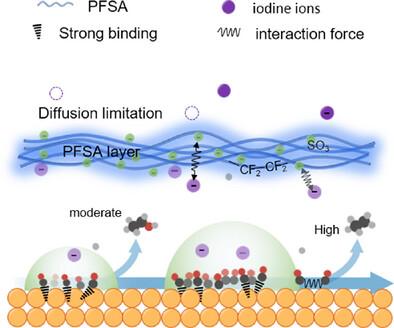
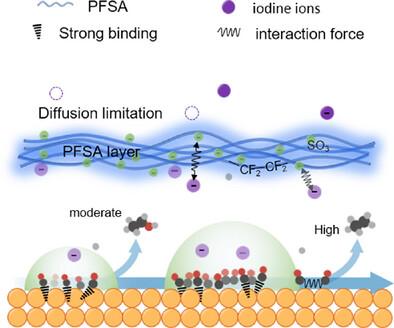
The selective CO2 electroreduction (CO2R) toward specific C2 products represents a critical challenge for practical applicability, requiring precise control over *CO intermediates. Herein, a “polymer-halogen” pocketed Cu catalyst is proposed, wherein the adjustable concentration of Iodide ion (I−) within the pocket enables continuous modulation of *CO adsorption configurations on the Cu, thereby enabling tailored CO2R toward ethylene or ethanol production. A perfluorosulfonic acid (PFSA)-modified CuI catalyst is constructed, where I− is in situ leaching from CuI and subsequently confined by PFSA as an anion shielding layer to form polymer-halogen pockets. By tuning the thickness of PFSA shell, the amount of I− in the pocket can be controlled. The surface-enhanced in situ Raman spectroscopy demonstrates that the coverage of *CO intermediates on Cu surface increases and tends to adsorb at low coordination Cu sites in catalyst granule for dimerization reaction as the I− concentration in the pocket increases. Furthermore, the coordination environment exhibits distinct product selectivity. *CO at medium-coordinated sites favor ethanol production, while those at low-coordinated sites are conducive to ethylene formation. This strategy enables wide modulation of ethylene-to-ethanol ratios from 0.65 to 3.96, achieving peak Faradaic efficiencies (FE) of 60.3 ± 2.1% for ethylene and 48.3 ± 1.3% for ethanol.
期刊介绍:
Advanced Materials, one of the world's most prestigious journals and the foundation of the Advanced portfolio, is the home of choice for best-in-class materials science for more than 30 years. Following this fast-growing and interdisciplinary field, we are considering and publishing the most important discoveries on any and all materials from materials scientists, chemists, physicists, engineers as well as health and life scientists and bringing you the latest results and trends in modern materials-related research every week.





 京公网安备 11010802042870号
京ICP备2023020795号-1
京公网安备 11010802042870号
京ICP备2023020795号-1

 分享
分享
 求助内容:
求助内容: 应助结果提醒方式:
 扫码关注我们
