Wubin Liao , Peng Liao , Zheng Wang , Chenggang Ci , Shiwei Xie
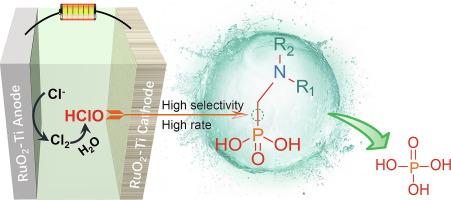
{"title":"New insight to phosphonate degradation by electrochlorination: Hypochlorous acid dominated dephosphorylation through selective attacking CP bond","authors":"Wubin Liao , Peng Liao , Zheng Wang , Chenggang Ci , Shiwei Xie","doi":"10.1016/j.seppur.2025.132958","DOIUrl":null,"url":null,"abstract":"<div><div>The dephosphorylation of N-containing phosphonates is crucial for mitigating their potential ecological risks and enabling phosphorus resource recovery. Here, we first show that the electrochlorination process outperforms other advanced oxidation methods in terms of conversion efficiency and rate constants for orthophosphate production. The high efficacy of electrochlorination process is primarily attributed to the generation of hypochlorous acid (HClO) under neutral pH conditions, as substantiated by a combination of speciation analysis, quantitative assessments, and quenching experiments. Furthermore, density functional theory (DFT) calculation and LC-MS measurements show that the degradation of nitrilotris-methylenephosphonic acid (NTMP) by HClO occurs spontaneously, with a preferential cleavage of the C<img>P bond over the C<img>N bond, thereby facilitating the efficiency of the dephosphorylation reaction. Altogether, our findings provide key insights into the role of reactive chlorine species in the degradation of N-containing phosphonates, offering valuable evidence for the development of next-generation, more effective phosphorus recovery strategies.</div></div>","PeriodicalId":427,"journal":{"name":"Separation and Purification Technology","volume":"367 ","pages":"Article 132958"},"PeriodicalIF":9.0000,"publicationDate":"2025-09-07","publicationTypes":"Journal Article","fieldsOfStudy":null,"isOpenAccess":false,"openAccessPdf":"","citationCount":"0","resultStr":null,"platform":"Semanticscholar","paperid":null,"PeriodicalName":"Separation and Purification Technology","FirstCategoryId":"5","ListUrlMain":"https://www.sciencedirect.com/science/article/pii/S1383586625015552","RegionNum":1,"RegionCategory":"工程技术","ArticlePicture":[],"TitleCN":null,"AbstractTextCN":null,"PMCID":null,"EPubDate":"2025/4/9 0:00:00","PubModel":"Epub","JCR":"Q1","JCRName":"ENGINEERING, CHEMICAL","Score":null,"Total":0}
引用次数: 0
Abstract
The dephosphorylation of N-containing phosphonates is crucial for mitigating their potential ecological risks and enabling phosphorus resource recovery. Here, we first show that the electrochlorination process outperforms other advanced oxidation methods in terms of conversion efficiency and rate constants for orthophosphate production. The high efficacy of electrochlorination process is primarily attributed to the generation of hypochlorous acid (HClO) under neutral pH conditions, as substantiated by a combination of speciation analysis, quantitative assessments, and quenching experiments. Furthermore, density functional theory (DFT) calculation and LC-MS measurements show that the degradation of nitrilotris-methylenephosphonic acid (NTMP) by HClO occurs spontaneously, with a preferential cleavage of the CP bond over the CN bond, thereby facilitating the efficiency of the dephosphorylation reaction. Altogether, our findings provide key insights into the role of reactive chlorine species in the degradation of N-containing phosphonates, offering valuable evidence for the development of next-generation, more effective phosphorus recovery strategies.
期刊介绍:
Separation and Purification Technology is a premier journal committed to sharing innovative methods for separation and purification in chemical and environmental engineering, encompassing both homogeneous solutions and heterogeneous mixtures. Our scope includes the separation and/or purification of liquids, vapors, and gases, as well as carbon capture and separation techniques. However, it's important to note that methods solely intended for analytical purposes are not within the scope of the journal. Additionally, disciplines such as soil science, polymer science, and metallurgy fall outside the purview of Separation and Purification Technology. Join us in advancing the field of separation and purification methods for sustainable solutions in chemical and environmental engineering.




 京公网安备 11010802042870号
京ICP备2023020795号-1
京公网安备 11010802042870号
京ICP备2023020795号-1

 分享
分享
 求助内容:
求助内容: 应助结果提醒方式:
 扫码关注我们
