Man Xue , Mengjia Liang , Yanping Shi , Jihua Cai , Xianyu Yang , Chunzheng Jin , Zexin Chen , Maoyan Xu
{"title":"Enhancing dewaterability and purification of waste engineering slurry by environmentally friendly bio-based flocculant","authors":"Man Xue , Mengjia Liang , Yanping Shi , Jihua Cai , Xianyu Yang , Chunzheng Jin , Zexin Chen , Maoyan Xu","doi":"10.1016/j.seppur.2025.132906","DOIUrl":null,"url":null,"abstract":"<div><div>Flocculation is widely used to enhance the dewatering efficiency of waste slurry. However, traditional flocculants have poor biodegradability and secondary pollution problems. Bio-based flocculants are promising due to their non-toxicity and biodegradability. In this study, a novel bio-based flocculant (PGR) derived from waste pomelo peel was successfully synthesized by TEMPO-mediated oxidation and acrylamide/N, N-Dimethylacrylamide grafting. The effect of PGR dosage on the flocculation performance of waste slurry and the adsorption performance of Pb(Ⅱ) and Cd(Ⅱ) was investigated. Results showed that the presence of PGR significantly enhanced the flocculation efficiency of waste slurry. The slurry dehydration rate and moisture content of mud cake reached approximately 30 % and 67.1 %, respectively. The turbidity of supernatant was minimized at 3.76 NTU with PGR concentration of 12 g/L. Batch adsorption experiments highlighted the effectiveness of PGR in adsorbing and removing Pb(Ⅱ) and Cd(Ⅱ) from contaminated slurry. The maximum removal efficiencies of Pb(Ⅱ) and Cd(Ⅱ) were 97 % and 55.3 %, respectively. The environmental assessment indicated that PGR solution is non-toxic. the EC<sub>50</sub> of PGR solution was 1.44 × 10<sup>5</sup> ppm. Adding a small amount of nutrient soil, the slurry or mud cakes could be directly used to cultivate grass. Characterization methods revealed that the abundant pore structures and functional groups of PGR contributed to excellent flocculation and absorption capacity for waste slurry. Adsorption and chain bridging are the main mechanisms of slurry dewatering and ion adsorption. The use of bio-based flocculant in slurry treatment reduces environmental pollution, while simultaneously achieving the sustainable goal of “waste-treating-waste”.</div></div>","PeriodicalId":427,"journal":{"name":"Separation and Purification Technology","volume":"367 ","pages":"Article 132906"},"PeriodicalIF":9.1000,"publicationDate":"2025-09-07","publicationTypes":"Journal Article","fieldsOfStudy":null,"isOpenAccess":false,"openAccessPdf":"","citationCount":"0","resultStr":null,"platform":"Semanticscholar","paperid":null,"PeriodicalName":"Separation and Purification Technology","FirstCategoryId":"5","ListUrlMain":"https://www.sciencedirect.com/science/article/pii/S1383586625015035","RegionNum":1,"RegionCategory":"工程技术","ArticlePicture":[],"TitleCN":null,"AbstractTextCN":null,"PMCID":null,"EPubDate":"2025/4/9 0:00:00","PubModel":"Epub","JCR":"Q1","JCRName":"ENGINEERING, CHEMICAL","Score":null,"Total":0}
引用次数: 0
Abstract
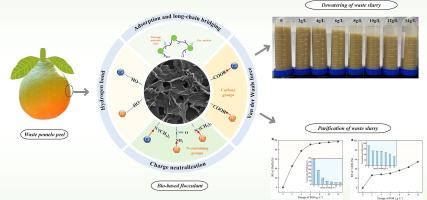
Flocculation is widely used to enhance the dewatering efficiency of waste slurry. However, traditional flocculants have poor biodegradability and secondary pollution problems. Bio-based flocculants are promising due to their non-toxicity and biodegradability. In this study, a novel bio-based flocculant (PGR) derived from waste pomelo peel was successfully synthesized by TEMPO-mediated oxidation and acrylamide/N, N-Dimethylacrylamide grafting. The effect of PGR dosage on the flocculation performance of waste slurry and the adsorption performance of Pb(Ⅱ) and Cd(Ⅱ) was investigated. Results showed that the presence of PGR significantly enhanced the flocculation efficiency of waste slurry. The slurry dehydration rate and moisture content of mud cake reached approximately 30 % and 67.1 %, respectively. The turbidity of supernatant was minimized at 3.76 NTU with PGR concentration of 12 g/L. Batch adsorption experiments highlighted the effectiveness of PGR in adsorbing and removing Pb(Ⅱ) and Cd(Ⅱ) from contaminated slurry. The maximum removal efficiencies of Pb(Ⅱ) and Cd(Ⅱ) were 97 % and 55.3 %, respectively. The environmental assessment indicated that PGR solution is non-toxic. the EC50 of PGR solution was 1.44 × 10⁵ ppm. Adding a small amount of nutrient soil, the slurry or mud cakes could be directly used to cultivate grass. Characterization methods revealed that the abundant pore structures and functional groups of PGR contributed to excellent flocculation and absorption capacity for waste slurry. Adsorption and chain bridging are the main mechanisms of slurry dewatering and ion adsorption. The use of bio-based flocculant in slurry treatment reduces environmental pollution, while simultaneously achieving the sustainable goal of “waste-treating-waste”.
期刊介绍:
Separation and Purification Technology is a premier journal committed to sharing innovative methods for separation and purification in chemical and environmental engineering, encompassing both homogeneous solutions and heterogeneous mixtures. Our scope includes the separation and/or purification of liquids, vapors, and gases, as well as carbon capture and separation techniques. However, it's important to note that methods solely intended for analytical purposes are not within the scope of the journal. Additionally, disciplines such as soil science, polymer science, and metallurgy fall outside the purview of Separation and Purification Technology. Join us in advancing the field of separation and purification methods for sustainable solutions in chemical and environmental engineering.





 京公网安备 11010802042870号
京ICP备2023020795号-1
京公网安备 11010802042870号
京ICP备2023020795号-1

 分享
分享
 求助内容:
求助内容: 应助结果提醒方式:
 扫码关注我们
