Yunhui Han , Gonghua Peng , Xiangfei Zeng , Huimin Yang , Ling Hu , Qian Liang , Fan Lin , Shaoqin Chen , Xingyu Luo , Jun Luo , Haiyin Gang , Qingyuan Dong , Jiancheng Shu , Mengjun Chen
{"title":"Recovery of Ni-Co alloy, MnO2, graphite and Li2CO3 from spent ternary lithium-ion batteries through three-compartment electrolysis","authors":"Yunhui Han , Gonghua Peng , Xiangfei Zeng , Huimin Yang , Ling Hu , Qian Liang , Fan Lin , Shaoqin Chen , Xingyu Luo , Jun Luo , Haiyin Gang , Qingyuan Dong , Jiancheng Shu , Mengjun Chen","doi":"10.1016/j.seppur.2025.132956","DOIUrl":null,"url":null,"abstract":"<div><div>The separation and recovery of key metals are essential for the sustainable recycling of spent lithium-ion batteries (SLIBs). In this paper, a three-compartment electrolysis is proposed to achieve the direct separation of multiple components in a one-step process through the application of an electric field. In the middle compartment, lithium nickel cobalt manganese oxide (NCM) material dissolves and separates from graphite. Simultaneously, Ni-Co alloy deposits at the cathode, while MnO<sub>2</sub> synthesizes at the anode. Additionally, Li<sup>+</sup> concentrates and subsequently precipitates as Li<sub>2</sub>CO<sub>3</sub> through chemical precipitation in the electrolyte. As a result, the leaching efficiencies of Ni, Co, Mn, and Li in spent lithium nickel cobalt manganese oxide (SNCM) materials reach 94.30 %, 90.78 %, 98.19 %, and 94.33 %, respectively, in the middle compartment within 6 h at 80 ℃. Meanwhile, the recovery rates for Ni, Co, and Mn are 87.22 %, 81.50 %, and 48.89 %, respectively. The proportions of Ni and Co in the Ni-Co alloy are 33.42 % and 44.82 %, respectively. Li<sub>2</sub>CO<sub>3</sub> with a purity greater than 95 % is recovered from the electrolyte through simple concentration and precipitation. For every 1 kg of SNCM electrode powder recovered, the carbon emissions from the three-compartment electrolysis and electrolyte reuse are 3.81 kg CO<sub>2</sub> eq. and −3.47 kg CO<sub>2</sub> eq., resulting in economic benefits of $0.25 and $2.06, respectively. This approach enables the simultaneous separation and recovery of multiple metals in a single step, addressing the growing demand for critical energy metals.</div></div>","PeriodicalId":427,"journal":{"name":"Separation and Purification Technology","volume":"367 ","pages":"Article 132956"},"PeriodicalIF":9.0000,"publicationDate":"2025-09-07","publicationTypes":"Journal Article","fieldsOfStudy":null,"isOpenAccess":false,"openAccessPdf":"","citationCount":"0","resultStr":null,"platform":"Semanticscholar","paperid":null,"PeriodicalName":"Separation and Purification Technology","FirstCategoryId":"5","ListUrlMain":"https://www.sciencedirect.com/science/article/pii/S1383586625015539","RegionNum":1,"RegionCategory":"工程技术","ArticlePicture":[],"TitleCN":null,"AbstractTextCN":null,"PMCID":null,"EPubDate":"2025/4/9 0:00:00","PubModel":"Epub","JCR":"Q1","JCRName":"ENGINEERING, CHEMICAL","Score":null,"Total":0}
引用次数: 0
Abstract
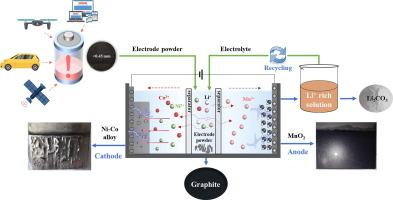
The separation and recovery of key metals are essential for the sustainable recycling of spent lithium-ion batteries (SLIBs). In this paper, a three-compartment electrolysis is proposed to achieve the direct separation of multiple components in a one-step process through the application of an electric field. In the middle compartment, lithium nickel cobalt manganese oxide (NCM) material dissolves and separates from graphite. Simultaneously, Ni-Co alloy deposits at the cathode, while MnO2 synthesizes at the anode. Additionally, Li+ concentrates and subsequently precipitates as Li2CO3 through chemical precipitation in the electrolyte. As a result, the leaching efficiencies of Ni, Co, Mn, and Li in spent lithium nickel cobalt manganese oxide (SNCM) materials reach 94.30 %, 90.78 %, 98.19 %, and 94.33 %, respectively, in the middle compartment within 6 h at 80 ℃. Meanwhile, the recovery rates for Ni, Co, and Mn are 87.22 %, 81.50 %, and 48.89 %, respectively. The proportions of Ni and Co in the Ni-Co alloy are 33.42 % and 44.82 %, respectively. Li2CO3 with a purity greater than 95 % is recovered from the electrolyte through simple concentration and precipitation. For every 1 kg of SNCM electrode powder recovered, the carbon emissions from the three-compartment electrolysis and electrolyte reuse are 3.81 kg CO2 eq. and −3.47 kg CO2 eq., resulting in economic benefits of $0.25 and $2.06, respectively. This approach enables the simultaneous separation and recovery of multiple metals in a single step, addressing the growing demand for critical energy metals.
期刊介绍:
Separation and Purification Technology is a premier journal committed to sharing innovative methods for separation and purification in chemical and environmental engineering, encompassing both homogeneous solutions and heterogeneous mixtures. Our scope includes the separation and/or purification of liquids, vapors, and gases, as well as carbon capture and separation techniques. However, it's important to note that methods solely intended for analytical purposes are not within the scope of the journal. Additionally, disciplines such as soil science, polymer science, and metallurgy fall outside the purview of Separation and Purification Technology. Join us in advancing the field of separation and purification methods for sustainable solutions in chemical and environmental engineering.




 京公网安备 11010802042870号
京ICP备2023020795号-1
京公网安备 11010802042870号
京ICP备2023020795号-1

 分享
分享
 求助内容:
求助内容: 应助结果提醒方式:
 扫码关注我们
