Wenchao Ji , Mingzhu Ren , Hefei Jin , Yu Lou , Shuzhen Wang , Xingjun Fan , Salma Tabassum
{"title":"Ball milling-assisted synthesis of attapulgite-rice husk biochar composites for efficient formaldehyde removal: Experimental and computational insights","authors":"Wenchao Ji , Mingzhu Ren , Hefei Jin , Yu Lou , Shuzhen Wang , Xingjun Fan , Salma Tabassum","doi":"10.1016/j.seppur.2025.132918","DOIUrl":null,"url":null,"abstract":"<div><div>This study explores the Ball milling-assisted synthesis of attapulgite-rice husk biochar composites (5 %ATP/BBC) to remove formaldehyde (HCHO) efficiently. The composite was fabricated to enhance surface area and increase exposure to functional groups, which are crucial for adsorption. The experimental findings showed that 5 %ATP/BBC effectively removes HCHO, with a maximum theoretical static adsorption capacity of 0.260 mg/g and a dynamic adsorption capacity of 141.048 mg/g, surpassing both BBC500 and BC500. Chemical adsorption was the predominant process, and the adsorption followed pseudo-second-order kinetics. Further X-ray photoelectron spectroscopy (XPS) analysis indicated that formaldehyde molecules were incorporated onto the biochar surface, as evidenced by changes in C=O and C–C bonds. Molecular-level investigations through density functional theory (DFT) and Bader charge analysis revealed that adsorption involves charge redistribution, with ATP playing a key role as an active site. These findings were confirmed by charge density difference (CDD) analysis, which demonstrated charge transfer during adsorption. The results show that 5 % ATP/BBC can be a sustainable and practical material for HCHO removal, offering valuable insights into developing advanced adsorbents for environmental applications.</div></div>","PeriodicalId":427,"journal":{"name":"Separation and Purification Technology","volume":"367 ","pages":"Article 132918"},"PeriodicalIF":9.0000,"publicationDate":"2025-04-09","publicationTypes":"Journal Article","fieldsOfStudy":null,"isOpenAccess":false,"openAccessPdf":"","citationCount":"0","resultStr":null,"platform":"Semanticscholar","paperid":null,"PeriodicalName":"Separation and Purification Technology","FirstCategoryId":"5","ListUrlMain":"https://www.sciencedirect.com/science/article/pii/S1383586625015151","RegionNum":1,"RegionCategory":"工程技术","ArticlePicture":[],"TitleCN":null,"AbstractTextCN":null,"PMCID":null,"EPubDate":"","PubModel":"","JCR":"Q1","JCRName":"ENGINEERING, CHEMICAL","Score":null,"Total":0}
引用次数: 0
Abstract
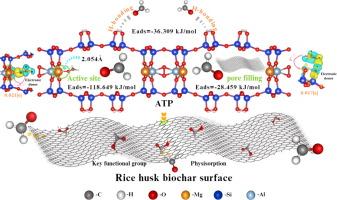
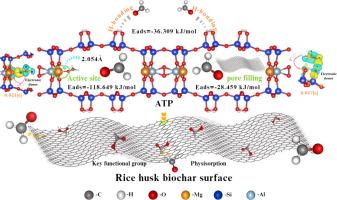
This study explores the Ball milling-assisted synthesis of attapulgite-rice husk biochar composites (5 %ATP/BBC) to remove formaldehyde (HCHO) efficiently. The composite was fabricated to enhance surface area and increase exposure to functional groups, which are crucial for adsorption. The experimental findings showed that 5 %ATP/BBC effectively removes HCHO, with a maximum theoretical static adsorption capacity of 0.260 mg/g and a dynamic adsorption capacity of 141.048 mg/g, surpassing both BBC500 and BC500. Chemical adsorption was the predominant process, and the adsorption followed pseudo-second-order kinetics. Further X-ray photoelectron spectroscopy (XPS) analysis indicated that formaldehyde molecules were incorporated onto the biochar surface, as evidenced by changes in C=O and C–C bonds. Molecular-level investigations through density functional theory (DFT) and Bader charge analysis revealed that adsorption involves charge redistribution, with ATP playing a key role as an active site. These findings were confirmed by charge density difference (CDD) analysis, which demonstrated charge transfer during adsorption. The results show that 5 % ATP/BBC can be a sustainable and practical material for HCHO removal, offering valuable insights into developing advanced adsorbents for environmental applications.
期刊介绍:
Separation and Purification Technology is a premier journal committed to sharing innovative methods for separation and purification in chemical and environmental engineering, encompassing both homogeneous solutions and heterogeneous mixtures. Our scope includes the separation and/or purification of liquids, vapors, and gases, as well as carbon capture and separation techniques. However, it's important to note that methods solely intended for analytical purposes are not within the scope of the journal. Additionally, disciplines such as soil science, polymer science, and metallurgy fall outside the purview of Separation and Purification Technology. Join us in advancing the field of separation and purification methods for sustainable solutions in chemical and environmental engineering.




 京公网安备 11010802042870号
京ICP备2023020795号-1
京公网安备 11010802042870号
京ICP备2023020795号-1

 分享
分享
 求助内容:
求助内容: 应助结果提醒方式:
 扫码关注我们
