Teng Wang, Dongxiang Liu, Rongze Liu, Feng Yuan, Yongcheng Ding, Jianguo Tao, Yaping Wang, Wenwen Yu, Yining Fang, Baojie Li
{"title":"Weathering Process and Characteristics of Microplastics in Coastal Wetlands: A 24-Month In Situ Study","authors":"Teng Wang, Dongxiang Liu, Rongze Liu, Feng Yuan, Yongcheng Ding, Jianguo Tao, Yaping Wang, Wenwen Yu, Yining Fang, Baojie Li","doi":"10.1021/acs.est.4c12140","DOIUrl":null,"url":null,"abstract":"Coastal wetlands function as critical retention zones for environmental microplastics, potentially accelerating their degradation through unique hydrological conditions. This study conducted a comprehensive 24-month in situ experiment at the Chongming Dongtan National Nature Reserve, examining the weathering processes of five morphologically distinct polyethylene (PE), polypropylene (PP), and polystyrene (PS) microplastics. Quarterly analyses revealed progressive surface deterioration in all microplastics after initial exposure, followed by polymer-specific fragmentation patterns and environmental pollutant adherence. Surface elemental analysis showed rising O/C ratios, with intertidal zones exhibiting higher variance (0.0014–0.0096 vs 0.0006–0.0028 supratidal). Carbonyl index (CI) displayed fluctuating increases, with PS showing the highest CI rise (75.75%/year intertidal vs 61.77%/year supratidal). Systematic comparisons identified three weathering determinants: enhanced intertidal degradation from mechanical-photochemical synergy; spherical particles degrading faster than films via larger surface area; and polymer vulnerabilities dictating PS > PP > PE degradation rates. These findings demonstrate that microplastic weathering in coastal wetlands is collectively governed by hydrological conditions, particle morphology, and polymer composition, providing crucial quantitative parameters for assessing environmental persistence and ecological risks in these sensitive transition ecosystems.","PeriodicalId":36,"journal":{"name":"环境科学与技术","volume":"13 1","pages":""},"PeriodicalIF":11.3000,"publicationDate":"2025-04-08","publicationTypes":"Journal Article","fieldsOfStudy":null,"isOpenAccess":false,"openAccessPdf":"","citationCount":"0","resultStr":null,"platform":"Semanticscholar","paperid":null,"PeriodicalName":"环境科学与技术","FirstCategoryId":"1","ListUrlMain":"https://doi.org/10.1021/acs.est.4c12140","RegionNum":1,"RegionCategory":"环境科学与生态学","ArticlePicture":[],"TitleCN":null,"AbstractTextCN":null,"PMCID":null,"EPubDate":"","PubModel":"","JCR":"Q1","JCRName":"ENGINEERING, ENVIRONMENTAL","Score":null,"Total":0}
引用次数: 0
Abstract
Coastal wetlands function as critical retention zones for environmental microplastics, potentially accelerating their degradation through unique hydrological conditions. This study conducted a comprehensive 24-month in situ experiment at the Chongming Dongtan National Nature Reserve, examining the weathering processes of five morphologically distinct polyethylene (PE), polypropylene (PP), and polystyrene (PS) microplastics. Quarterly analyses revealed progressive surface deterioration in all microplastics after initial exposure, followed by polymer-specific fragmentation patterns and environmental pollutant adherence. Surface elemental analysis showed rising O/C ratios, with intertidal zones exhibiting higher variance (0.0014–0.0096 vs 0.0006–0.0028 supratidal). Carbonyl index (CI) displayed fluctuating increases, with PS showing the highest CI rise (75.75%/year intertidal vs 61.77%/year supratidal). Systematic comparisons identified three weathering determinants: enhanced intertidal degradation from mechanical-photochemical synergy; spherical particles degrading faster than films via larger surface area; and polymer vulnerabilities dictating PS > PP > PE degradation rates. These findings demonstrate that microplastic weathering in coastal wetlands is collectively governed by hydrological conditions, particle morphology, and polymer composition, providing crucial quantitative parameters for assessing environmental persistence and ecological risks in these sensitive transition ecosystems.
沿海湿地是环境微塑料的关键保留区,通过独特的水文条件可能加速其降解。本研究在崇明东滩国家级自然保护区进行了为期24个月的综合原位实验,研究了五种形态不同的聚乙烯(PE)、聚丙烯(PP)和聚苯乙烯(PS)微塑料的风化过程。季度分析显示,在初次接触后,所有微塑料的表面都逐渐恶化,随后出现聚合物特异性破碎模式和环境污染物粘附性。地表元素分析显示O/C比值上升,潮间带差异较大(0.0014-0.0096 vs 0.0006-0.0028)。羰基指数(CI)呈波动上升,其中PS的CI上升幅度最大(75.75%/年潮间带vs 61.77%/年潮上带)。系统比较确定了三个风化决定因素:机械-光化学协同作用导致潮间带退化加剧;球形颗粒的表面积越大,降解速度越快;聚合物的脆弱性决定PS >;页的在PE降解率。这些发现表明,沿海湿地的微塑性风化是由水文条件、颗粒形态和聚合物组成共同控制的,为评估这些敏感过渡生态系统的环境持久性和生态风险提供了重要的定量参数。
期刊介绍:
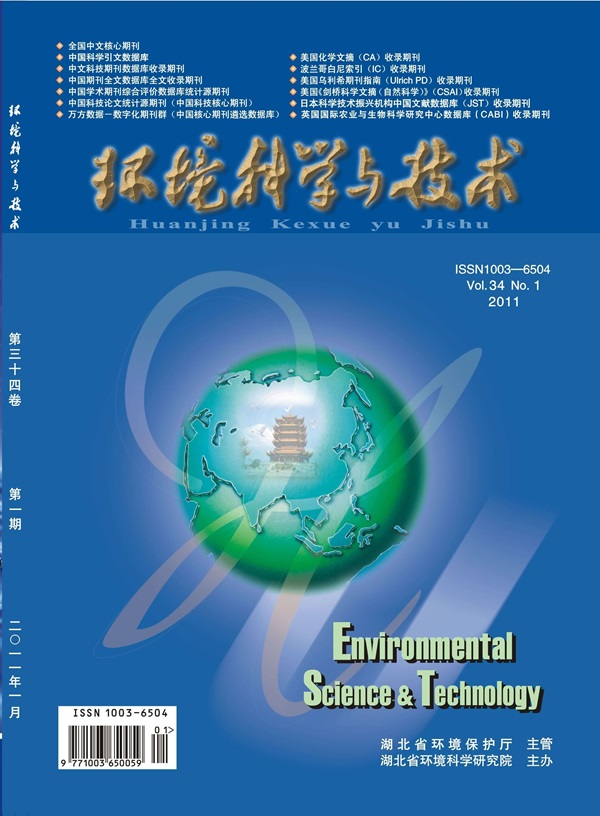
Environmental Science & Technology (ES&T) is a co-sponsored academic and technical magazine by the Hubei Provincial Environmental Protection Bureau and the Hubei Provincial Academy of Environmental Sciences.
Environmental Science & Technology (ES&T) holds the status of Chinese core journals, scientific papers source journals of China, Chinese Science Citation Database source journals, and Chinese Academic Journal Comprehensive Evaluation Database source journals. This publication focuses on the academic field of environmental protection, featuring articles related to environmental protection and technical advancements.




 京公网安备 11010802042870号
京ICP备2023020795号-1
京公网安备 11010802042870号
京ICP备2023020795号-1

 分享
分享
 求助内容:
求助内容: 应助结果提醒方式:
 扫码关注我们
