Rahel Mesfin Ketema, Yu Ait Bamai, Houman Goudarzi, Takeshi Yamaguchi, Yi Zeng, Ayaka Yasuda, Megasari Marsela, Satoshi Konno, Reiko Kishi, Atsuko Ikeda
{"title":"Association of Phthalate Exposure with Respiratory and Allergic Symptoms and Type 2 and Non-Type 2 Inflammation: The Hokkaido Study","authors":"Rahel Mesfin Ketema, Yu Ait Bamai, Houman Goudarzi, Takeshi Yamaguchi, Yi Zeng, Ayaka Yasuda, Megasari Marsela, Satoshi Konno, Reiko Kishi, Atsuko Ikeda","doi":"10.1021/acs.est.4c14579","DOIUrl":null,"url":null,"abstract":"Phthalate exposure is linked to asthma and allergic symptoms, yet their individual and combined effects on symptoms and inflammatory biomarkers, type 2 (T2) and non-T2, remain unexplored. This study examined the association of phthalate metabolites with allergic symptoms (wheeze, allergic rhinoconjunctivitis, and eczema), T2 biomarker (fraction of exhaled nitric oxide (FeNO), blood eosinophil count, and total immunoglobulin E (IgE)), and non-T2 biomarker (absolute neutrophil count (ANC)) and also their association with oxidative stress biomarkers, such as 4-hydroxynonenal, hexanoyl-lysine, and 8-hydroxy-2-deoxyguanosine. Ten urinary phthalate metabolites were measured using UPLC-MS/MS in 421 children (aged 9–12 years) from The Hokkaido Cohort, Japan. Symptoms were defined using the International Study of Asthma and Allergies in Childhood questionnaire, and biomarkers were measured in blood. Logistic regression assessed individual metabolites, while quantile-g computation and Bayesian kernel machine regression analyzed mixture effects on binary outcomes. Individual analysis showed that MnBP (mono-<i>n</i>-butyl phthalate) was positively associated with allergic rhinoconjunctivitis and eosinophil ≥ 300 cells/μL, while ∑DBP (dibutyl phthalate) and OH-MiNP (mono-hydroxy-isononyl phthalate) were linked with FeNO ≥ 35 ppb. DEHP (di(2-ethylhexyl) phthalate) metabolites were associated with a high prevalence of blood eosinophils ≥ 300 cells/μL. We found a positive association between phthalates and oxidative stress markers, but no link was observed between oxidative stress and inflammatory markers. Mixture analysis identified MnBP as a major contributor to the high FeNO level, with di-<i>n</i>-butyl phthalate (DnBP) and DEHP metabolites contributing to eosinophil count ≥ 300 cells/μL and ANC ≥ 4400 cells/μL. These findings suggest that phthalate exposure from DnBP and DEHP is associated with immune dysregulation by triggering both T2 and non-T2 inflammatory responses.","PeriodicalId":36,"journal":{"name":"环境科学与技术","volume":"31 1","pages":""},"PeriodicalIF":11.3000,"publicationDate":"2025-04-08","publicationTypes":"Journal Article","fieldsOfStudy":null,"isOpenAccess":false,"openAccessPdf":"","citationCount":"0","resultStr":null,"platform":"Semanticscholar","paperid":null,"PeriodicalName":"环境科学与技术","FirstCategoryId":"1","ListUrlMain":"https://doi.org/10.1021/acs.est.4c14579","RegionNum":1,"RegionCategory":"环境科学与生态学","ArticlePicture":[],"TitleCN":null,"AbstractTextCN":null,"PMCID":null,"EPubDate":"","PubModel":"","JCR":"Q1","JCRName":"ENGINEERING, ENVIRONMENTAL","Score":null,"Total":0}
引用次数: 0
Abstract
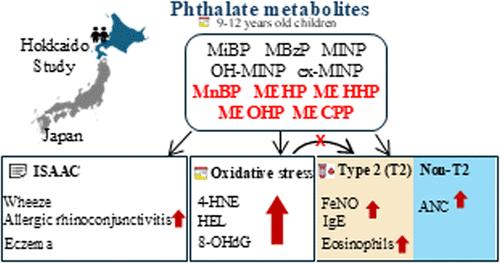
Phthalate exposure is linked to asthma and allergic symptoms, yet their individual and combined effects on symptoms and inflammatory biomarkers, type 2 (T2) and non-T2, remain unexplored. This study examined the association of phthalate metabolites with allergic symptoms (wheeze, allergic rhinoconjunctivitis, and eczema), T2 biomarker (fraction of exhaled nitric oxide (FeNO), blood eosinophil count, and total immunoglobulin E (IgE)), and non-T2 biomarker (absolute neutrophil count (ANC)) and also their association with oxidative stress biomarkers, such as 4-hydroxynonenal, hexanoyl-lysine, and 8-hydroxy-2-deoxyguanosine. Ten urinary phthalate metabolites were measured using UPLC-MS/MS in 421 children (aged 9–12 years) from The Hokkaido Cohort, Japan. Symptoms were defined using the International Study of Asthma and Allergies in Childhood questionnaire, and biomarkers were measured in blood. Logistic regression assessed individual metabolites, while quantile-g computation and Bayesian kernel machine regression analyzed mixture effects on binary outcomes. Individual analysis showed that MnBP (mono-n-butyl phthalate) was positively associated with allergic rhinoconjunctivitis and eosinophil ≥ 300 cells/μL, while ∑DBP (dibutyl phthalate) and OH-MiNP (mono-hydroxy-isononyl phthalate) were linked with FeNO ≥ 35 ppb. DEHP (di(2-ethylhexyl) phthalate) metabolites were associated with a high prevalence of blood eosinophils ≥ 300 cells/μL. We found a positive association between phthalates and oxidative stress markers, but no link was observed between oxidative stress and inflammatory markers. Mixture analysis identified MnBP as a major contributor to the high FeNO level, with di-n-butyl phthalate (DnBP) and DEHP metabolites contributing to eosinophil count ≥ 300 cells/μL and ANC ≥ 4400 cells/μL. These findings suggest that phthalate exposure from DnBP and DEHP is associated with immune dysregulation by triggering both T2 and non-T2 inflammatory responses.
期刊介绍:
Environmental Science & Technology (ES&T) is a co-sponsored academic and technical magazine by the Hubei Provincial Environmental Protection Bureau and the Hubei Provincial Academy of Environmental Sciences.
Environmental Science & Technology (ES&T) holds the status of Chinese core journals, scientific papers source journals of China, Chinese Science Citation Database source journals, and Chinese Academic Journal Comprehensive Evaluation Database source journals. This publication focuses on the academic field of environmental protection, featuring articles related to environmental protection and technical advancements.



 京公网安备 11010802042870号
京ICP备2023020795号-1
京公网安备 11010802042870号
京ICP备2023020795号-1

 分享
分享
 求助内容:
求助内容: 应助结果提醒方式:
 扫码关注我们
