Yufeng Lin, Harry Cheuk-Hay Lau, Chuanfa Liu, Xiao Ding, Yang Sun, Jiamei Rong, Xiang Zhang, Luyao Wang, Kai Yuan, Yinglei Miao, William Ka-Kei Wu, Sunny Hei Wong, Joseph Jao-Yiu Sung, Jun Yu
{"title":"Multi-cohort analysis reveals colorectal cancer tumor location-associated fecal microbiota and their clinical impact","authors":"Yufeng Lin, Harry Cheuk-Hay Lau, Chuanfa Liu, Xiao Ding, Yang Sun, Jiamei Rong, Xiang Zhang, Luyao Wang, Kai Yuan, Yinglei Miao, William Ka-Kei Wu, Sunny Hei Wong, Joseph Jao-Yiu Sung, Jun Yu","doi":"10.1016/j.chom.2025.03.012","DOIUrl":null,"url":null,"abstract":"Microbial alterations in different tumor locations of colorectal cancer (CRC) remain unclear. Here, 1,375 fecal metagenomes from six in-house and published datasets were analyzed, including 128 right-sided CRC (rCRC), 168 left-sided CRC (lCRC), 250 rectal cancer (RC), and 829 controls. Firmicutes progressively increase from rCRC, lCRC, to RC, in contrast to the gradual decrease of Bacteroidetes. Tumor location-associated fecal microbes are identified, including <em>Veillonella parvula</em> for rCRC, <em>Streptococcus angionosus</em> for lCRC, and <em>Peptostreptococcus anaerobius</em> for RC, while <em>Fusobacterium nucleatum</em> is enriched in all tumor locations. Tumor location-associated bacteria correlate with patient survival. Clinically, we establish a microbial biomarker panel for each tumor location that accurately diagnoses rCRC (area under the receiver operating characteristic curve [AUC] = 91.59%), lCRC (AUC = 91.69%), or RC (AUC = 90.53%) from controls. Tumor location-specific biomarkers also have higher diagnostic accuracy (AUC = 91.38%) than location-non-specific biomarkers (AUC = 82.92%). Overall, we characterize fecal microbes associated with different CRC tumor locations, highlighting that tumor location should be considered in non-invasive diagnosis.","PeriodicalId":9693,"journal":{"name":"Cell host & microbe","volume":"1 1","pages":""},"PeriodicalIF":18.7000,"publicationDate":"2025-04-09","publicationTypes":"Journal Article","fieldsOfStudy":null,"isOpenAccess":false,"openAccessPdf":"","citationCount":"0","resultStr":null,"platform":"Semanticscholar","paperid":null,"PeriodicalName":"Cell host & microbe","FirstCategoryId":"3","ListUrlMain":"https://doi.org/10.1016/j.chom.2025.03.012","RegionNum":1,"RegionCategory":"医学","ArticlePicture":[],"TitleCN":null,"AbstractTextCN":null,"PMCID":null,"EPubDate":"","PubModel":"","JCR":"Q1","JCRName":"MICROBIOLOGY","Score":null,"Total":0}
引用次数: 0
Abstract
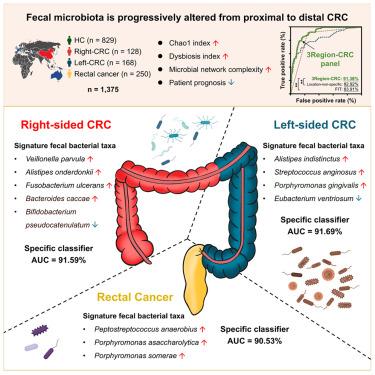
Microbial alterations in different tumor locations of colorectal cancer (CRC) remain unclear. Here, 1,375 fecal metagenomes from six in-house and published datasets were analyzed, including 128 right-sided CRC (rCRC), 168 left-sided CRC (lCRC), 250 rectal cancer (RC), and 829 controls. Firmicutes progressively increase from rCRC, lCRC, to RC, in contrast to the gradual decrease of Bacteroidetes. Tumor location-associated fecal microbes are identified, including Veillonella parvula for rCRC, Streptococcus angionosus for lCRC, and Peptostreptococcus anaerobius for RC, while Fusobacterium nucleatum is enriched in all tumor locations. Tumor location-associated bacteria correlate with patient survival. Clinically, we establish a microbial biomarker panel for each tumor location that accurately diagnoses rCRC (area under the receiver operating characteristic curve [AUC] = 91.59%), lCRC (AUC = 91.69%), or RC (AUC = 90.53%) from controls. Tumor location-specific biomarkers also have higher diagnostic accuracy (AUC = 91.38%) than location-non-specific biomarkers (AUC = 82.92%). Overall, we characterize fecal microbes associated with different CRC tumor locations, highlighting that tumor location should be considered in non-invasive diagnosis.
期刊介绍:
Cell Host & Microbe is a scientific journal that was launched in March 2007. The journal aims to provide a platform for scientists to exchange ideas and concepts related to the study of microbes and their interaction with host organisms at a molecular, cellular, and immune level. It publishes novel findings on a wide range of microorganisms including bacteria, fungi, parasites, and viruses. The journal focuses on the interface between the microbe and its host, whether the host is a vertebrate, invertebrate, or plant, and whether the microbe is pathogenic, non-pathogenic, or commensal. The integrated study of microbes and their interactions with each other, their host, and the cellular environment they inhabit is a unifying theme of the journal. The published work in Cell Host & Microbe is expected to be of exceptional significance within its field and also of interest to researchers in other areas. In addition to primary research articles, the journal features expert analysis, commentary, and reviews on current topics of interest in the field.



 京公网安备 11010802042870号
京ICP备2023020795号-1
京公网安备 11010802042870号
京ICP备2023020795号-1

 分享
分享
 求助内容:
求助内容: 应助结果提醒方式:
 扫码关注我们
