Sebastian Valenzuela, Xuefeng Zhu, Bertil Macao, Mattias Stamgren, Carol Geukens, Paul S. Charifson, Gunther Kern, Emily Hoberg, Louise Jenninger, Anja V. Gruszczyk, Seoeun Lee, Katarina A. S. Johansson, Javier Miralles Fusté, Yonghong Shi, S. Jordan Kerns, Laleh Arabanian, Gabriel Martinez Botella, Sofie Ekström, Jeremy Green, Andrew M. Griffin, Carlos Pardo-Hernández, Thomas A. Keating, Barbara Küppers-Munther, Nils-Göran Larsson, Cindy Phan, Viktor Posse, Juli E. Jones, Xie Xie, Simon Giroux, Claes M. Gustafsson, Maria Falkenberg
{"title":"Small molecules restore mutant mitochondrial DNA polymerase activity","authors":"Sebastian Valenzuela, Xuefeng Zhu, Bertil Macao, Mattias Stamgren, Carol Geukens, Paul S. Charifson, Gunther Kern, Emily Hoberg, Louise Jenninger, Anja V. Gruszczyk, Seoeun Lee, Katarina A. S. Johansson, Javier Miralles Fusté, Yonghong Shi, S. Jordan Kerns, Laleh Arabanian, Gabriel Martinez Botella, Sofie Ekström, Jeremy Green, Andrew M. Griffin, Carlos Pardo-Hernández, Thomas A. Keating, Barbara Küppers-Munther, Nils-Göran Larsson, Cindy Phan, Viktor Posse, Juli E. Jones, Xie Xie, Simon Giroux, Claes M. Gustafsson, Maria Falkenberg","doi":"10.1038/s41586-025-08856-9","DOIUrl":null,"url":null,"abstract":"Mammalian mitochondrial DNA (mtDNA) is replicated by DNA polymerase γ (POLγ), a heterotrimeric complex consisting of a catalytic POLγA subunit and two accessory POLγB subunits1. More than 300 mutations in POLG, the gene encoding the catalytic subunit, have been linked to severe, progressive conditions with high rates of morbidity and mortality, for which no treatment exists2. Here we report on the discovery and characterization of PZL-A, a first-in-class small-molecule activator of mtDNA synthesis that is capable of restoring function to the most common mutant variants of POLγ. PZL-A binds to an allosteric site at the interface between the catalytic POLγA subunit and the proximal POLγB subunit, a region that is unaffected by nearly all disease-causing mutations. The compound restores wild-type-like activity to mutant forms of POLγ in vitro and activates mtDNA synthesis in cells from paediatric patients with lethal POLG disease, thereby enhancing biogenesis of the oxidative phosphorylation machinery and cellular respiration. Our work demonstrates that a small molecule can restore function to mutant DNA polymerases, offering a promising avenue for treating POLG disorders and other severe conditions linked to depletion of mtDNA. An activator of DNA polymerase γ restores function to disease-causing mutant variants and demonstrates a potential route to treatments for inherited mitochondrial disorders involving POLG mutations.","PeriodicalId":18787,"journal":{"name":"Nature","volume":"642 8067","pages":"501-507"},"PeriodicalIF":48.5000,"publicationDate":"2025-04-09","publicationTypes":"Journal Article","fieldsOfStudy":null,"isOpenAccess":false,"openAccessPdf":"https://www.nature.com/articles/s41586-025-08856-9.pdf","citationCount":"0","resultStr":null,"platform":"Semanticscholar","paperid":null,"PeriodicalName":"Nature","FirstCategoryId":"103","ListUrlMain":"https://www.nature.com/articles/s41586-025-08856-9","RegionNum":1,"RegionCategory":"综合性期刊","ArticlePicture":[],"TitleCN":null,"AbstractTextCN":null,"PMCID":null,"EPubDate":"","PubModel":"","JCR":"Q1","JCRName":"MULTIDISCIPLINARY SCIENCES","Score":null,"Total":0}
引用次数: 0
Abstract
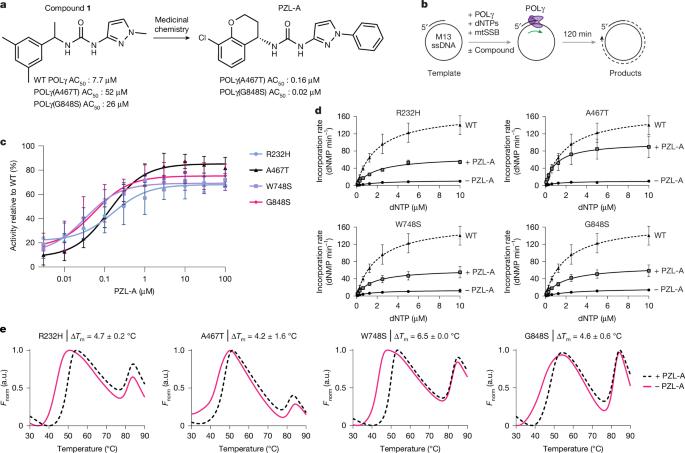
Mammalian mitochondrial DNA (mtDNA) is replicated by DNA polymerase γ (POLγ), a heterotrimeric complex consisting of a catalytic POLγA subunit and two accessory POLγB subunits1. More than 300 mutations in POLG, the gene encoding the catalytic subunit, have been linked to severe, progressive conditions with high rates of morbidity and mortality, for which no treatment exists2. Here we report on the discovery and characterization of PZL-A, a first-in-class small-molecule activator of mtDNA synthesis that is capable of restoring function to the most common mutant variants of POLγ. PZL-A binds to an allosteric site at the interface between the catalytic POLγA subunit and the proximal POLγB subunit, a region that is unaffected by nearly all disease-causing mutations. The compound restores wild-type-like activity to mutant forms of POLγ in vitro and activates mtDNA synthesis in cells from paediatric patients with lethal POLG disease, thereby enhancing biogenesis of the oxidative phosphorylation machinery and cellular respiration. Our work demonstrates that a small molecule can restore function to mutant DNA polymerases, offering a promising avenue for treating POLG disorders and other severe conditions linked to depletion of mtDNA. An activator of DNA polymerase γ restores function to disease-causing mutant variants and demonstrates a potential route to treatments for inherited mitochondrial disorders involving POLG mutations.
期刊介绍:
Nature is a prestigious international journal that publishes peer-reviewed research in various scientific and technological fields. The selection of articles is based on criteria such as originality, importance, interdisciplinary relevance, timeliness, accessibility, elegance, and surprising conclusions. In addition to showcasing significant scientific advances, Nature delivers rapid, authoritative, insightful news, and interpretation of current and upcoming trends impacting science, scientists, and the broader public. The journal serves a dual purpose: firstly, to promptly share noteworthy scientific advances and foster discussions among scientists, and secondly, to ensure the swift dissemination of scientific results globally, emphasizing their significance for knowledge, culture, and daily life.



 京公网安备 11010802042870号
京ICP备2023020795号-1
京公网安备 11010802042870号
京ICP备2023020795号-1

 分享
分享
 求助内容:
求助内容: 应助结果提醒方式:
 扫码关注我们
