Axel Camazzola, Elena Buglakova, Louis W. Perrin, Verena Rukes and Chan Cao*,
{"title":"Eliminating the Interference of Neighboring Nucleobases in Aerolysin for Nanopore Sequencing","authors":"Axel Camazzola, Elena Buglakova, Louis W. Perrin, Verena Rukes and Chan Cao*, ","doi":"10.1021/acssensors.5c00334","DOIUrl":null,"url":null,"abstract":"<p >Biological nanopores have revolutionized DNA sequencing with their incredible advantages of long reads, high throughput, portability, and low material requirement. Despite numerous improvements, base calling remains challenging due to the influence of neighboring nucleobases at the reading site. One direction of development is exploring or designing new nanopores to improve base calling accuracy. Aerolysin is emerging as a powerful candidate, which can identify the subtle differences of detected molecules. However, not many studies focus on translating these advantages into DNA sequencing. Here, we used streptavidin to immobilize ssDNA inside an engineered aerolysin channel, which allows us to investigate its sensing regions, and the neighboring bases influence. By increasing the voltage, we eliminate the neighboring influence and reduce the k-mer size to one nucleobase. These findings hold great potential for improving the accuracy of nanopore DNA sequencing as well as aerolysin nanopore-based sequencing for other polymers.</p>","PeriodicalId":24,"journal":{"name":"ACS Sensors","volume":"10 6","pages":"4202–4208"},"PeriodicalIF":9.1000,"publicationDate":"2025-04-08","publicationTypes":"Journal Article","fieldsOfStudy":null,"isOpenAccess":false,"openAccessPdf":"https://pubs.acs.org/doi/pdf/10.1021/acssensors.5c00334","citationCount":"0","resultStr":null,"platform":"Semanticscholar","paperid":null,"PeriodicalName":"ACS Sensors","FirstCategoryId":"92","ListUrlMain":"https://pubs.acs.org/doi/10.1021/acssensors.5c00334","RegionNum":1,"RegionCategory":"化学","ArticlePicture":[],"TitleCN":null,"AbstractTextCN":null,"PMCID":null,"EPubDate":"","PubModel":"","JCR":"Q1","JCRName":"CHEMISTRY, ANALYTICAL","Score":null,"Total":0}
引用次数: 0
Abstract
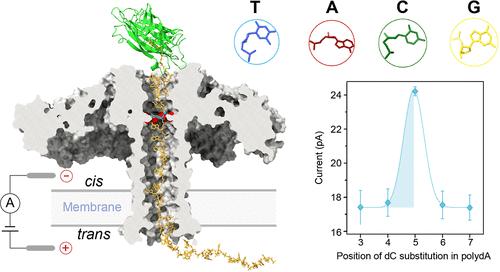
Biological nanopores have revolutionized DNA sequencing with their incredible advantages of long reads, high throughput, portability, and low material requirement. Despite numerous improvements, base calling remains challenging due to the influence of neighboring nucleobases at the reading site. One direction of development is exploring or designing new nanopores to improve base calling accuracy. Aerolysin is emerging as a powerful candidate, which can identify the subtle differences of detected molecules. However, not many studies focus on translating these advantages into DNA sequencing. Here, we used streptavidin to immobilize ssDNA inside an engineered aerolysin channel, which allows us to investigate its sensing regions, and the neighboring bases influence. By increasing the voltage, we eliminate the neighboring influence and reduce the k-mer size to one nucleobase. These findings hold great potential for improving the accuracy of nanopore DNA sequencing as well as aerolysin nanopore-based sequencing for other polymers.
期刊介绍:
ACS Sensors is a peer-reviewed research journal that focuses on the dissemination of new and original knowledge in the field of sensor science, particularly those that selectively sense chemical or biological species or processes. The journal covers a broad range of topics, including but not limited to biosensors, chemical sensors, gas sensors, intracellular sensors, single molecule sensors, cell chips, and microfluidic devices. It aims to publish articles that address conceptual advances in sensing technology applicable to various types of analytes or application papers that report on the use of existing sensing concepts in new ways or for new analytes.



 京公网安备 11010802042870号
京ICP备2023020795号-1
京公网安备 11010802042870号
京ICP备2023020795号-1

 分享
分享
 求助内容:
求助内容: 应助结果提醒方式:
 扫码关注我们
