Ru Guo, Hang Luo, Shaoshuai He, Xin Xia, Tingting Hou, Haoyu Wang, Chaojie Chen, Dou Zhang and Yunlong Zi
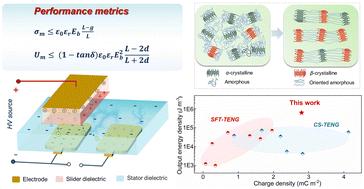
{"title":"Performance metrics of triboelectric nanogenerator toward record-high output energy density†","authors":"Ru Guo, Hang Luo, Shaoshuai He, Xin Xia, Tingting Hou, Haoyu Wang, Chaojie Chen, Dou Zhang and Yunlong Zi","doi":"10.1039/D5EE00376H","DOIUrl":null,"url":null,"abstract":"<p >State-of-the-art studies have promoted the output energy density of triboelectric nanogenerators (TENGs) to 10<small><sup>5</sup></small> J m<small><sup>−3</sup></small>, while the current major barrier lies in the breakdown discharge limit. Universal performance metrics that reveal the maximized energy output ability of TENG approaching the breakdown limit are highly desirable but remain a major challenge. Herein, this work proposed performance metrics for charge density and output energy density, quantitatively characterizing the output performance based on a sliding-freestanding TENG with the charge excitation strategy. A series of parameters of different dielectric materials was systematically investigated to reveal their impacts on the performance metrics. Consequently, the maximum output energy density of 10 kinds of tribo-dielectrics was evaluated based on the voltage–charge (<em>V</em>–<em>Q</em>) curve, validating the proposed performance metrics. Guided by this new standard, we developed a stretched poly(vinylidene fluoride-<em>co</em>-trifluoroethylene) (P(VDF-TrFE)) film with synergistically improved permittivity and breakdown strength, achieving a record-high charge density and output energy density of 2.8 mC m<small><sup>−2</sup></small> and 6.2 × 10<small><sup>5</sup></small> J m<small><sup>−3</sup></small>, respectively. Furthermore, a self-driven charge excitation system was explored in rotary-mode TENGs, showing excellent output capability to directly light up 15 series bulbs. This work establishes a basic standard and guideline for improving the energy output of TENGs, highlighting their potential applications for energy harvesting.</p>","PeriodicalId":72,"journal":{"name":"Energy & Environmental Science","volume":" 10","pages":" 4893-4904"},"PeriodicalIF":30.8000,"publicationDate":"2025-04-09","publicationTypes":"Journal Article","fieldsOfStudy":null,"isOpenAccess":false,"openAccessPdf":"","citationCount":"0","resultStr":null,"platform":"Semanticscholar","paperid":null,"PeriodicalName":"Energy & Environmental Science","FirstCategoryId":"88","ListUrlMain":"https://pubs.rsc.org/en/content/articlelanding/2025/ee/d5ee00376h","RegionNum":1,"RegionCategory":"材料科学","ArticlePicture":[],"TitleCN":null,"AbstractTextCN":null,"PMCID":null,"EPubDate":"","PubModel":"","JCR":"Q1","JCRName":"CHEMISTRY, MULTIDISCIPLINARY","Score":null,"Total":0}
引用次数: 0
Abstract
State-of-the-art studies have promoted the output energy density of triboelectric nanogenerators (TENGs) to 105 J m−3, while the current major barrier lies in the breakdown discharge limit. Universal performance metrics that reveal the maximized energy output ability of TENG approaching the breakdown limit are highly desirable but remain a major challenge. Herein, this work proposed performance metrics for charge density and output energy density, quantitatively characterizing the output performance based on a sliding-freestanding TENG with the charge excitation strategy. A series of parameters of different dielectric materials was systematically investigated to reveal their impacts on the performance metrics. Consequently, the maximum output energy density of 10 kinds of tribo-dielectrics was evaluated based on the voltage–charge (V–Q) curve, validating the proposed performance metrics. Guided by this new standard, we developed a stretched poly(vinylidene fluoride-co-trifluoroethylene) (P(VDF-TrFE)) film with synergistically improved permittivity and breakdown strength, achieving a record-high charge density and output energy density of 2.8 mC m−2 and 6.2 × 10⁵ J m−3, respectively. Furthermore, a self-driven charge excitation system was explored in rotary-mode TENGs, showing excellent output capability to directly light up 15 series bulbs. This work establishes a basic standard and guideline for improving the energy output of TENGs, highlighting their potential applications for energy harvesting.
期刊介绍:
Energy & Environmental Science, a peer-reviewed scientific journal, publishes original research and review articles covering interdisciplinary topics in the (bio)chemical and (bio)physical sciences, as well as chemical engineering disciplines. Published monthly by the Royal Society of Chemistry (RSC), a not-for-profit publisher, Energy & Environmental Science is recognized as a leading journal. It boasts an impressive impact factor of 8.500 as of 2009, ranking 8th among 140 journals in the category "Chemistry, Multidisciplinary," second among 71 journals in "Energy & Fuels," second among 128 journals in "Engineering, Chemical," and first among 181 scientific journals in "Environmental Sciences."
Energy & Environmental Science publishes various types of articles, including Research Papers (original scientific work), Review Articles, Perspectives, and Minireviews (feature review-type articles of broad interest), Communications (original scientific work of an urgent nature), Opinions (personal, often speculative viewpoints or hypotheses on current topics), and Analysis Articles (in-depth examination of energy-related issues).



 京公网安备 11010802042870号
京ICP备2023020795号-1
京公网安备 11010802042870号
京ICP备2023020795号-1

 分享
分享
 求助内容:
求助内容: 应助结果提醒方式:
 扫码关注我们
