Shijing Liang, Alan D. Ziegler, Peter B. Reich, Kai Zhu, Dashan Wang, Xin Jiang, Deliang Chen, Philippe Ciais, Zhenzhong Zeng
{"title":"Climate mitigation potential for targeted forestation after considering climate change, fires, and albedo","authors":"Shijing Liang, Alan D. Ziegler, Peter B. Reich, Kai Zhu, Dashan Wang, Xin Jiang, Deliang Chen, Philippe Ciais, Zhenzhong Zeng","doi":"10.1126/sciadv.adn7915","DOIUrl":null,"url":null,"abstract":"<div >Afforestation and reforestation, both of which refer to forestation strategies, are widely promoted as key tools to mitigate anthropogenic warming. However, the carbon sequestration potential of these efforts remains uncertain in satellite-based assessments, particularly when accounting for dynamic climate conditions, vegetation-climate feedback, fire-dominated disturbance, and the trade-offs associated with surface albedo changes. Leveraging a coupled Earth system model, we estimated that global forestation mitigates 31.3 to 69.2 Pg C<sub>eq</sub> (carbon equivalent) during 2021–2100 under a sustainable shared socioeconomic pathway. Regionally, the highest carbon mitigation potential of forestation concentrates in tropical areas, while mid-high-latitude regions demonstrate higher heterogeneity, highlighting the need for region-specific strategies and further refinement of nature-based mitigation plans. Our findings underscore the importance of considering disturbances and minimizing adverse albedo changes when estimating the carbon mitigation potential of forestation initiatives. We also advocate for the development of consistent, high-resolution maps of suitable areas for targeted forestation, avoiding environmentally sensitive lands and potential conflicts with other human activities.</div>","PeriodicalId":21609,"journal":{"name":"Science Advances","volume":"11 15","pages":""},"PeriodicalIF":12.5000,"publicationDate":"2025-04-09","publicationTypes":"Journal Article","fieldsOfStudy":null,"isOpenAccess":false,"openAccessPdf":"https://www.science.org/doi/reader/10.1126/sciadv.adn7915","citationCount":"0","resultStr":null,"platform":"Semanticscholar","paperid":null,"PeriodicalName":"Science Advances","FirstCategoryId":"103","ListUrlMain":"https://www.science.org/doi/10.1126/sciadv.adn7915","RegionNum":1,"RegionCategory":"综合性期刊","ArticlePicture":[],"TitleCN":null,"AbstractTextCN":null,"PMCID":null,"EPubDate":"","PubModel":"","JCR":"Q1","JCRName":"MULTIDISCIPLINARY SCIENCES","Score":null,"Total":0}
引用次数: 0
Abstract
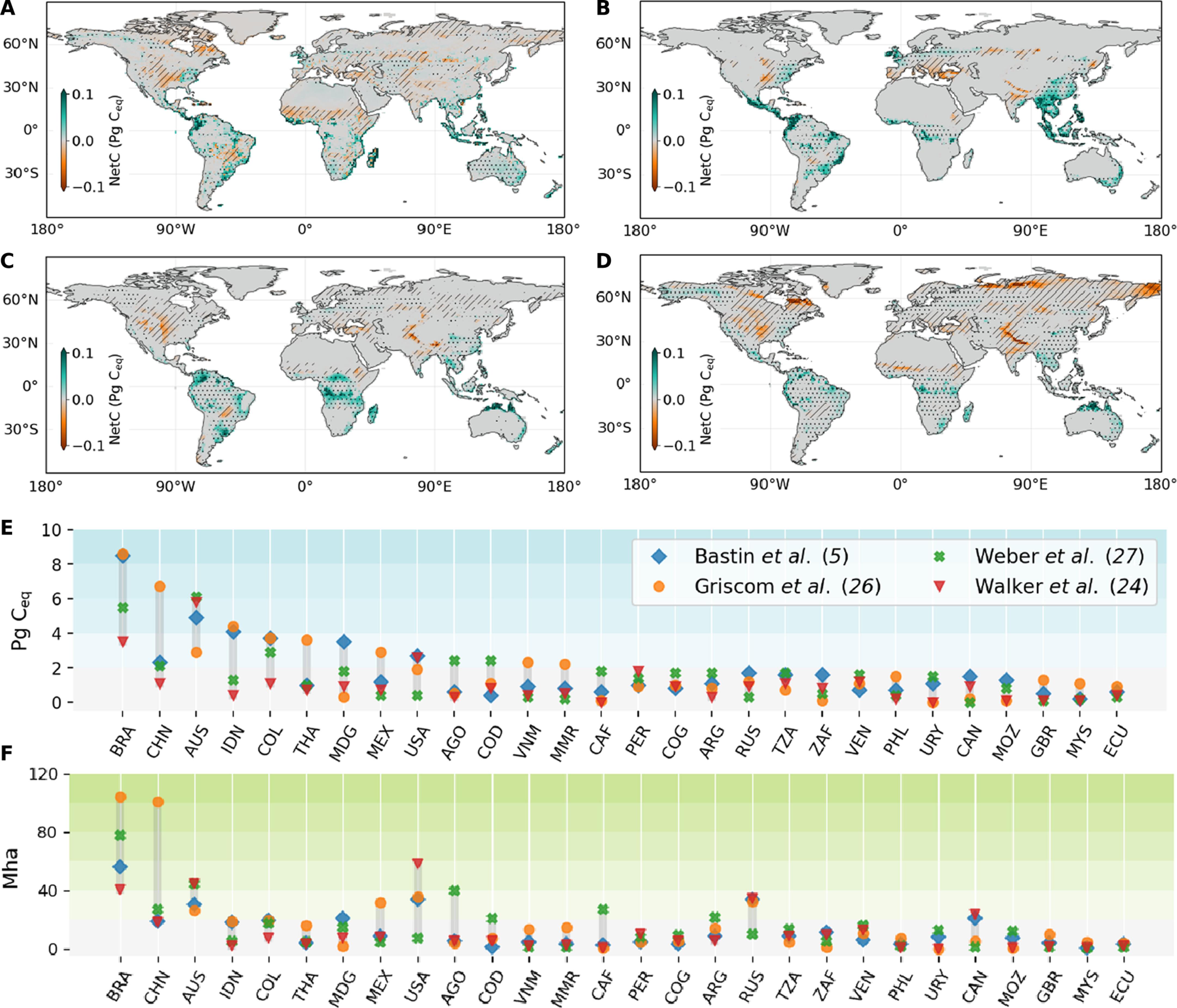
Afforestation and reforestation, both of which refer to forestation strategies, are widely promoted as key tools to mitigate anthropogenic warming. However, the carbon sequestration potential of these efforts remains uncertain in satellite-based assessments, particularly when accounting for dynamic climate conditions, vegetation-climate feedback, fire-dominated disturbance, and the trade-offs associated with surface albedo changes. Leveraging a coupled Earth system model, we estimated that global forestation mitigates 31.3 to 69.2 Pg Ceq (carbon equivalent) during 2021–2100 under a sustainable shared socioeconomic pathway. Regionally, the highest carbon mitigation potential of forestation concentrates in tropical areas, while mid-high-latitude regions demonstrate higher heterogeneity, highlighting the need for region-specific strategies and further refinement of nature-based mitigation plans. Our findings underscore the importance of considering disturbances and minimizing adverse albedo changes when estimating the carbon mitigation potential of forestation initiatives. We also advocate for the development of consistent, high-resolution maps of suitable areas for targeted forestation, avoiding environmentally sensitive lands and potential conflicts with other human activities.
期刊介绍:
Science Advances, an open-access journal by AAAS, publishes impactful research in diverse scientific areas. It aims for fair, fast, and expert peer review, providing freely accessible research to readers. Led by distinguished scientists, the journal supports AAAS's mission by extending Science magazine's capacity to identify and promote significant advances. Evolving digital publishing technologies play a crucial role in advancing AAAS's global mission for science communication and benefitting humankind.



 京公网安备 11010802042870号
京ICP备2023020795号-1
京公网安备 11010802042870号
京ICP备2023020795号-1

 分享
分享
 求助内容:
求助内容: 应助结果提醒方式:
 扫码关注我们
