Yeong Jun Yun, Hyun Jin Kang, Chan Yun Bae, Gyu Heon Bae, Hyun Jin Lee, Ki Hoon Kim, Yeong Jun Jang, Tae Won Nam, Jung Woo Lee
{"title":"Flash-Thermal Reduction of Graphene Oxide with Flexible Electronics Platform for Highly Sensitive Wearable Temperature Sensor","authors":"Yeong Jun Yun, Hyun Jin Kang, Chan Yun Bae, Gyu Heon Bae, Hyun Jin Lee, Ki Hoon Kim, Yeong Jun Jang, Tae Won Nam, Jung Woo Lee","doi":"10.1002/aelm.202400984","DOIUrl":null,"url":null,"abstract":"<p>Accurate and continuous temperature monitoring is essential for effective diagnosis and management of health conditions, particularly amid global challenges such as the COVID-19 pandemic and the rising prevalence of age-related diseases and cancer. However, conventional temperature-measuring devices suffer from inherent limitations, including rigidity, bulkiness, and insufficient sensitivity, making them unsuitable for long-term, real-time applications. To overcome these challenges, a highly sensitive and flexible temperature sensor utilizing partially reduced graphene oxide (PrGO) as the sensing material is developed. Graphene oxide (GO), characterized by disrupted sp<sup>2</sup> bonds and oxygen-rich functional groups that act as electron traps, undergoes controlled reduction to modulate its electrical and structural properties. In this study, by employing the flash-thermal reduction technique, the reduction degree of the GO with systematic analyses on conductivity and material stability is precisely adjusted. The optimized flash-thermal reduced graphene oxide based sensor exhibits exceptional flexibility, reversibility, high sensitivity (≈1.28% °C<sup>−1</sup>), excellent linearity (R<sup>2</sup> ≈ 0.999), long-term stability, and a rapid response time (≈0.6 s), outperforming conventional metal-based temperature sensors in sensitivity. These advancements highlight the transformative potential of flash-thermal reduction for next-generation wearable sensors, offering a lightweight, adaptable, and highly responsive platform for real-time medical monitoring and healthcare applications.</p>","PeriodicalId":110,"journal":{"name":"Advanced Electronic Materials","volume":"11 10","pages":""},"PeriodicalIF":5.3000,"publicationDate":"2025-04-08","publicationTypes":"Journal Article","fieldsOfStudy":null,"isOpenAccess":false,"openAccessPdf":"https://onlinelibrary.wiley.com/doi/epdf/10.1002/aelm.202400984","citationCount":"0","resultStr":null,"platform":"Semanticscholar","paperid":null,"PeriodicalName":"Advanced Electronic Materials","FirstCategoryId":"88","ListUrlMain":"https://advanced.onlinelibrary.wiley.com/doi/10.1002/aelm.202400984","RegionNum":2,"RegionCategory":"材料科学","ArticlePicture":[],"TitleCN":null,"AbstractTextCN":null,"PMCID":null,"EPubDate":"","PubModel":"","JCR":"Q2","JCRName":"MATERIALS SCIENCE, MULTIDISCIPLINARY","Score":null,"Total":0}
引用次数: 0
Abstract
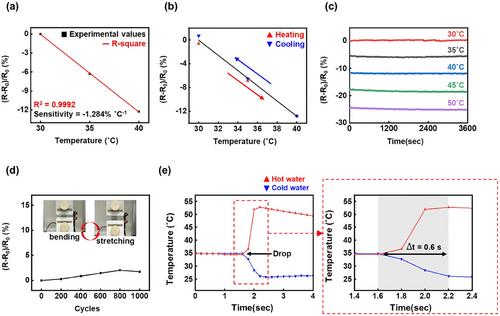
Accurate and continuous temperature monitoring is essential for effective diagnosis and management of health conditions, particularly amid global challenges such as the COVID-19 pandemic and the rising prevalence of age-related diseases and cancer. However, conventional temperature-measuring devices suffer from inherent limitations, including rigidity, bulkiness, and insufficient sensitivity, making them unsuitable for long-term, real-time applications. To overcome these challenges, a highly sensitive and flexible temperature sensor utilizing partially reduced graphene oxide (PrGO) as the sensing material is developed. Graphene oxide (GO), characterized by disrupted sp2 bonds and oxygen-rich functional groups that act as electron traps, undergoes controlled reduction to modulate its electrical and structural properties. In this study, by employing the flash-thermal reduction technique, the reduction degree of the GO with systematic analyses on conductivity and material stability is precisely adjusted. The optimized flash-thermal reduced graphene oxide based sensor exhibits exceptional flexibility, reversibility, high sensitivity (≈1.28% °C−1), excellent linearity (R2 ≈ 0.999), long-term stability, and a rapid response time (≈0.6 s), outperforming conventional metal-based temperature sensors in sensitivity. These advancements highlight the transformative potential of flash-thermal reduction for next-generation wearable sensors, offering a lightweight, adaptable, and highly responsive platform for real-time medical monitoring and healthcare applications.
期刊介绍:
Advanced Electronic Materials is an interdisciplinary forum for peer-reviewed, high-quality, high-impact research in the fields of materials science, physics, and engineering of electronic and magnetic materials. It includes research on physics and physical properties of electronic and magnetic materials, spintronics, electronics, device physics and engineering, micro- and nano-electromechanical systems, and organic electronics, in addition to fundamental research.





 京公网安备 11010802042870号
京ICP备2023020795号-1
京公网安备 11010802042870号
京ICP备2023020795号-1

 分享
分享
 求助内容:
求助内容: 应助结果提醒方式:
 扫码关注我们
