Feilong Yang, Ke Zhang, Qi Wang, Jinxi Chen and Yongbing Lou
{"title":"Facile chloride ion (Cl−) doping enhances the oxygen evolution reaction activity of La0.5Sr0.5FeO3−δ †","authors":"Feilong Yang, Ke Zhang, Qi Wang, Jinxi Chen and Yongbing Lou","doi":"10.1039/D5DT00372E","DOIUrl":null,"url":null,"abstract":"<p >Perovskite electrocatalysts have garnered significant attention due to their catalytic activity, environmental friendliness, tunable structure and high performance. However, their activities in the oxygen evolution reaction (OER) still require further enhancement. In this study, to address this challenge, an anion doping strategy was employed to modify La<small><sub>0.5</sub></small>Sr<small><sub>0.5</sub></small>FeO<small><sub>3−<em>δ</em></sub></small> (LSFO) perovskite oxides, and a series of chloride ion doped catalysts were successfully prepared. The Cl<small><sup>−</sup></small> doping induced the selective leaching of Sr ions, leading to the formation of Sr vacancies on the perovskite surface and a significant increase in the proportion of oxidative oxygen species (O<small><sub>2</sub></small><small><sup>2−</sup></small>/O<small><sup>−</sup></small>). Additionally, a significant increase in the oxidation state of iron (Fe) in the perovskite was observed after the reaction. This synergistic effect effectively optimized the electronic conductivity of the perovskites, accelerated the intrinsic reaction kinetics, and substantially enhanced OER performance. Electrochemical testing results demonstrated that the optimal Cl-doped LSFO electrocatalyst exhibited an overpotential of only 232 mV at a current density of 10 mA cm<small><sup>−2</sup></small>, with a Tafel slope of 31 mV dec<small><sup>−2</sup></small>. Additionally, the optimal Cl-doped LSFO showed a low charge transfer resistance and excellent long-term cyclic stability. This study not only demonstrated the regulatory mechanism of Cl<small><sup>−</sup></small> doping on the catalytic activity of perovskite catalysts but also provided theoretical insights and practical strategies for the design of efficient and stable electrocatalysts.</p>","PeriodicalId":71,"journal":{"name":"Dalton Transactions","volume":" 18","pages":" 7391-7399"},"PeriodicalIF":3.3000,"publicationDate":"2025-04-09","publicationTypes":"Journal Article","fieldsOfStudy":null,"isOpenAccess":false,"openAccessPdf":"","citationCount":"0","resultStr":null,"platform":"Semanticscholar","paperid":null,"PeriodicalName":"Dalton Transactions","FirstCategoryId":"92","ListUrlMain":"https://pubs.rsc.org/en/content/articlelanding/2025/dt/d5dt00372e","RegionNum":3,"RegionCategory":"化学","ArticlePicture":[],"TitleCN":null,"AbstractTextCN":null,"PMCID":null,"EPubDate":"","PubModel":"","JCR":"Q2","JCRName":"CHEMISTRY, INORGANIC & NUCLEAR","Score":null,"Total":0}
引用次数: 0
Abstract
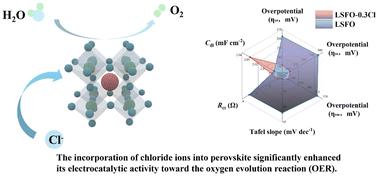
Perovskite electrocatalysts have garnered significant attention due to their catalytic activity, environmental friendliness, tunable structure and high performance. However, their activities in the oxygen evolution reaction (OER) still require further enhancement. In this study, to address this challenge, an anion doping strategy was employed to modify La0.5Sr0.5FeO3−δ (LSFO) perovskite oxides, and a series of chloride ion doped catalysts were successfully prepared. The Cl− doping induced the selective leaching of Sr ions, leading to the formation of Sr vacancies on the perovskite surface and a significant increase in the proportion of oxidative oxygen species (O22−/O−). Additionally, a significant increase in the oxidation state of iron (Fe) in the perovskite was observed after the reaction. This synergistic effect effectively optimized the electronic conductivity of the perovskites, accelerated the intrinsic reaction kinetics, and substantially enhanced OER performance. Electrochemical testing results demonstrated that the optimal Cl-doped LSFO electrocatalyst exhibited an overpotential of only 232 mV at a current density of 10 mA cm−2, with a Tafel slope of 31 mV dec−2. Additionally, the optimal Cl-doped LSFO showed a low charge transfer resistance and excellent long-term cyclic stability. This study not only demonstrated the regulatory mechanism of Cl− doping on the catalytic activity of perovskite catalysts but also provided theoretical insights and practical strategies for the design of efficient and stable electrocatalysts.
期刊介绍:
Dalton Transactions is a journal for all areas of inorganic chemistry, which encompasses the organometallic, bioinorganic and materials chemistry of the elements, with applications including synthesis, catalysis, energy conversion/storage, electrical devices and medicine. Dalton Transactions welcomes high-quality, original submissions in all of these areas and more, where the advancement of knowledge in inorganic chemistry is significant.




 京公网安备 11010802042870号
京ICP备2023020795号-1
京公网安备 11010802042870号
京ICP备2023020795号-1

 分享
分享
 求助内容:
求助内容: 应助结果提醒方式:
 扫码关注我们
