Peter Osei Ohemeng , Yanliang Huang , Robert Godin
{"title":"Arsenic (III) and (V) remediation in water using a particulate photocatalytic carbon nitride (CNx) system","authors":"Peter Osei Ohemeng , Yanliang Huang , Robert Godin","doi":"10.1016/j.seppur.2025.132941","DOIUrl":null,"url":null,"abstract":"<div><div>Carbon nitride (CN<sub>x</sub>) has recently gained widespread attention as a greener material for water remediation. The inherent biocompatibility of CN<sub>x</sub> coupled with its adsorption and photocatalytic abilities underscore its potential utilization to overcome the major challenge of arsenic (As) contamination in water. Nonetheless, CN<sub>x</sub> typically exhibits poor dispersibility in aqueous media, suppressing its effectiveness as both adsorbent and photocatalyst. Herein, we present the use of CN<sub>x</sub> and its modified counterpart as effective agents for remediating As(III) and As(V) in water. Our results reveal that both benchmark CN<sub>x</sub> (CN<sub>x0</sub>) and the modified CN<sub>x</sub> (CN<sub>x50</sub>) exhibit promising As remediation effectiveness driven by photooxidation and adsorption. CN<sub>x0</sub> exhibits strong affinity for As(III) with an adsorption effectiveness of 89 %, whereas CN<sub>x50</sub> demonstrates an adsorption effectiveness of 76 % for As(V). Notably, CN<sub>x50</sub> outperforms CN<sub>x0</sub> in the photoconversion of As(III) into As(V) under simulated solar irradiation and quasi-monochromatic irradiation due to its lower amount of trapped charges and improved water dispersibility. In fact, the more toxic As(III) species is remediated by CN<sub>x50</sub> with an efficiency of <span><math><mrow><mo>≥</mo></mrow></math></span> 95 %, through the combination of photooxidation and adsorption. Overall, this study emphasizes, for the first time, the potential of CN<sub>x</sub> to integrate both photocatalysis and adsorption processes for As remediation, providing a simplistic approach to addressing As contamination in water.</div></div>","PeriodicalId":427,"journal":{"name":"Separation and Purification Technology","volume":"368 ","pages":"Article 132941"},"PeriodicalIF":9.0000,"publicationDate":"2025-09-17","publicationTypes":"Journal Article","fieldsOfStudy":null,"isOpenAccess":false,"openAccessPdf":"","citationCount":"0","resultStr":null,"platform":"Semanticscholar","paperid":null,"PeriodicalName":"Separation and Purification Technology","FirstCategoryId":"5","ListUrlMain":"https://www.sciencedirect.com/science/article/pii/S1383586625015382","RegionNum":1,"RegionCategory":"工程技术","ArticlePicture":[],"TitleCN":null,"AbstractTextCN":null,"PMCID":null,"EPubDate":"2025/4/9 0:00:00","PubModel":"Epub","JCR":"Q1","JCRName":"ENGINEERING, CHEMICAL","Score":null,"Total":0}
引用次数: 0
Abstract
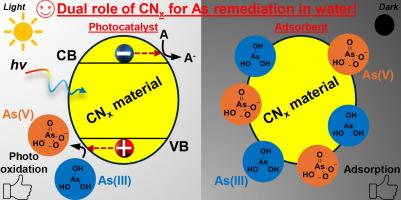
Carbon nitride (CNx) has recently gained widespread attention as a greener material for water remediation. The inherent biocompatibility of CNx coupled with its adsorption and photocatalytic abilities underscore its potential utilization to overcome the major challenge of arsenic (As) contamination in water. Nonetheless, CNx typically exhibits poor dispersibility in aqueous media, suppressing its effectiveness as both adsorbent and photocatalyst. Herein, we present the use of CNx and its modified counterpart as effective agents for remediating As(III) and As(V) in water. Our results reveal that both benchmark CNx (CNx0) and the modified CNx (CNx50) exhibit promising As remediation effectiveness driven by photooxidation and adsorption. CNx0 exhibits strong affinity for As(III) with an adsorption effectiveness of 89 %, whereas CNx50 demonstrates an adsorption effectiveness of 76 % for As(V). Notably, CNx50 outperforms CNx0 in the photoconversion of As(III) into As(V) under simulated solar irradiation and quasi-monochromatic irradiation due to its lower amount of trapped charges and improved water dispersibility. In fact, the more toxic As(III) species is remediated by CNx50 with an efficiency of 95 %, through the combination of photooxidation and adsorption. Overall, this study emphasizes, for the first time, the potential of CNx to integrate both photocatalysis and adsorption processes for As remediation, providing a simplistic approach to addressing As contamination in water.
期刊介绍:
Separation and Purification Technology is a premier journal committed to sharing innovative methods for separation and purification in chemical and environmental engineering, encompassing both homogeneous solutions and heterogeneous mixtures. Our scope includes the separation and/or purification of liquids, vapors, and gases, as well as carbon capture and separation techniques. However, it's important to note that methods solely intended for analytical purposes are not within the scope of the journal. Additionally, disciplines such as soil science, polymer science, and metallurgy fall outside the purview of Separation and Purification Technology. Join us in advancing the field of separation and purification methods for sustainable solutions in chemical and environmental engineering.




 京公网安备 11010802042870号
京ICP备2023020795号-1
京公网安备 11010802042870号
京ICP备2023020795号-1

 分享
分享
 求助内容:
求助内容: 应助结果提醒方式:
 扫码关注我们
