Shiyun Li, Jianping Li, Yongli Xiao, Hongpeng Ma, Yang Chen, Xia Jiang, Hualin Wang
{"title":"Separation and recovery of waste heat from millimeter-sized blast furnace slag in cyclone separators","authors":"Shiyun Li, Jianping Li, Yongli Xiao, Hongpeng Ma, Yang Chen, Xia Jiang, Hualin Wang","doi":"10.1016/j.seppur.2025.132908","DOIUrl":null,"url":null,"abstract":"Achieving green and energy-efficient heat separation and mitigating thermal pollution from slag with the temperature exceeding 1500 °C and the global annual production of 857 million tons, remains a formidable challenge for the iron and steel industry. To address this issue, this work introduces an innovative approach by leveraging the distinct characteristics of high-speed particle self-rotation and revolution driven by the cyclone separator for slag heat separation. In contrast to the traditional air blast method, the average heat separation coefficient is increased by up to 25.1 %, along with a 30.0 % reduction in energy consumption. This enhancement can be attributed to the cyclone-induced high-speed particle self-rotation behavior, reaching up to 14,459 rpm. The heat separation efficiency of the cyclone separator for blast furnace slag reaches 94.6 %. Moreover, this approach has been applied in a 60 t/h commercial slag disposal project, achieving high-value slag with 100 % glassy content and generating 25,952 kg/h superheated steam. As a result, 706.3 kg CO<sub>2</sub> emissions are reduced, surpassing the state-of-the-art centrifugal granulation technology (31.2 kg CO<sub>2</sub> emissions) per ten tonnes slag processed. Benefiting from the utilization of cyclone separator, an annual reduction of 420,712 GJ in waste thermal emissions has been achieved. This work paves a novel pathway for the green and energy-efficient separation and recovery of heat from the high-temperature slag for the iron and steel industry.","PeriodicalId":427,"journal":{"name":"Separation and Purification Technology","volume":"34 1","pages":""},"PeriodicalIF":9.0000,"publicationDate":"2025-04-08","publicationTypes":"Journal Article","fieldsOfStudy":null,"isOpenAccess":false,"openAccessPdf":"","citationCount":"0","resultStr":null,"platform":"Semanticscholar","paperid":null,"PeriodicalName":"Separation and Purification Technology","FirstCategoryId":"5","ListUrlMain":"https://doi.org/10.1016/j.seppur.2025.132908","RegionNum":1,"RegionCategory":"工程技术","ArticlePicture":[],"TitleCN":null,"AbstractTextCN":null,"PMCID":null,"EPubDate":"","PubModel":"","JCR":"Q1","JCRName":"ENGINEERING, CHEMICAL","Score":null,"Total":0}
引用次数: 0
Abstract
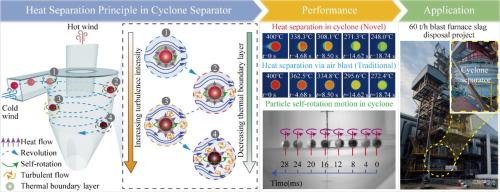
Achieving green and energy-efficient heat separation and mitigating thermal pollution from slag with the temperature exceeding 1500 °C and the global annual production of 857 million tons, remains a formidable challenge for the iron and steel industry. To address this issue, this work introduces an innovative approach by leveraging the distinct characteristics of high-speed particle self-rotation and revolution driven by the cyclone separator for slag heat separation. In contrast to the traditional air blast method, the average heat separation coefficient is increased by up to 25.1 %, along with a 30.0 % reduction in energy consumption. This enhancement can be attributed to the cyclone-induced high-speed particle self-rotation behavior, reaching up to 14,459 rpm. The heat separation efficiency of the cyclone separator for blast furnace slag reaches 94.6 %. Moreover, this approach has been applied in a 60 t/h commercial slag disposal project, achieving high-value slag with 100 % glassy content and generating 25,952 kg/h superheated steam. As a result, 706.3 kg CO2 emissions are reduced, surpassing the state-of-the-art centrifugal granulation technology (31.2 kg CO2 emissions) per ten tonnes slag processed. Benefiting from the utilization of cyclone separator, an annual reduction of 420,712 GJ in waste thermal emissions has been achieved. This work paves a novel pathway for the green and energy-efficient separation and recovery of heat from the high-temperature slag for the iron and steel industry.
期刊介绍:
Separation and Purification Technology is a premier journal committed to sharing innovative methods for separation and purification in chemical and environmental engineering, encompassing both homogeneous solutions and heterogeneous mixtures. Our scope includes the separation and/or purification of liquids, vapors, and gases, as well as carbon capture and separation techniques. However, it's important to note that methods solely intended for analytical purposes are not within the scope of the journal. Additionally, disciplines such as soil science, polymer science, and metallurgy fall outside the purview of Separation and Purification Technology. Join us in advancing the field of separation and purification methods for sustainable solutions in chemical and environmental engineering.




 京公网安备 11010802042870号
京ICP备2023020795号-1
京公网安备 11010802042870号
京ICP备2023020795号-1

 分享
分享
 求助内容:
求助内容: 应助结果提醒方式:
 扫码关注我们
