{"title":"Increased Ethylene Production by the Combination Technology of Targeted Catalytic Cracking to Olefins and Dehydration of Bioethanol Reaction","authors":"Ruilin Wang, Wenjie Yang, Youhao Xu, Xingtian Shu, Yongrui Wang, Yibin Luo, Enhui Xing, Ying Ouyang, Lina Zhou, Weixin Huang, Yunxing Bai","doi":"10.1021/acs.iecr.4c04659","DOIUrl":null,"url":null,"abstract":"Ethylene is mostly produced by the naphtha steam cracking (NSC) process, which has a higher cracking temperature, higher energy consumption, and strict requirements for raw materials. The targeted catalytic cracking to olefins (TCO) presents a new reaction pathway for ethylene production. The combined process of TCO and bioethanol dehydration reaction reduces methane yield by 16.51% and improves the utilization of carbon/hydrogen atoms by 23.67%/25.08% with the ethylene yield of 44.56%. Also, the reaction temperature of TCO/bioethanol dehydration reaction (670–740 °C/400 °C) is lower than that of NSC (750–900 °C). Especially, the AHZ-C catalyst with weak acid sites and increased distance between the acid sites blocked the protonation process of ethylene and improved the ethylene selectivity in the bioethanol dehydration reaction. The combination of TCO and ethanol dehydration reaction may be one of the effective technologies for producing ethylene.","PeriodicalId":39,"journal":{"name":"Industrial & Engineering Chemistry Research","volume":"25 1","pages":""},"PeriodicalIF":3.9000,"publicationDate":"2025-04-09","publicationTypes":"Journal Article","fieldsOfStudy":null,"isOpenAccess":false,"openAccessPdf":"","citationCount":"0","resultStr":null,"platform":"Semanticscholar","paperid":null,"PeriodicalName":"Industrial & Engineering Chemistry Research","FirstCategoryId":"5","ListUrlMain":"https://doi.org/10.1021/acs.iecr.4c04659","RegionNum":3,"RegionCategory":"工程技术","ArticlePicture":[],"TitleCN":null,"AbstractTextCN":null,"PMCID":null,"EPubDate":"","PubModel":"","JCR":"Q2","JCRName":"ENGINEERING, CHEMICAL","Score":null,"Total":0}
引用次数: 0
Abstract
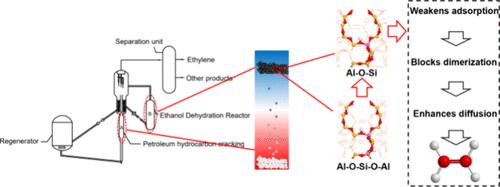
Ethylene is mostly produced by the naphtha steam cracking (NSC) process, which has a higher cracking temperature, higher energy consumption, and strict requirements for raw materials. The targeted catalytic cracking to olefins (TCO) presents a new reaction pathway for ethylene production. The combined process of TCO and bioethanol dehydration reaction reduces methane yield by 16.51% and improves the utilization of carbon/hydrogen atoms by 23.67%/25.08% with the ethylene yield of 44.56%. Also, the reaction temperature of TCO/bioethanol dehydration reaction (670–740 °C/400 °C) is lower than that of NSC (750–900 °C). Especially, the AHZ-C catalyst with weak acid sites and increased distance between the acid sites blocked the protonation process of ethylene and improved the ethylene selectivity in the bioethanol dehydration reaction. The combination of TCO and ethanol dehydration reaction may be one of the effective technologies for producing ethylene.
期刊介绍:
ndustrial & Engineering Chemistry, with variations in title and format, has been published since 1909 by the American Chemical Society. Industrial & Engineering Chemistry Research is a weekly publication that reports industrial and academic research in the broad fields of applied chemistry and chemical engineering with special focus on fundamentals, processes, and products.




 京公网安备 11010802042870号
京ICP备2023020795号-1
京公网安备 11010802042870号
京ICP备2023020795号-1

 分享
分享
 求助内容:
求助内容: 应助结果提醒方式:
 扫码关注我们
