{"title":"NO2 Reduction by HCN, HNC, and CN during Cofiring of Spent Pot Lining in Cement Plant: A DFT and Reaction Kinetics Study","authors":"Manjusha C. Padole, Abhijeet Raj","doi":"10.1021/acs.iecr.4c04765","DOIUrl":null,"url":null,"abstract":"Cement industries contribute significantly to greenhouse gas emissions, including nitrogen oxides (NO<sub><i>x</i></sub>) that pose serious risks to respiratory health and the environment and require effective reduction strategies. This study explores the potential of hydrogen cyanide (HCN) released from spent pot lining (SPL) during its cocombustion with coal in a cement kiln as an effective reducing agent to mitigate NO<sub>2</sub> emissions from the plant. A detailed reaction mechanism for the interactions of HCN, HNC, and CN with NO<sub>2</sub> is developed to form several possible products, including N<sub>2</sub>. The study employs a CBS-QB3 composite method and density functional theory (uB3LYP/6–311++G(d,p)) as tools for quantum chemical calculations to analyze the elementary reactions, optimize the structures of intermediate species and transition states, and determine their reaction energetics. The reaction kinetics of all the elementary steps are determined using transition state theory and RRKM methods to determine the preferred reactions among the competing channels. Through reactor simulations using the developed reaction mechanism, the possibility of NO<sub>2</sub> reduction by HCN and the most preferred pathway for it are reported. It is found that HCN is highly effective in reducing NO and NO<sub>2</sub> to N<sub>2</sub> under cement kiln conditions. The results suggest that the utilization of SPL in cement plants together with coal can reduce both coal requirements and NO<sub><i>x</i></sub> emission from the plant.","PeriodicalId":39,"journal":{"name":"Industrial & Engineering Chemistry Research","volume":"58 1","pages":""},"PeriodicalIF":3.9000,"publicationDate":"2025-04-09","publicationTypes":"Journal Article","fieldsOfStudy":null,"isOpenAccess":false,"openAccessPdf":"","citationCount":"0","resultStr":null,"platform":"Semanticscholar","paperid":null,"PeriodicalName":"Industrial & Engineering Chemistry Research","FirstCategoryId":"5","ListUrlMain":"https://doi.org/10.1021/acs.iecr.4c04765","RegionNum":3,"RegionCategory":"工程技术","ArticlePicture":[],"TitleCN":null,"AbstractTextCN":null,"PMCID":null,"EPubDate":"","PubModel":"","JCR":"Q2","JCRName":"ENGINEERING, CHEMICAL","Score":null,"Total":0}
引用次数: 0
Abstract
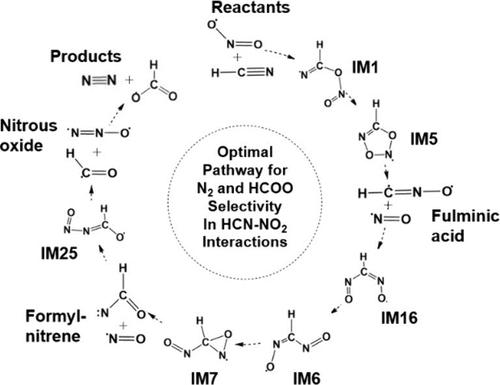
Cement industries contribute significantly to greenhouse gas emissions, including nitrogen oxides (NOx) that pose serious risks to respiratory health and the environment and require effective reduction strategies. This study explores the potential of hydrogen cyanide (HCN) released from spent pot lining (SPL) during its cocombustion with coal in a cement kiln as an effective reducing agent to mitigate NO2 emissions from the plant. A detailed reaction mechanism for the interactions of HCN, HNC, and CN with NO2 is developed to form several possible products, including N2. The study employs a CBS-QB3 composite method and density functional theory (uB3LYP/6–311++G(d,p)) as tools for quantum chemical calculations to analyze the elementary reactions, optimize the structures of intermediate species and transition states, and determine their reaction energetics. The reaction kinetics of all the elementary steps are determined using transition state theory and RRKM methods to determine the preferred reactions among the competing channels. Through reactor simulations using the developed reaction mechanism, the possibility of NO2 reduction by HCN and the most preferred pathway for it are reported. It is found that HCN is highly effective in reducing NO and NO2 to N2 under cement kiln conditions. The results suggest that the utilization of SPL in cement plants together with coal can reduce both coal requirements and NOx emission from the plant.
期刊介绍:
ndustrial & Engineering Chemistry, with variations in title and format, has been published since 1909 by the American Chemical Society. Industrial & Engineering Chemistry Research is a weekly publication that reports industrial and academic research in the broad fields of applied chemistry and chemical engineering with special focus on fundamentals, processes, and products.



 京公网安备 11010802042870号
京ICP备2023020795号-1
京公网安备 11010802042870号
京ICP备2023020795号-1

 分享
分享
 求助内容:
求助内容: 应助结果提醒方式:
 扫码关注我们
