Mei Wang , Zhenlin Jiang , Wenjun Wang , Wanyu Xie , Jizhe Liu , Jiaguo Li , Min Zhu , Jianping Yang , Ling Huang
{"title":"Reaction kinetics and application of polybutylene terephthalate alcoholysis for the preparation of recycled BHBT","authors":"Mei Wang , Zhenlin Jiang , Wenjun Wang , Wanyu Xie , Jizhe Liu , Jiaguo Li , Min Zhu , Jianping Yang , Ling Huang","doi":"10.1016/j.polymer.2025.128383","DOIUrl":null,"url":null,"abstract":"<div><div>Polybutylene terephthalate (PBT) is an important synthetic polymer in the plastics industry and is widely used in many fields. However, post-consumer PBT products are difficult to degrade in the natural environment, resulting in environmental pollution. Although traditional physical recycling methods can extend the life of the plastic, they degrade the material properties and cannot completely solve the environmental problems. In this paper, a novel chemical recycling process is proposed to convert waste PBT to bishydroxybutyl terephthalate (BHBT) through a controlled alcoholysis reaction, which is further used to produce high performance recycled PBT and poly(butyleneadipate-co-terephthalate) (PBAT). The process uses 1,4-butanediol (BDO) as a solvent and zinc acetate as a catalyst, which significantly improves the efficiency of alcoholysis. Under optimal conditions (zinc acetate content of 1 wt% PBT, PBT to BDO mass ratio of 1:4, alcoholysis temperature of 213 °C and alcoholysis time of 60 min), the conversion of PBT reached 93.5 % and the yield of BHBT was 65.1 %. The reaction kinetics study showed that the depolymerization reaction of PBT in BDO environment conformed to a first-order reaction kinetics model with an activation energy of 61.79 kJ/mol and a reaction kinetic constant of 0.02588 g (mol·min<sup>−1</sup>). The quantitative life cycle analysis (LCA) demonstrates that this process achieves a 45–50 % reduction in CO<sub>2</sub> emissions and 30–40 % cost savings. The alcoholysis process proposed in this paper has outstanding environmental and economic advantages. It not only avoids the generation of toxic gases from high-temperature thermal cracking, simplifies product separation and reduces the risk of secondary contamination, but also has mild reaction conditions, low energy consumption and catalyst cost, and is suitable for large-scale industrial application. Recycled BHBT can be used to produce high performance PBT and PBAT, reducing dependence on virgin raw materials and recycling resources. Economically, the process is commercially viable as it reduces raw material and waste disposal costs.</div></div>","PeriodicalId":405,"journal":{"name":"Polymer","volume":"327 ","pages":"Article 128383"},"PeriodicalIF":4.5000,"publicationDate":"2025-05-16","publicationTypes":"Journal Article","fieldsOfStudy":null,"isOpenAccess":false,"openAccessPdf":"","citationCount":"0","resultStr":null,"platform":"Semanticscholar","paperid":null,"PeriodicalName":"Polymer","FirstCategoryId":"92","ListUrlMain":"https://www.sciencedirect.com/science/article/pii/S0032386125003696","RegionNum":2,"RegionCategory":"化学","ArticlePicture":[],"TitleCN":null,"AbstractTextCN":null,"PMCID":null,"EPubDate":"2025/4/9 0:00:00","PubModel":"Epub","JCR":"Q2","JCRName":"POLYMER SCIENCE","Score":null,"Total":0}
引用次数: 0
Abstract
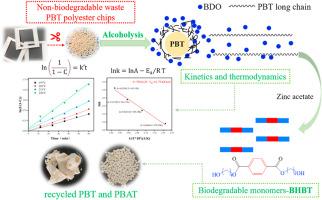
Polybutylene terephthalate (PBT) is an important synthetic polymer in the plastics industry and is widely used in many fields. However, post-consumer PBT products are difficult to degrade in the natural environment, resulting in environmental pollution. Although traditional physical recycling methods can extend the life of the plastic, they degrade the material properties and cannot completely solve the environmental problems. In this paper, a novel chemical recycling process is proposed to convert waste PBT to bishydroxybutyl terephthalate (BHBT) through a controlled alcoholysis reaction, which is further used to produce high performance recycled PBT and poly(butyleneadipate-co-terephthalate) (PBAT). The process uses 1,4-butanediol (BDO) as a solvent and zinc acetate as a catalyst, which significantly improves the efficiency of alcoholysis. Under optimal conditions (zinc acetate content of 1 wt% PBT, PBT to BDO mass ratio of 1:4, alcoholysis temperature of 213 °C and alcoholysis time of 60 min), the conversion of PBT reached 93.5 % and the yield of BHBT was 65.1 %. The reaction kinetics study showed that the depolymerization reaction of PBT in BDO environment conformed to a first-order reaction kinetics model with an activation energy of 61.79 kJ/mol and a reaction kinetic constant of 0.02588 g (mol·min−1). The quantitative life cycle analysis (LCA) demonstrates that this process achieves a 45–50 % reduction in CO2 emissions and 30–40 % cost savings. The alcoholysis process proposed in this paper has outstanding environmental and economic advantages. It not only avoids the generation of toxic gases from high-temperature thermal cracking, simplifies product separation and reduces the risk of secondary contamination, but also has mild reaction conditions, low energy consumption and catalyst cost, and is suitable for large-scale industrial application. Recycled BHBT can be used to produce high performance PBT and PBAT, reducing dependence on virgin raw materials and recycling resources. Economically, the process is commercially viable as it reduces raw material and waste disposal costs.
期刊介绍:
Polymer is an interdisciplinary journal dedicated to publishing innovative and significant advances in Polymer Physics, Chemistry and Technology. We welcome submissions on polymer hybrids, nanocomposites, characterisation and self-assembly. Polymer also publishes work on the technological application of polymers in energy and optoelectronics.
The main scope is covered but not limited to the following core areas:
Polymer Materials
Nanocomposites and hybrid nanomaterials
Polymer blends, films, fibres, networks and porous materials
Physical Characterization
Characterisation, modelling and simulation* of molecular and materials properties in bulk, solution, and thin films
Polymer Engineering
Advanced multiscale processing methods
Polymer Synthesis, Modification and Self-assembly
Including designer polymer architectures, mechanisms and kinetics, and supramolecular polymerization
Technological Applications
Polymers for energy generation and storage
Polymer membranes for separation technology
Polymers for opto- and microelectronics.




 京公网安备 11010802042870号
京ICP备2023020795号-1
京公网安备 11010802042870号
京ICP备2023020795号-1

 分享
分享
 求助内容:
求助内容: 应助结果提醒方式:
 扫码关注我们
