Shuang Liang , Dongyu Zhao , Xiangyu Liu , Bin Liu , Yuan Li
{"title":"The stomach, small intestine, and colon-specific gastrointestinal tract delivery systems for bioactive nutrients","authors":"Shuang Liang , Dongyu Zhao , Xiangyu Liu , Bin Liu , Yuan Li","doi":"10.1016/j.cis.2025.103503","DOIUrl":null,"url":null,"abstract":"<div><div>Oral administration is a convenient way to deliver bioactive nutrients. However, the complex and dynamic environment of the gastrointestinal (GI) tract poses distinct challenges. These include the acidic environment of the stomach, limited transport across the GI mucosa, and the risk of enzymatic degradation, all of which can compromise the nutritional effectiveness of orally delivered nutrients. In response to these challenges, various GI tract delivery systems have been developed to target specific regions, such as the stomach, small intestine, or colon, to precisely control the release of bioactive nutrients and enhance their health-promoting benefits. This review critically examines the principles underlying stomach-, small intestine-, and colon-targeted delivery systems, highlighting the selection of appropriate wall materials and the interactions between delivery systems and the mucosal epithelial barrier. Moreover, we describe relevant biological models and quantitative analyses to measure these interactions. In particular, we emphasize the significant advantages offered by colon-targeted delivery systems in maintaining a healthy colonic microenvironment. This review aims to inspire novel concepts and stimulate further research into GI tract delivery systems, offering promising avenues for maximizing the therapeutic effects of bioactive nutrients in practical applications.</div></div>","PeriodicalId":239,"journal":{"name":"Advances in Colloid and Interface Science","volume":"341 ","pages":"Article 103503"},"PeriodicalIF":19.3000,"publicationDate":"2025-07-01","publicationTypes":"Journal Article","fieldsOfStudy":null,"isOpenAccess":false,"openAccessPdf":"","citationCount":"0","resultStr":null,"platform":"Semanticscholar","paperid":null,"PeriodicalName":"Advances in Colloid and Interface Science","FirstCategoryId":"92","ListUrlMain":"https://www.sciencedirect.com/science/article/pii/S0001868625001149","RegionNum":1,"RegionCategory":"化学","ArticlePicture":[],"TitleCN":null,"AbstractTextCN":null,"PMCID":null,"EPubDate":"2025/4/1 0:00:00","PubModel":"Epub","JCR":"Q1","JCRName":"CHEMISTRY, PHYSICAL","Score":null,"Total":0}
引用次数: 0
Abstract
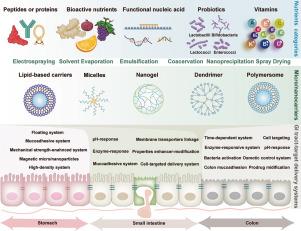
Oral administration is a convenient way to deliver bioactive nutrients. However, the complex and dynamic environment of the gastrointestinal (GI) tract poses distinct challenges. These include the acidic environment of the stomach, limited transport across the GI mucosa, and the risk of enzymatic degradation, all of which can compromise the nutritional effectiveness of orally delivered nutrients. In response to these challenges, various GI tract delivery systems have been developed to target specific regions, such as the stomach, small intestine, or colon, to precisely control the release of bioactive nutrients and enhance their health-promoting benefits. This review critically examines the principles underlying stomach-, small intestine-, and colon-targeted delivery systems, highlighting the selection of appropriate wall materials and the interactions between delivery systems and the mucosal epithelial barrier. Moreover, we describe relevant biological models and quantitative analyses to measure these interactions. In particular, we emphasize the significant advantages offered by colon-targeted delivery systems in maintaining a healthy colonic microenvironment. This review aims to inspire novel concepts and stimulate further research into GI tract delivery systems, offering promising avenues for maximizing the therapeutic effects of bioactive nutrients in practical applications.
期刊介绍:
"Advances in Colloid and Interface Science" is an international journal that focuses on experimental and theoretical developments in interfacial and colloidal phenomena. The journal covers a wide range of disciplines including biology, chemistry, physics, and technology.
The journal accepts review articles on any topic within the scope of colloid and interface science. These articles should provide an in-depth analysis of the subject matter, offering a critical review of the current state of the field. The author's informed opinion on the topic should also be included. The manuscript should compare and contrast ideas found in the reviewed literature and address the limitations of these ideas.
Typically, the articles published in this journal are written by recognized experts in the field.



 京公网安备 11010802042870号
京ICP备2023020795号-1
京公网安备 11010802042870号
京ICP备2023020795号-1

 分享
分享
 求助内容:
求助内容: 应助结果提醒方式:
 扫码关注我们
