Sarhan Khalil , Rebeka Strah , Arianna Lodovici , Petr Vojta , Jörg Ziegler , Maruša Pompe Novak , Laura Zanin , Nicola Tomasi , Astrid Forneck , Michaela Griesser
{"title":"Lime-induced iron deficiency stimulates a stronger response in tolerant grapevine rootstocks compared to low iron availability","authors":"Sarhan Khalil , Rebeka Strah , Arianna Lodovici , Petr Vojta , Jörg Ziegler , Maruša Pompe Novak , Laura Zanin , Nicola Tomasi , Astrid Forneck , Michaela Griesser","doi":"10.1016/j.stress.2025.100841","DOIUrl":null,"url":null,"abstract":"<div><div>Iron (Fe) is abundant in soil, but its bioavailability can be limited by environmental factors, negatively impacting plant growth and productivity. While root mechanisms for enhancing Fe uptake are well-studied in some model plants, the responses of tolerant and susceptible grapevine rootstocks to low Fe availability remain poorly understood. This study examined the responses of two grapevine rootstocks, Fercal (tolerant) and 3309C (susceptible), to three Fe conditions: direct Fe deficiency (−Fe), induced Fe deficiency through the addition of bicarbonate (+Fe+BIC), and control (+Fe). Our main findings include: 1) more severe leaf symptoms in 3309C than in Fercal independent of the type of stress, 2) overall growth reduction due to direct Fe deficiency (−Fe), while under induced Fe deficiency (+Fe+BIC) Fercal strongly increased root biomass. This observation is supported by the increased expression of root-development related genes <em>VviSAUR66</em> and <em>VviZAT6,</em> 3) enhanced organic acid contents under induced Fe deficiency (+Fe+BIC) and different organic acids profiles depending on applied stress and genotype, and 4) stronger modulation of gene expression in Fercal root tips, including enhanced expression of Fe mobilization and transport genes (<em>VviOPT3, VviIREG3, VviZIF1</em>). Overall, bicarbonate-induced Fe deficiency (+Fe+BIC) had greater negative effects than direct Fe deficiency (−Fe), with Fercal showing a higher adaptive capability to maintain Fe homeostasis.</div></div>","PeriodicalId":34736,"journal":{"name":"Plant Stress","volume":"16 ","pages":"Article 100841"},"PeriodicalIF":6.8000,"publicationDate":"2025-06-01","publicationTypes":"Journal Article","fieldsOfStudy":null,"isOpenAccess":false,"openAccessPdf":"","citationCount":"0","resultStr":null,"platform":"Semanticscholar","paperid":null,"PeriodicalName":"Plant Stress","FirstCategoryId":"1085","ListUrlMain":"https://www.sciencedirect.com/science/article/pii/S2667064X2500106X","RegionNum":0,"RegionCategory":null,"ArticlePicture":[],"TitleCN":null,"AbstractTextCN":null,"PMCID":null,"EPubDate":"2025/4/6 0:00:00","PubModel":"Epub","JCR":"Q1","JCRName":"PLANT SCIENCES","Score":null,"Total":0}
引用次数: 0
Abstract
Iron (Fe) is abundant in soil, but its bioavailability can be limited by environmental factors, negatively impacting plant growth and productivity. While root mechanisms for enhancing Fe uptake are well-studied in some model plants, the responses of tolerant and susceptible grapevine rootstocks to low Fe availability remain poorly understood. This study examined the responses of two grapevine rootstocks, Fercal (tolerant) and 3309C (susceptible), to three Fe conditions: direct Fe deficiency (−Fe), induced Fe deficiency through the addition of bicarbonate (+Fe+BIC), and control (+Fe). Our main findings include: 1) more severe leaf symptoms in 3309C than in Fercal independent of the type of stress, 2) overall growth reduction due to direct Fe deficiency (−Fe), while under induced Fe deficiency (+Fe+BIC) Fercal strongly increased root biomass. This observation is supported by the increased expression of root-development related genes VviSAUR66 and VviZAT6, 3) enhanced organic acid contents under induced Fe deficiency (+Fe+BIC) and different organic acids profiles depending on applied stress and genotype, and 4) stronger modulation of gene expression in Fercal root tips, including enhanced expression of Fe mobilization and transport genes (VviOPT3, VviIREG3, VviZIF1). Overall, bicarbonate-induced Fe deficiency (+Fe+BIC) had greater negative effects than direct Fe deficiency (−Fe), with Fercal showing a higher adaptive capability to maintain Fe homeostasis.
期刊介绍:
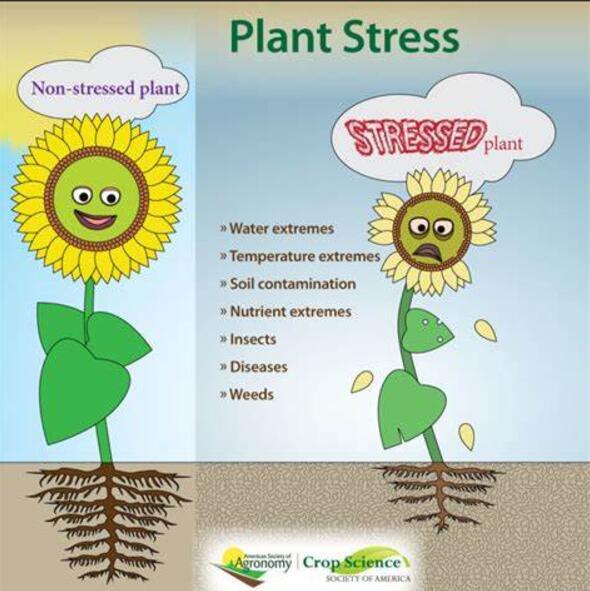
The journal Plant Stress deals with plant (or other photoautotrophs, such as algae, cyanobacteria and lichens) responses to abiotic and biotic stress factors that can result in limited growth and productivity. Such responses can be analyzed and described at a physiological, biochemical and molecular level. Experimental approaches/technologies aiming to improve growth and productivity with a potential for downstream validation under stress conditions will also be considered. Both fundamental and applied research manuscripts are welcome, provided that clear mechanistic hypotheses are made and descriptive approaches are avoided. In addition, high-quality review articles will also be considered, provided they follow a critical approach and stimulate thought for future research avenues.
Plant Stress welcomes high-quality manuscripts related (but not limited) to interactions between plants and:
Lack of water (drought) and excess (flooding),
Salinity stress,
Elevated temperature and/or low temperature (chilling and freezing),
Hypoxia and/or anoxia,
Mineral nutrient excess and/or deficiency,
Heavy metals and/or metalloids,
Plant priming (chemical, biological, physiological, nanomaterial, biostimulant) approaches for improved stress protection,
Viral, phytoplasma, bacterial and fungal plant-pathogen interactions.
The journal welcomes basic and applied research articles, as well as review articles and short communications. All submitted manuscripts will be subject to a thorough peer-reviewing process.



 京公网安备 11010802042870号
京ICP备2023020795号-1
京公网安备 11010802042870号
京ICP备2023020795号-1

 分享
分享
 求助内容:
求助内容: 应助结果提醒方式:
 扫码关注我们
