Fanny Coutelot , Daniel I. Kaplan , Annie B. Kersting , Mavrik Zavarin , Brian A. Powell
{"title":"Effect of seasonal anoxia on geochemical cycling in a stratified pond: Comparison to cooler pond conditions 40 years ago","authors":"Fanny Coutelot , Daniel I. Kaplan , Annie B. Kersting , Mavrik Zavarin , Brian A. Powell","doi":"10.1016/j.scitotenv.2025.179337","DOIUrl":null,"url":null,"abstract":"<div><div>Seasonal stratification in temperate lakes deeper than a few meters creates favorable conditions for pronounced vertical redox zones, often resulting in anaerobic hypolimnions and significant geochemical changes. This study examined thermocline formation and trace element behavior in a seasonally stratified pond amid rising air temperatures. Over two years, data were collected from Pond B at the US Department of Energy Savannah River Site in Aiken, South Carolina. Pond B, a man-made monomictic reservoir, received cooling water from a nuclear reactor from 1961 to 1964. Strong thermal stratification forms a distinct thermocline in May and progresses downward until November. Compared to the 1980s, this study shows a delayed onset and extended duration of stratification. The prolonged summer stratification reduces deep water oxygen replenishment, extending hypoxic conditions. Trace and major elements sampled in the water column revealed strong correlations between As, Fe, and Mn profiles, with concentrations increasing by 1–2 orders of magnitude in the anaerobic hypolimnion. This period captured the seasonal transition from winter mixing to summer stratification to fall overturn. Under anoxic conditions, Fe(III) reduces to Fe(II) in the sediment, releasing dissolved iron into the water column. The extended anoxic periods likely promoted arsenic release from sediments. Prolonged anoxia may enhance arsenic mobilization and solubility in the lake. This study illustrates how climate-induced changes in seasonal stratification of contaminated waters can convert contaminant sinks into sources, offering insights into the cycling of arsenic and other dissolved ions in stratified lakes and their implications for water quality management.</div></div>","PeriodicalId":422,"journal":{"name":"Science of the Total Environment","volume":"976 ","pages":"Article 179337"},"PeriodicalIF":8.0000,"publicationDate":"2025-05-10","publicationTypes":"Journal Article","fieldsOfStudy":null,"isOpenAccess":false,"openAccessPdf":"","citationCount":"0","resultStr":null,"platform":"Semanticscholar","paperid":null,"PeriodicalName":"Science of the Total Environment","FirstCategoryId":"93","ListUrlMain":"https://www.sciencedirect.com/science/article/pii/S0048969725009738","RegionNum":1,"RegionCategory":"环境科学与生态学","ArticlePicture":[],"TitleCN":null,"AbstractTextCN":null,"PMCID":null,"EPubDate":"2025/4/9 0:00:00","PubModel":"Epub","JCR":"Q1","JCRName":"ENVIRONMENTAL SCIENCES","Score":null,"Total":0}
引用次数: 0
Abstract
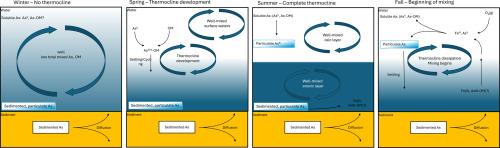
Seasonal stratification in temperate lakes deeper than a few meters creates favorable conditions for pronounced vertical redox zones, often resulting in anaerobic hypolimnions and significant geochemical changes. This study examined thermocline formation and trace element behavior in a seasonally stratified pond amid rising air temperatures. Over two years, data were collected from Pond B at the US Department of Energy Savannah River Site in Aiken, South Carolina. Pond B, a man-made monomictic reservoir, received cooling water from a nuclear reactor from 1961 to 1964. Strong thermal stratification forms a distinct thermocline in May and progresses downward until November. Compared to the 1980s, this study shows a delayed onset and extended duration of stratification. The prolonged summer stratification reduces deep water oxygen replenishment, extending hypoxic conditions. Trace and major elements sampled in the water column revealed strong correlations between As, Fe, and Mn profiles, with concentrations increasing by 1–2 orders of magnitude in the anaerobic hypolimnion. This period captured the seasonal transition from winter mixing to summer stratification to fall overturn. Under anoxic conditions, Fe(III) reduces to Fe(II) in the sediment, releasing dissolved iron into the water column. The extended anoxic periods likely promoted arsenic release from sediments. Prolonged anoxia may enhance arsenic mobilization and solubility in the lake. This study illustrates how climate-induced changes in seasonal stratification of contaminated waters can convert contaminant sinks into sources, offering insights into the cycling of arsenic and other dissolved ions in stratified lakes and their implications for water quality management.
期刊介绍:
The Science of the Total Environment is an international journal dedicated to scientific research on the environment and its interaction with humanity. It covers a wide range of disciplines and seeks to publish innovative, hypothesis-driven, and impactful research that explores the entire environment, including the atmosphere, lithosphere, hydrosphere, biosphere, and anthroposphere.
The journal's updated Aims & Scope emphasizes the importance of interdisciplinary environmental research with broad impact. Priority is given to studies that advance fundamental understanding and explore the interconnectedness of multiple environmental spheres. Field studies are preferred, while laboratory experiments must demonstrate significant methodological advancements or mechanistic insights with direct relevance to the environment.



 京公网安备 11010802042870号
京ICP备2023020795号-1
京公网安备 11010802042870号
京ICP备2023020795号-1

 分享
分享
 求助内容:
求助内容: 应助结果提醒方式:
 扫码关注我们
