Potential environmental transmission of antibiotic-resistant Escherichia coli and Enterococcus faecium harbouring multiple antibiotic resistance genes and mobile genetic elements in surface waters close to informal settlements: A tale of two cities
Fulufhelo N. Mukwevho , J. Mbanga , Linda A. Bester , Arshad Ismail , Sabiha Y. Essack , Akebe L.K. Abia
{"title":"Potential environmental transmission of antibiotic-resistant Escherichia coli and Enterococcus faecium harbouring multiple antibiotic resistance genes and mobile genetic elements in surface waters close to informal settlements: A tale of two cities","authors":"Fulufhelo N. Mukwevho , J. Mbanga , Linda A. Bester , Arshad Ismail , Sabiha Y. Essack , Akebe L.K. Abia","doi":"10.1016/j.scitotenv.2025.179321","DOIUrl":null,"url":null,"abstract":"<div><div>Aquatic environments, including wastewater and surface water (rivers and streams), increasingly harbour third-generation cephalosporin-resistant <em>Escherichia coli</em> and drug-resistant <em>Enterococcus faecium</em>, presenting a transmission risk to humans, animals, and plants. We investigated the resistome, mobilome, and phylogenetic relationships of antibiotic-resistant <em>E. coli</em> and <em>E. faecium</em> in surface water from two cities using whole genome sequencing (WGS). Water samples (500 mL) from streams near informal settlements in Durban and Pietermaritzburg were filtered through 0.45 μm membrane filters. <em>E. faecium</em> and <em>E. coli</em> were identified on selective media and tested for antibiotic susceptibility using the VITEK® 2 platform. DNA was extracted from isolates for WGS to delineate the resistome, mobilome, multi-locus strain types (STs) and phylogenetic relationships using the open-source CARD, CGE, RAST, BV-BRC and PubMLST tools. Eleven <em>E. faecium</em> and 12 <em>E. coli</em> isolates were molecularly identified. Antibiotic resistance was observed in seven <em>E. coli</em> belonging to two STs and seven <em>E. faecium</em> belonging to five STs. Third and fourth-generation cephalosporin-resistant <em>E. coli</em> (3/7) were found in Durban. These isolates did not harbour extended-spectrum β-lactamase genes conferring cephalosporin resistance but had the AcrAB-TolC efflux pump for multiple antibiotic resistance. <em>E. coli</em> harboured <em>bla</em>TEM-1, <em>sul</em>1, <em>sul</em>3, and <em>dfr</em>A12, conferring resistance to amoxicillin-clavulanic acid, piperacillin-tazobactam and cotrimoxazole, respectively. Also, <em>E. faecium</em> harboured <em>qnr</em>B19, <em>qnr</em>S1, <em>tet</em>(A), <em>cml</em>A1, <em>aad</em>A1 and <em>aad</em>A2. <em>tet</em>(M), <em>tet</em>(L), <em>msr</em>(C) and <em>erm</em>(B) conferring resistance to tetracycline and erythromycin, respectively. ARGs and MGEs in <em>E. faecium</em> were mostly chromosome-borne. Plasmid-carried ARGs were associated with IS1, IS1B, IS6, IS256 and ISKpn19, and the Tn3 transposons in <em>E. coli</em>. Phylogenetic analysis revealed close relationships with other South African human, animal and environmental isolates. These ARGs, associated with MGEs, present possible transmission routes of these resistance genes within and across bacterial species in aquatic environments, making these surface waters potential reservoirs for antibiotic resistance transmission.</div></div>","PeriodicalId":422,"journal":{"name":"Science of the Total Environment","volume":"976 ","pages":"Article 179321"},"PeriodicalIF":8.0000,"publicationDate":"2025-05-10","publicationTypes":"Journal Article","fieldsOfStudy":null,"isOpenAccess":false,"openAccessPdf":"","citationCount":"0","resultStr":null,"platform":"Semanticscholar","paperid":null,"PeriodicalName":"Science of the Total Environment","FirstCategoryId":"93","ListUrlMain":"https://www.sciencedirect.com/science/article/pii/S004896972500957X","RegionNum":1,"RegionCategory":"环境科学与生态学","ArticlePicture":[],"TitleCN":null,"AbstractTextCN":null,"PMCID":null,"EPubDate":"2025/4/9 0:00:00","PubModel":"Epub","JCR":"Q1","JCRName":"ENVIRONMENTAL SCIENCES","Score":null,"Total":0}
引用次数: 0
Abstract
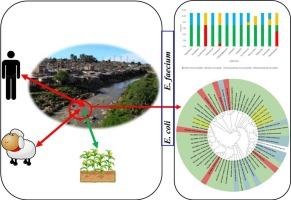
Aquatic environments, including wastewater and surface water (rivers and streams), increasingly harbour third-generation cephalosporin-resistant Escherichia coli and drug-resistant Enterococcus faecium, presenting a transmission risk to humans, animals, and plants. We investigated the resistome, mobilome, and phylogenetic relationships of antibiotic-resistant E. coli and E. faecium in surface water from two cities using whole genome sequencing (WGS). Water samples (500 mL) from streams near informal settlements in Durban and Pietermaritzburg were filtered through 0.45 μm membrane filters. E. faecium and E. coli were identified on selective media and tested for antibiotic susceptibility using the VITEK® 2 platform. DNA was extracted from isolates for WGS to delineate the resistome, mobilome, multi-locus strain types (STs) and phylogenetic relationships using the open-source CARD, CGE, RAST, BV-BRC and PubMLST tools. Eleven E. faecium and 12 E. coli isolates were molecularly identified. Antibiotic resistance was observed in seven E. coli belonging to two STs and seven E. faecium belonging to five STs. Third and fourth-generation cephalosporin-resistant E. coli (3/7) were found in Durban. These isolates did not harbour extended-spectrum β-lactamase genes conferring cephalosporin resistance but had the AcrAB-TolC efflux pump for multiple antibiotic resistance. E. coli harboured blaTEM-1, sul1, sul3, and dfrA12, conferring resistance to amoxicillin-clavulanic acid, piperacillin-tazobactam and cotrimoxazole, respectively. Also, E. faecium harboured qnrB19, qnrS1, tet(A), cmlA1, aadA1 and aadA2. tet(M), tet(L), msr(C) and erm(B) conferring resistance to tetracycline and erythromycin, respectively. ARGs and MGEs in E. faecium were mostly chromosome-borne. Plasmid-carried ARGs were associated with IS1, IS1B, IS6, IS256 and ISKpn19, and the Tn3 transposons in E. coli. Phylogenetic analysis revealed close relationships with other South African human, animal and environmental isolates. These ARGs, associated with MGEs, present possible transmission routes of these resistance genes within and across bacterial species in aquatic environments, making these surface waters potential reservoirs for antibiotic resistance transmission.
期刊介绍:
The Science of the Total Environment is an international journal dedicated to scientific research on the environment and its interaction with humanity. It covers a wide range of disciplines and seeks to publish innovative, hypothesis-driven, and impactful research that explores the entire environment, including the atmosphere, lithosphere, hydrosphere, biosphere, and anthroposphere.
The journal's updated Aims & Scope emphasizes the importance of interdisciplinary environmental research with broad impact. Priority is given to studies that advance fundamental understanding and explore the interconnectedness of multiple environmental spheres. Field studies are preferred, while laboratory experiments must demonstrate significant methodological advancements or mechanistic insights with direct relevance to the environment.



 京公网安备 11010802042870号
京ICP备2023020795号-1
京公网安备 11010802042870号
京ICP备2023020795号-1

 分享
分享
 求助内容:
求助内容: 应助结果提醒方式:
 扫码关注我们
