Dimitra Tsakiri , Konstantinos Kotsaridis , Vassiliki A. Michalopoulou , Ning Zhang , Sotiris Marinos , Nikos Kountourakis , Michael Kokkinidis , Gregory B. Martin , Panagiotis F. Sarris
{"title":"Subcellular targets and recognition mechanism of Ralstonia solanacearum effector RipE1","authors":"Dimitra Tsakiri , Konstantinos Kotsaridis , Vassiliki A. Michalopoulou , Ning Zhang , Sotiris Marinos , Nikos Kountourakis , Michael Kokkinidis , Gregory B. Martin , Panagiotis F. Sarris","doi":"10.1016/j.isci.2025.112307","DOIUrl":null,"url":null,"abstract":"<div><div>Some plant NLRs carry unusual integrated protein domains (IDs) that mimic host targets of pathogen effectors. RipE1 is a core <em>Ralstonia solanacearum</em> Type III effector with a predicted cysteine protease activity that activates defense responses in resistant plants. In this study, we used a library of NLR-IDs as an investigative tool to screen for potential host-cell targets of RipE1. Based on these findings and the effector’s localization, we identified two plant membrane trafficking components as RipE1’s subcellular targets. Depending on its protease activity, RipE1 promotes the degradation of both exocyst complex subunit Exo70B1 and its known interactor RPM1-interacting protein-4 (RIN4), a known plant immunity regulator. RipE1 protease activity is recognized by the RIN4-guarding NLR <em>Pseudomonas</em> tomato race 1 (Ptr1) in <em>Nicotiana benthamiana</em>. Overall, the data presented here, along with the existing literature, suggest a possible link between RipE1 activity upon the host secretion machinery and its NLR-mediated recognition.</div></div>","PeriodicalId":342,"journal":{"name":"iScience","volume":"28 5","pages":"Article 112307"},"PeriodicalIF":4.1000,"publicationDate":"2025-05-16","publicationTypes":"Journal Article","fieldsOfStudy":null,"isOpenAccess":false,"openAccessPdf":"","citationCount":"0","resultStr":null,"platform":"Semanticscholar","paperid":null,"PeriodicalName":"iScience","FirstCategoryId":"103","ListUrlMain":"https://www.sciencedirect.com/science/article/pii/S2589004225005681","RegionNum":2,"RegionCategory":"综合性期刊","ArticlePicture":[],"TitleCN":null,"AbstractTextCN":null,"PMCID":null,"EPubDate":"2025/3/28 0:00:00","PubModel":"Epub","JCR":"Q1","JCRName":"MULTIDISCIPLINARY SCIENCES","Score":null,"Total":0}
引用次数: 0
Abstract
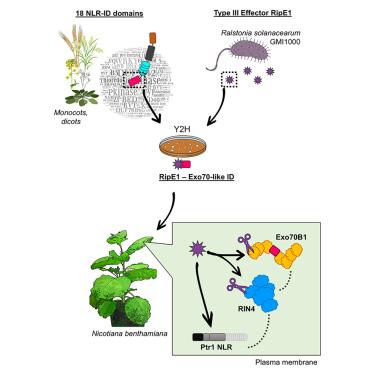
Some plant NLRs carry unusual integrated protein domains (IDs) that mimic host targets of pathogen effectors. RipE1 is a core Ralstonia solanacearum Type III effector with a predicted cysteine protease activity that activates defense responses in resistant plants. In this study, we used a library of NLR-IDs as an investigative tool to screen for potential host-cell targets of RipE1. Based on these findings and the effector’s localization, we identified two plant membrane trafficking components as RipE1’s subcellular targets. Depending on its protease activity, RipE1 promotes the degradation of both exocyst complex subunit Exo70B1 and its known interactor RPM1-interacting protein-4 (RIN4), a known plant immunity regulator. RipE1 protease activity is recognized by the RIN4-guarding NLR Pseudomonas tomato race 1 (Ptr1) in Nicotiana benthamiana. Overall, the data presented here, along with the existing literature, suggest a possible link between RipE1 activity upon the host secretion machinery and its NLR-mediated recognition.
期刊介绍:
Science has many big remaining questions. To address them, we will need to work collaboratively and across disciplines. The goal of iScience is to help fuel that type of interdisciplinary thinking. iScience is a new open-access journal from Cell Press that provides a platform for original research in the life, physical, and earth sciences. The primary criterion for publication in iScience is a significant contribution to a relevant field combined with robust results and underlying methodology. The advances appearing in iScience include both fundamental and applied investigations across this interdisciplinary range of topic areas. To support transparency in scientific investigation, we are happy to consider replication studies and papers that describe negative results.
We know you want your work to be published quickly and to be widely visible within your community and beyond. With the strong international reputation of Cell Press behind it, publication in iScience will help your work garner the attention and recognition it merits. Like all Cell Press journals, iScience prioritizes rapid publication. Our editorial team pays special attention to high-quality author service and to efficient, clear-cut decisions based on the information available within the manuscript. iScience taps into the expertise across Cell Press journals and selected partners to inform our editorial decisions and help publish your science in a timely and seamless way.




 京公网安备 11010802042870号
京ICP备2023020795号-1
京公网安备 11010802042870号
京ICP备2023020795号-1

 分享
分享
 求助内容:
求助内容: 应助结果提醒方式:
 扫码关注我们
