{"title":"Agriculture driven rural-to-urban migration trends among farmers impacting urban policy development in Northern India","authors":"Sushmita Saini , Rajarshi Roy Burman , Rabindra Nath Padaria , Girijesh Singh Mahra , Sitaram Bishnoi , Smruti Ranjan Padhan , Sonali Mallick , Sweety Mukherjee","doi":"10.1016/j.cities.2025.105960","DOIUrl":null,"url":null,"abstract":"<div><div>The agricultural migration in the Northern India was quite significant and was driven by multifaceted factors especially aftermath COVID-19 pandemic. However, only the push-pull factors of migration leaving the psychological factors of migration was explored earlier. Hence, the study was framed to address this research gap by examining migration behavior using the traditional constructs of Theory of Planned Behavior (TPB). We extended the TPB framework with two additional constructs: household decision-making and engagement of women in agriculture. For extracting the latent constructs, 480 migrant farmer's data were analyzed through exploratory factor analysis and hypothesis testing using confirmatory factor analysis and structural equation modeling. The measurement and structural model of TPB framework have significant association between traditional and extended constructs. The finding revealed that in Northern India, migrant farmers demonstrate inter-state migration behavior. The comparison of migration behavior highlights that cities must adopt differentiated policies to address the diverse needs of seasonal, forced, and voluntary migrant farmers. For seasonal migrants, cities must focus on housing, labor rights, and access to social services (short-term policies), whereas for forced migrants, the targeted interventions for skill-building, and resilience planning to address sudden urban population surges needed (crisis management policies). While for voluntary migrants, cities must focus on inclusive urban development, infrastructure expansion, and economic integration to support sustainable urbanization (long-term policies). These finding are significant in fostering a more resilient and equitable society through sustainable rural development for human settlements and achieving Sustainable Development Goals.</div></div>","PeriodicalId":48405,"journal":{"name":"Cities","volume":"162 ","pages":"Article 105960"},"PeriodicalIF":6.6000,"publicationDate":"2025-04-10","publicationTypes":"Journal Article","fieldsOfStudy":null,"isOpenAccess":false,"openAccessPdf":"","citationCount":"0","resultStr":null,"platform":"Semanticscholar","paperid":null,"PeriodicalName":"Cities","FirstCategoryId":"96","ListUrlMain":"https://www.sciencedirect.com/science/article/pii/S0264275125002604","RegionNum":1,"RegionCategory":"经济学","ArticlePicture":[],"TitleCN":null,"AbstractTextCN":null,"PMCID":null,"EPubDate":"","PubModel":"","JCR":"Q1","JCRName":"URBAN STUDIES","Score":null,"Total":0}
引用次数: 0
Abstract
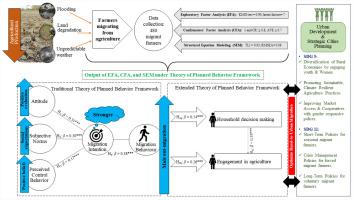
The agricultural migration in the Northern India was quite significant and was driven by multifaceted factors especially aftermath COVID-19 pandemic. However, only the push-pull factors of migration leaving the psychological factors of migration was explored earlier. Hence, the study was framed to address this research gap by examining migration behavior using the traditional constructs of Theory of Planned Behavior (TPB). We extended the TPB framework with two additional constructs: household decision-making and engagement of women in agriculture. For extracting the latent constructs, 480 migrant farmer's data were analyzed through exploratory factor analysis and hypothesis testing using confirmatory factor analysis and structural equation modeling. The measurement and structural model of TPB framework have significant association between traditional and extended constructs. The finding revealed that in Northern India, migrant farmers demonstrate inter-state migration behavior. The comparison of migration behavior highlights that cities must adopt differentiated policies to address the diverse needs of seasonal, forced, and voluntary migrant farmers. For seasonal migrants, cities must focus on housing, labor rights, and access to social services (short-term policies), whereas for forced migrants, the targeted interventions for skill-building, and resilience planning to address sudden urban population surges needed (crisis management policies). While for voluntary migrants, cities must focus on inclusive urban development, infrastructure expansion, and economic integration to support sustainable urbanization (long-term policies). These finding are significant in fostering a more resilient and equitable society through sustainable rural development for human settlements and achieving Sustainable Development Goals.
期刊介绍:
Cities offers a comprehensive range of articles on all aspects of urban policy. It provides an international and interdisciplinary platform for the exchange of ideas and information between urban planners and policy makers from national and local government, non-government organizations, academia and consultancy. The primary aims of the journal are to analyse and assess past and present urban development and management as a reflection of effective, ineffective and non-existent planning policies; and the promotion of the implementation of appropriate urban policies in both the developed and the developing world.



 京公网安备 11010802042870号
京ICP备2023020795号-1
京公网安备 11010802042870号
京ICP备2023020795号-1

 分享
分享
 求助内容:
求助内容: 应助结果提醒方式:
 扫码关注我们
