Aaron M. Praiss , Lea A. Moukarzel , Yingjie Zhu , Ana Leda F. Longhini , Fatemeh Derakhshan , Timothy Hoang , Giulio Pesci , Hunter Green , Melih A. Ozsoy , Etta Hanlon , Ryan Kahn , Melica Nourmoussavi Brodeur , Tiffany Sia , Nadeem R. Abu-Rustum , Ginger Gardner , Kara Long Roche , Yukio Sonoda , Oliver Zivanovic , Dennis S. Chi , Taha Merghoub , Dmitriy Zamarin
{"title":"Evolution of tumor stress response during cytoreductive surgery for ovarian cancer","authors":"Aaron M. Praiss , Lea A. Moukarzel , Yingjie Zhu , Ana Leda F. Longhini , Fatemeh Derakhshan , Timothy Hoang , Giulio Pesci , Hunter Green , Melih A. Ozsoy , Etta Hanlon , Ryan Kahn , Melica Nourmoussavi Brodeur , Tiffany Sia , Nadeem R. Abu-Rustum , Ginger Gardner , Kara Long Roche , Yukio Sonoda , Oliver Zivanovic , Dennis S. Chi , Taha Merghoub , Dmitriy Zamarin","doi":"10.1016/j.isci.2025.112317","DOIUrl":null,"url":null,"abstract":"<div><div>Upfront treatment for patients with advanced high-grade serous ovarian cancer (HGSOC) includes a multi-hour cytoreductive surgery. Although the procedure is necessary for maximal tumor cytoreduction, understanding of the biology of systemic and intratumoral responses induced by surgical cytoreduction is limited. Through analysis of matched tumor and normal tissues and peripheral blood collected at multiple time points during cytoreductive surgery in patients with HGSOC, we demonstrate that surgery leads to rapid induction of systemic inflammatory response and activation of inflammatory signaling in the tumor and normal tissue, with interleukin-6 emerging as a dominant inflammatory pathway. A parallel study in a syngeneic murine HGSOC model recapitulated these findings and demonstrated accelerated tumor growth in response to surgery. This study highlights the previously unappreciated impact of specimen collection timing on the tumor signaling networks and provides insights into stress pathways activated by surgery, generating rationale for perioperative therapeutic interventions to reduce protumorigenic effects.</div></div>","PeriodicalId":342,"journal":{"name":"iScience","volume":"28 5","pages":"Article 112317"},"PeriodicalIF":4.1000,"publicationDate":"2025-03-28","publicationTypes":"Journal Article","fieldsOfStudy":null,"isOpenAccess":false,"openAccessPdf":"","citationCount":"0","resultStr":null,"platform":"Semanticscholar","paperid":null,"PeriodicalName":"iScience","FirstCategoryId":"103","ListUrlMain":"https://www.sciencedirect.com/science/article/pii/S2589004225005784","RegionNum":2,"RegionCategory":"综合性期刊","ArticlePicture":[],"TitleCN":null,"AbstractTextCN":null,"PMCID":null,"EPubDate":"","PubModel":"","JCR":"Q1","JCRName":"MULTIDISCIPLINARY SCIENCES","Score":null,"Total":0}
引用次数: 0
Abstract
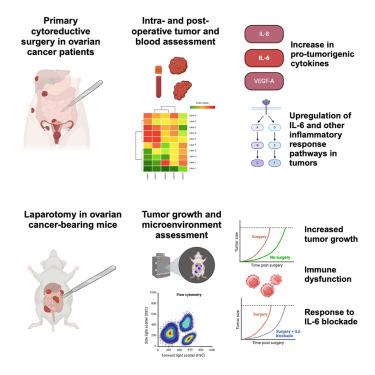
Upfront treatment for patients with advanced high-grade serous ovarian cancer (HGSOC) includes a multi-hour cytoreductive surgery. Although the procedure is necessary for maximal tumor cytoreduction, understanding of the biology of systemic and intratumoral responses induced by surgical cytoreduction is limited. Through analysis of matched tumor and normal tissues and peripheral blood collected at multiple time points during cytoreductive surgery in patients with HGSOC, we demonstrate that surgery leads to rapid induction of systemic inflammatory response and activation of inflammatory signaling in the tumor and normal tissue, with interleukin-6 emerging as a dominant inflammatory pathway. A parallel study in a syngeneic murine HGSOC model recapitulated these findings and demonstrated accelerated tumor growth in response to surgery. This study highlights the previously unappreciated impact of specimen collection timing on the tumor signaling networks and provides insights into stress pathways activated by surgery, generating rationale for perioperative therapeutic interventions to reduce protumorigenic effects.
期刊介绍:
Science has many big remaining questions. To address them, we will need to work collaboratively and across disciplines. The goal of iScience is to help fuel that type of interdisciplinary thinking. iScience is a new open-access journal from Cell Press that provides a platform for original research in the life, physical, and earth sciences. The primary criterion for publication in iScience is a significant contribution to a relevant field combined with robust results and underlying methodology. The advances appearing in iScience include both fundamental and applied investigations across this interdisciplinary range of topic areas. To support transparency in scientific investigation, we are happy to consider replication studies and papers that describe negative results.
We know you want your work to be published quickly and to be widely visible within your community and beyond. With the strong international reputation of Cell Press behind it, publication in iScience will help your work garner the attention and recognition it merits. Like all Cell Press journals, iScience prioritizes rapid publication. Our editorial team pays special attention to high-quality author service and to efficient, clear-cut decisions based on the information available within the manuscript. iScience taps into the expertise across Cell Press journals and selected partners to inform our editorial decisions and help publish your science in a timely and seamless way.



 京公网安备 11010802042870号
京ICP备2023020795号-1
京公网安备 11010802042870号
京ICP备2023020795号-1

 分享
分享
 求助内容:
求助内容: 应助结果提醒方式:
 扫码关注我们
