Aaron Albert Aryee , Alam Venugopal Narendra Kumar , Won Sik Shin
{"title":"Novel hemin-derived Fe/N–C magnetic catalyst for enhanced peroxymonosulfate activation and diclofenac degradation","authors":"Aaron Albert Aryee , Alam Venugopal Narendra Kumar , Won Sik Shin","doi":"10.1016/j.chemosphere.2025.144388","DOIUrl":null,"url":null,"abstract":"<div><div>In this study, Fe involved N-doped carbon catalysts labelled as PA@Hem<sub>x</sub> (x = pyrolysis temperature) was synthesized through a one-step pyrolysis of hemin (Hem) and polyacrylate (PA). The reported method enables high dispersion and exposure of both Fe and N active sites on PA derived carbon. The PA@Hem<sub>x</sub> samples were then used for peroxymonosulfate (PMS) activated diclofenac (DCF) degradation. Results from the characterization studies verified the successful incorporation of hemin in the composite. Approximately 99.2 % DCF degradation at pH = 6.01 was achieved in 60 min using 0.1 g L<sup>−1</sup> PA@Hem<sub>700</sub> and 1.0 mM PMS. The pseudo-second-order kinetic model and Langmuir model were used to described the uptake and equilibrium process in DCF/PA@Hem<sub>700</sub> system. Scavenging and electron-spin-resonance studies showed a non-radical singlet oxygen species (<sup>1</sup>O<sub>2</sub>) dominates over <sup>•</sup>OH and SO<sub>4</sub><sup>•−</sup> radicals in the system. The role of electron transfer was also verified via chronoamperometry and electrochemical-impedance spectroscopy techniques. Furthermore, the PA@Hem<sub>700</sub>/PMS remained highly active towards DCF degradation even in the presence of common anions, humic acid, and various water matrices. The developed catalyst exhibited a TOC removal of 65.8 %. The study also established the potential of PA@Hem<sub>700</sub>/PMS to degrade other organic pollutants (e.g., tetracycline (TC), simazine (SIM), and sulfamethoxazole (SMX)). The results from this study are expected to advance research on synthesizing other novel polymer-based Fe/N–C catalysts for degrading organic pollutants.</div></div>","PeriodicalId":276,"journal":{"name":"Chemosphere","volume":"378 ","pages":"Article 144388"},"PeriodicalIF":8.1000,"publicationDate":"2025-06-01","publicationTypes":"Journal Article","fieldsOfStudy":null,"isOpenAccess":false,"openAccessPdf":"","citationCount":"0","resultStr":null,"platform":"Semanticscholar","paperid":null,"PeriodicalName":"Chemosphere","FirstCategoryId":"93","ListUrlMain":"https://www.sciencedirect.com/science/article/pii/S0045653525003315","RegionNum":2,"RegionCategory":"环境科学与生态学","ArticlePicture":[],"TitleCN":null,"AbstractTextCN":null,"PMCID":null,"EPubDate":"2025/4/10 0:00:00","PubModel":"Epub","JCR":"Q1","JCRName":"ENVIRONMENTAL SCIENCES","Score":null,"Total":0}
引用次数: 0
Abstract
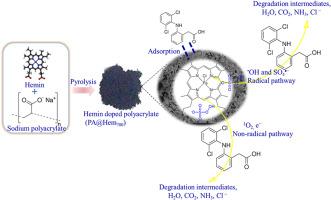
In this study, Fe involved N-doped carbon catalysts labelled as PA@Hemx (x = pyrolysis temperature) was synthesized through a one-step pyrolysis of hemin (Hem) and polyacrylate (PA). The reported method enables high dispersion and exposure of both Fe and N active sites on PA derived carbon. The PA@Hemx samples were then used for peroxymonosulfate (PMS) activated diclofenac (DCF) degradation. Results from the characterization studies verified the successful incorporation of hemin in the composite. Approximately 99.2 % DCF degradation at pH = 6.01 was achieved in 60 min using 0.1 g L−1 PA@Hem700 and 1.0 mM PMS. The pseudo-second-order kinetic model and Langmuir model were used to described the uptake and equilibrium process in DCF/PA@Hem700 system. Scavenging and electron-spin-resonance studies showed a non-radical singlet oxygen species (1O2) dominates over •OH and SO4•− radicals in the system. The role of electron transfer was also verified via chronoamperometry and electrochemical-impedance spectroscopy techniques. Furthermore, the PA@Hem700/PMS remained highly active towards DCF degradation even in the presence of common anions, humic acid, and various water matrices. The developed catalyst exhibited a TOC removal of 65.8 %. The study also established the potential of PA@Hem700/PMS to degrade other organic pollutants (e.g., tetracycline (TC), simazine (SIM), and sulfamethoxazole (SMX)). The results from this study are expected to advance research on synthesizing other novel polymer-based Fe/N–C catalysts for degrading organic pollutants.
期刊介绍:
Chemosphere, being an international multidisciplinary journal, is dedicated to publishing original communications and review articles on chemicals in the environment. The scope covers a wide range of topics, including the identification, quantification, behavior, fate, toxicology, treatment, and remediation of chemicals in the bio-, hydro-, litho-, and atmosphere, ensuring the broad dissemination of research in this field.



 京公网安备 11010802042870号
京ICP备2023020795号-1
京公网安备 11010802042870号
京ICP备2023020795号-1

 分享
分享
 求助内容:
求助内容: 应助结果提醒方式:
 扫码关注我们
