Luis Vélez-Trujillo , Luca Carisio , Ewa Popiela , Lars Straub , Simone Tosi
{"title":"Romance in peril: A common pesticide impairs mating behaviours and male fertility of solitary bees (Osmia bicornis)","authors":"Luis Vélez-Trujillo , Luca Carisio , Ewa Popiela , Lars Straub , Simone Tosi","doi":"10.1016/j.chemosphere.2025.144335","DOIUrl":null,"url":null,"abstract":"<div><div>Mating behaviour and fertility are strong selective forces, driving the reproductive trends of animals. Mating disorders may therefore contribute to the recent decline in insect and pollinators health worldwide. While the impact of pesticides on pollinators is widely considered as a driving factor for reducing pollinators health, their effect on mating behaviour and male fertility remains widely overlooked. Here, we assessed the effects of field-realistic exposure to a common pesticide used as a neonicotinoid substitute worldwide, sulfoxaflor, on the behaviour and male physiology of the solitary bee, <em>Osmia bicornis</em>. We measured a variety of parameters focusing on behaviours occurring before, and during mating, as well as sperm quantity. For the first time, we demonstrate that short-term chronic, field-realistic exposure to a common pesticide reduced pre-copulatory display (−36 %) and sounds (−27 %), increased the number of copulations (+110 %) and the mating duration (+166 %), while finally reducing sperm quantity (−25 %) and mating success (−43 %). Our research raises considerable concern on the impact of field-realistic, low sublethal pesticide levels on the fertility and reproductive success of pollinators. Assessing the impact of pesticides on fitness parameters and implementing more sustainable agricultural solutions would allow mitigating the ongoing threat of pesticide pollution on wild insect populations and the broader environment.</div></div>","PeriodicalId":276,"journal":{"name":"Chemosphere","volume":"377 ","pages":"Article 144335"},"PeriodicalIF":8.1000,"publicationDate":"2025-05-01","publicationTypes":"Journal Article","fieldsOfStudy":null,"isOpenAccess":false,"openAccessPdf":"","citationCount":"0","resultStr":null,"platform":"Semanticscholar","paperid":null,"PeriodicalName":"Chemosphere","FirstCategoryId":"93","ListUrlMain":"https://www.sciencedirect.com/science/article/pii/S0045653525002772","RegionNum":2,"RegionCategory":"环境科学与生态学","ArticlePicture":[],"TitleCN":null,"AbstractTextCN":null,"PMCID":null,"EPubDate":"2025/4/9 0:00:00","PubModel":"Epub","JCR":"Q1","JCRName":"ENVIRONMENTAL SCIENCES","Score":null,"Total":0}
引用次数: 0
Abstract
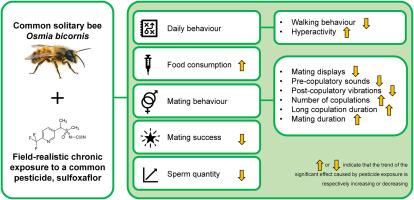
Mating behaviour and fertility are strong selective forces, driving the reproductive trends of animals. Mating disorders may therefore contribute to the recent decline in insect and pollinators health worldwide. While the impact of pesticides on pollinators is widely considered as a driving factor for reducing pollinators health, their effect on mating behaviour and male fertility remains widely overlooked. Here, we assessed the effects of field-realistic exposure to a common pesticide used as a neonicotinoid substitute worldwide, sulfoxaflor, on the behaviour and male physiology of the solitary bee, Osmia bicornis. We measured a variety of parameters focusing on behaviours occurring before, and during mating, as well as sperm quantity. For the first time, we demonstrate that short-term chronic, field-realistic exposure to a common pesticide reduced pre-copulatory display (−36 %) and sounds (−27 %), increased the number of copulations (+110 %) and the mating duration (+166 %), while finally reducing sperm quantity (−25 %) and mating success (−43 %). Our research raises considerable concern on the impact of field-realistic, low sublethal pesticide levels on the fertility and reproductive success of pollinators. Assessing the impact of pesticides on fitness parameters and implementing more sustainable agricultural solutions would allow mitigating the ongoing threat of pesticide pollution on wild insect populations and the broader environment.
期刊介绍:
Chemosphere, being an international multidisciplinary journal, is dedicated to publishing original communications and review articles on chemicals in the environment. The scope covers a wide range of topics, including the identification, quantification, behavior, fate, toxicology, treatment, and remediation of chemicals in the bio-, hydro-, litho-, and atmosphere, ensuring the broad dissemination of research in this field.



 京公网安备 11010802042870号
京ICP备2023020795号-1
京公网安备 11010802042870号
京ICP备2023020795号-1

 分享
分享
 求助内容:
求助内容: 应助结果提醒方式:
 扫码关注我们
