{"title":"Mechanistic insights from simulations of drug–drug conjugate nanoclusters for co-delivery across cancer cell membranes†","authors":"Cherdpong Choodet, Unnop Srikulwong, Pakawat Toomjeen, Adulvit Chuaephon, Witthawat Phanchai and Theerapong Puangmali","doi":"10.1039/D5RA00480B","DOIUrl":null,"url":null,"abstract":"<p >Amphiphilic drug–drug conjugates (ADDCs) such as gemcitabine–camptothecin (<strong>GEM</strong>–<strong>CPT</strong>) and doxorubicin–10-hydroxycamptothecin (<strong>DOX</strong>–<strong>HCPT</strong>) nanoclusters offer innovative solutions to overcome the limitations of conventional cancer therapies, including poor solubility and nonspecific targeting. Using molecular dynamics (MD) simulations, we explored the mechanisms by which these nanoclusters interact with and penetrate cancer and normal cell membranes. <strong>GEM</strong>–<strong>CPT</strong> exhibited enhanced membrane penetration in cancer cells through combined hydrophilic and hydrophobic interactions, along with its ability to extract cholesterol and induce membrane remodelling. In contrast, <strong>DOX</strong>–<strong>HCPT</strong> maintained structural integrity through stable π–π stacking interactions, showing selective binding to membrane head groups (HG) with minimal cholesterol interaction, particularly in normal membranes. The <strong>GEM</strong>–<strong>CPT</strong> nanocluster disrupted the cancer membrane by inducing asymmetric lipid distribution and facilitating water infiltration, whereas the hydrophobic <strong>DOX</strong>–<strong>HCPT</strong> repelled water, maintaining membrane stability. The size of the nanocluster further influenced the behaviour; larger clusters drove steric assembly and lipid reorganisation, while smaller clusters achieved deeper penetration at the cost of structural integrity. The contrasting behaviours of <strong>GEM</strong>–<strong>CPT</strong> and <strong>DOX</strong>–<strong>HCPT</strong> highlight the critical roles of size, charge, and amphiphilicity in membrane transport mechanisms. These findings provide valuable insights into the design of efficient and selective nanomedicines, paving the way for optimised drug delivery systems with reduced off-target effects.</p>","PeriodicalId":102,"journal":{"name":"RSC Advances","volume":" 15","pages":" 11343-11353"},"PeriodicalIF":4.6000,"publicationDate":"2025-04-10","publicationTypes":"Journal Article","fieldsOfStudy":null,"isOpenAccess":false,"openAccessPdf":"https://pubs.rsc.org/en/content/articlepdf/2025/ra/d5ra00480b?page=search","citationCount":"0","resultStr":null,"platform":"Semanticscholar","paperid":null,"PeriodicalName":"RSC Advances","FirstCategoryId":"92","ListUrlMain":"https://pubs.rsc.org/en/content/articlelanding/2025/ra/d5ra00480b","RegionNum":3,"RegionCategory":"化学","ArticlePicture":[],"TitleCN":null,"AbstractTextCN":null,"PMCID":null,"EPubDate":"","PubModel":"","JCR":"Q2","JCRName":"CHEMISTRY, MULTIDISCIPLINARY","Score":null,"Total":0}
引用次数: 0
Abstract
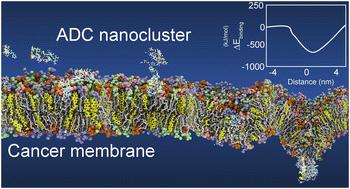
Amphiphilic drug–drug conjugates (ADDCs) such as gemcitabine–camptothecin (GEM–CPT) and doxorubicin–10-hydroxycamptothecin (DOX–HCPT) nanoclusters offer innovative solutions to overcome the limitations of conventional cancer therapies, including poor solubility and nonspecific targeting. Using molecular dynamics (MD) simulations, we explored the mechanisms by which these nanoclusters interact with and penetrate cancer and normal cell membranes. GEM–CPT exhibited enhanced membrane penetration in cancer cells through combined hydrophilic and hydrophobic interactions, along with its ability to extract cholesterol and induce membrane remodelling. In contrast, DOX–HCPT maintained structural integrity through stable π–π stacking interactions, showing selective binding to membrane head groups (HG) with minimal cholesterol interaction, particularly in normal membranes. The GEM–CPT nanocluster disrupted the cancer membrane by inducing asymmetric lipid distribution and facilitating water infiltration, whereas the hydrophobic DOX–HCPT repelled water, maintaining membrane stability. The size of the nanocluster further influenced the behaviour; larger clusters drove steric assembly and lipid reorganisation, while smaller clusters achieved deeper penetration at the cost of structural integrity. The contrasting behaviours of GEM–CPT and DOX–HCPT highlight the critical roles of size, charge, and amphiphilicity in membrane transport mechanisms. These findings provide valuable insights into the design of efficient and selective nanomedicines, paving the way for optimised drug delivery systems with reduced off-target effects.
期刊介绍:
An international, peer-reviewed journal covering all of the chemical sciences, including multidisciplinary and emerging areas. RSC Advances is a gold open access journal allowing researchers free access to research articles, and offering an affordable open access publishing option for authors around the world.



 京公网安备 11010802042870号
京ICP备2023020795号-1
京公网安备 11010802042870号
京ICP备2023020795号-1

 分享
分享
 求助内容:
求助内容: 应助结果提醒方式:
 扫码关注我们
