Maria Mendes, Maria António, Ana L. Daniel-da-Silva, José Sereno, Rui Oliveira, Luís G. Arnaut, Célia Gomes, Maria Luísa Ramos, Miguel Castelo-Branco, João Sousa, Alberto Pais and Carla Vitorino
{"title":"A switch-on chemo-photothermal nanotherapy impairs glioblastoma†","authors":"Maria Mendes, Maria António, Ana L. Daniel-da-Silva, José Sereno, Rui Oliveira, Luís G. Arnaut, Célia Gomes, Maria Luísa Ramos, Miguel Castelo-Branco, João Sousa, Alberto Pais and Carla Vitorino","doi":"10.1039/D5MH00351B","DOIUrl":null,"url":null,"abstract":"<p >Judiciously combined modality approaches have proved highly effective for treating most forms of cancer, including glioblastoma. This study introduces a hybrid nanoparticle-based treatment designed to induce a synergistic effect. It employs repurposed celecoxib-loaded hybrid nanoparticles (HNPs) that are thermally activated by near-infrared laser irradiation to damage glioblastoma cells. The HNPs are constructed by covalently binding organic (ultra-small nanostructured lipid carriers, usNLCs) and inorganic nanoparticles (gold nanorods, AuNRs, with photothermal therapy capability), using c(RGDfK) that serves the dual purpose of a biolinker and a tumor-targeting peptide. The HNPs are further functionalized with transferrin (Tf) as a blood–brain barrier ligand denoted as HNPs<small><sup>Tf</sup></small>. Our comprehensive <em>in vitro</em> and <em>in vivo</em> studies have unveiled the remarkable capability of HNPs<small><sup>Tf</sup></small> to safely and specifically increase blood–brain barrier permeability through transferrin receptor interactions, facilitating precise nanoparticle accumulation in the tumor region within orthotopic tumor-bearing mice. Furthermore, the orchestrated combination of chemo- and photothermal therapy has exhibited a substantial therapeutic impact on glioblastoma, showcasing a noteworthy 78% inhibition in tumor volume growth and an impressive 98% delay in tumor growth. Notably, this treatment approach has resulted in prolonged survival rates among tumor-bearing mice, accompanied by a favorable side effect profile. Overall, our findings unequivocally demonstrate that celecoxib-loaded HNPs<small><sup>Tf</sup></small> offer a game-changing, chemo-photothermal combination, unleashing a synergistic effect that significantly enhances both brain drug delivery and the efficacy of anti-glioblastoma treatments.</p>","PeriodicalId":87,"journal":{"name":"Materials Horizons","volume":" 13","pages":" 4771-4787"},"PeriodicalIF":10.7000,"publicationDate":"2025-04-09","publicationTypes":"Journal Article","fieldsOfStudy":null,"isOpenAccess":false,"openAccessPdf":"https://pubs.rsc.org/en/content/articlepdf/2025/mh/d5mh00351b?page=search","citationCount":"0","resultStr":null,"platform":"Semanticscholar","paperid":null,"PeriodicalName":"Materials Horizons","FirstCategoryId":"88","ListUrlMain":"https://pubs.rsc.org/en/content/articlelanding/2025/mh/d5mh00351b","RegionNum":2,"RegionCategory":"材料科学","ArticlePicture":[],"TitleCN":null,"AbstractTextCN":null,"PMCID":null,"EPubDate":"","PubModel":"","JCR":"Q1","JCRName":"CHEMISTRY, MULTIDISCIPLINARY","Score":null,"Total":0}
引用次数: 0
Abstract
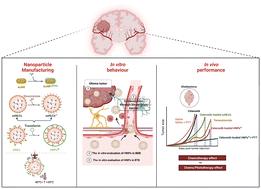
Judiciously combined modality approaches have proved highly effective for treating most forms of cancer, including glioblastoma. This study introduces a hybrid nanoparticle-based treatment designed to induce a synergistic effect. It employs repurposed celecoxib-loaded hybrid nanoparticles (HNPs) that are thermally activated by near-infrared laser irradiation to damage glioblastoma cells. The HNPs are constructed by covalently binding organic (ultra-small nanostructured lipid carriers, usNLCs) and inorganic nanoparticles (gold nanorods, AuNRs, with photothermal therapy capability), using c(RGDfK) that serves the dual purpose of a biolinker and a tumor-targeting peptide. The HNPs are further functionalized with transferrin (Tf) as a blood–brain barrier ligand denoted as HNPsTf. Our comprehensive in vitro and in vivo studies have unveiled the remarkable capability of HNPsTf to safely and specifically increase blood–brain barrier permeability through transferrin receptor interactions, facilitating precise nanoparticle accumulation in the tumor region within orthotopic tumor-bearing mice. Furthermore, the orchestrated combination of chemo- and photothermal therapy has exhibited a substantial therapeutic impact on glioblastoma, showcasing a noteworthy 78% inhibition in tumor volume growth and an impressive 98% delay in tumor growth. Notably, this treatment approach has resulted in prolonged survival rates among tumor-bearing mice, accompanied by a favorable side effect profile. Overall, our findings unequivocally demonstrate that celecoxib-loaded HNPsTf offer a game-changing, chemo-photothermal combination, unleashing a synergistic effect that significantly enhances both brain drug delivery and the efficacy of anti-glioblastoma treatments.




 京公网安备 11010802042870号
京ICP备2023020795号-1
京公网安备 11010802042870号
京ICP备2023020795号-1

 分享
分享
 求助内容:
求助内容: 应助结果提醒方式:
 扫码关注我们
