{"title":"Status of the scabies outbreak before, during and after the Covid- 19 pandemic: a single-center hospital-based retrospective evaluation.","authors":"Erhan Ayhan","doi":"10.1186/s12879-025-10922-6","DOIUrl":null,"url":null,"abstract":"<p><strong>Background: </strong>Scabies is an infestation that can be seen in all age groups, ethnicities, genders, socio-economic groups and in all societies. It is estimated that there are at least 200 million cases worldwide yearly. In this study, we aimed to evaluate the situation before, during and after Covid- 19.</p><p><strong>Methods: </strong>All patients admitted to our outpatient clinic between January 1, 2017 and April 30, 2024 and patients diagnosed with scabies were included in our study and examined retrospectively. The age and gender of the patients, the number of patients admitted monthly and the number of patients diagnosed with scabies among them were evaluated monthly.</p><p><strong>Results: </strong>Between January 1, 2017 and April 30, 2024, 257,536 patients applied to our outpatient clinic. Of these patients, 9407 were diagnosed with scabies. When the percentage of cases was evaluated by years, it was observed that it started to increase in 2019, reached high levels and remained stable in 2020-2022, and then continued to rise in the first 4 months of 2023 and 2024.</p><p><strong>Conclusion: </strong>As a result, we found an increase in the number of scabies cases during the pandemic period. Although the rate of scabies cases is stable between 2020 and 2022, it is seen that the increase continues and will continue in 2023 and the following years.</p>","PeriodicalId":8981,"journal":{"name":"BMC Infectious Diseases","volume":"25 1","pages":"481"},"PeriodicalIF":3.2000,"publicationDate":"2025-04-08","publicationTypes":"Journal Article","fieldsOfStudy":null,"isOpenAccess":false,"openAccessPdf":"https://www.ncbi.nlm.nih.gov/pmc/articles/PMC11980300/pdf/","citationCount":"0","resultStr":null,"platform":"Semanticscholar","paperid":null,"PeriodicalName":"BMC Infectious Diseases","FirstCategoryId":"3","ListUrlMain":"https://doi.org/10.1186/s12879-025-10922-6","RegionNum":3,"RegionCategory":"医学","ArticlePicture":[],"TitleCN":null,"AbstractTextCN":null,"PMCID":null,"EPubDate":"","PubModel":"","JCR":"Q2","JCRName":"INFECTIOUS DISEASES","Score":null,"Total":0}
引用次数: 0
Abstract
Background: Scabies is an infestation that can be seen in all age groups, ethnicities, genders, socio-economic groups and in all societies. It is estimated that there are at least 200 million cases worldwide yearly. In this study, we aimed to evaluate the situation before, during and after Covid- 19.
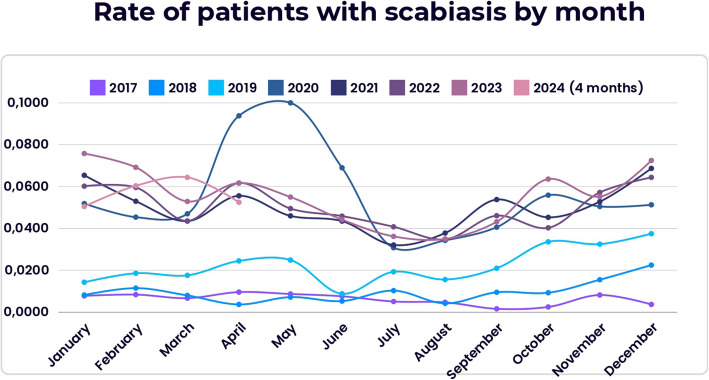
Methods: All patients admitted to our outpatient clinic between January 1, 2017 and April 30, 2024 and patients diagnosed with scabies were included in our study and examined retrospectively. The age and gender of the patients, the number of patients admitted monthly and the number of patients diagnosed with scabies among them were evaluated monthly.
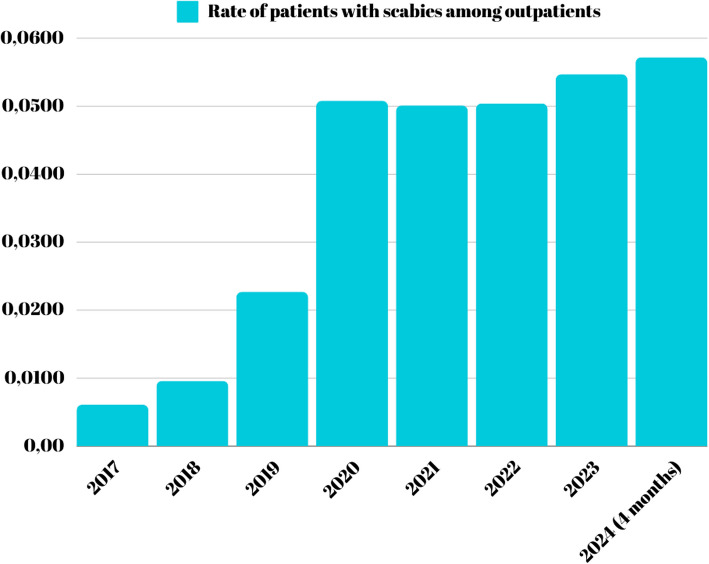
Results: Between January 1, 2017 and April 30, 2024, 257,536 patients applied to our outpatient clinic. Of these patients, 9407 were diagnosed with scabies. When the percentage of cases was evaluated by years, it was observed that it started to increase in 2019, reached high levels and remained stable in 2020-2022, and then continued to rise in the first 4 months of 2023 and 2024.
Conclusion: As a result, we found an increase in the number of scabies cases during the pandemic period. Although the rate of scabies cases is stable between 2020 and 2022, it is seen that the increase continues and will continue in 2023 and the following years.
期刊介绍:
BMC Infectious Diseases is an open access, peer-reviewed journal that considers articles on all aspects of the prevention, diagnosis and management of infectious and sexually transmitted diseases in humans, as well as related molecular genetics, pathophysiology, and epidemiology.




 京公网安备 11010802042870号
京ICP备2023020795号-1
京公网安备 11010802042870号
京ICP备2023020795号-1

 分享
分享
 求助内容:
求助内容: 应助结果提醒方式:
 扫码关注我们
