{"title":"Comprehensive analysis of morphology, transcriptomics, and metabolomics of banana (<i>Musa</i> spp.) molecular mechanisms related to plant height.","authors":"Junya Wei, Guoyin Liu, Mingzhen Sun, Hao Wang, Ping Yang, Shimin Cheng, Lina Huang, Shouxing Wei, Debing Liu","doi":"10.3389/fpls.2025.1509193","DOIUrl":null,"url":null,"abstract":"<p><strong>Introduction: </strong>Plant height is an important agronomic trait that not only affects crop yield but is also related to crop resistance to abiotic and biotic stresses.</p><p><strong>Methods: </strong>In this study, we analyzed the differentially expressed genes (DEGs) and differentially accumulated metabolites (DAMs) between Brazilian banana and local dwarf banana (Df19) through transcriptomics and metabolomics, and combined morphological differences and endogenous hormone content to analyze and discuss themolecular mechanisms controlling banana height.</p><p><strong>Results: </strong>Sequencing data showed that a total of 2851 DEGs and 1037 DAMs were detected between Brazilian banana and local dwarf banana (Df19). The main differential biological pathways of DEGs involve plant hormone signaling transduction, Cutin, suberin and wax biosynthesis, phenylpropanoid biosynthesis, mitogen-activated protein kinase (MAPK) signaling pathway in plants, amino sugar and nucleotide sugar metabolism, etc. DAMs were mainly enriched in ATP binding cassette (ABC) transporters, amino and nucleotide sugar metabolism, glycerophospholipid metabolism, lysine degradation, and phenylalanine metabolism.</p><p><strong>Discussion: </strong>Our analysis results indicate that banana plant height is the result of the synergistic effects of hormones such as abscisic acid (ABA), gibberellic acid (GA3), indole-3-acetic acid (IAA), jasmonic acid (JA), brassinosteroids (BR) and other plant hormones related to growth. In addition, transcription factors and ABC transporters may also play important regulatory roles in regulating the height of banana plants.</p>","PeriodicalId":12632,"journal":{"name":"Frontiers in Plant Science","volume":"16 ","pages":"1509193"},"PeriodicalIF":4.1000,"publicationDate":"2025-03-25","publicationTypes":"Journal Article","fieldsOfStudy":null,"isOpenAccess":false,"openAccessPdf":"https://www.ncbi.nlm.nih.gov/pmc/articles/PMC11975952/pdf/","citationCount":"0","resultStr":null,"platform":"Semanticscholar","paperid":null,"PeriodicalName":"Frontiers in Plant Science","FirstCategoryId":"99","ListUrlMain":"https://doi.org/10.3389/fpls.2025.1509193","RegionNum":2,"RegionCategory":"生物学","ArticlePicture":[],"TitleCN":null,"AbstractTextCN":null,"PMCID":null,"EPubDate":"2025/1/1 0:00:00","PubModel":"eCollection","JCR":"Q1","JCRName":"PLANT SCIENCES","Score":null,"Total":0}
引用次数: 0
Abstract
Introduction: Plant height is an important agronomic trait that not only affects crop yield but is also related to crop resistance to abiotic and biotic stresses.
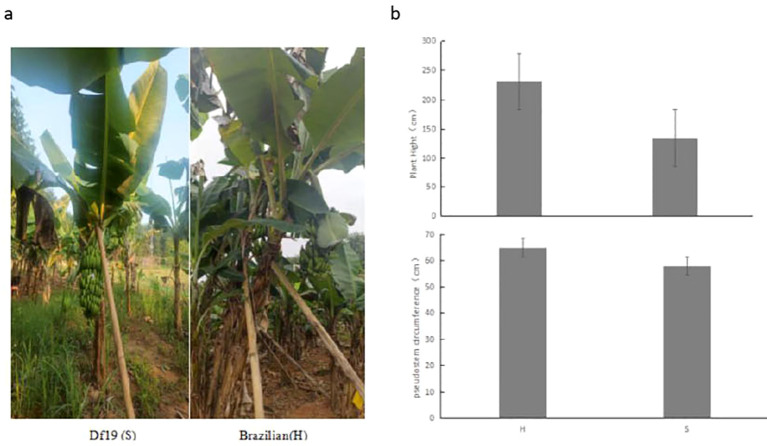
Methods: In this study, we analyzed the differentially expressed genes (DEGs) and differentially accumulated metabolites (DAMs) between Brazilian banana and local dwarf banana (Df19) through transcriptomics and metabolomics, and combined morphological differences and endogenous hormone content to analyze and discuss themolecular mechanisms controlling banana height.
Results: Sequencing data showed that a total of 2851 DEGs and 1037 DAMs were detected between Brazilian banana and local dwarf banana (Df19). The main differential biological pathways of DEGs involve plant hormone signaling transduction, Cutin, suberin and wax biosynthesis, phenylpropanoid biosynthesis, mitogen-activated protein kinase (MAPK) signaling pathway in plants, amino sugar and nucleotide sugar metabolism, etc. DAMs were mainly enriched in ATP binding cassette (ABC) transporters, amino and nucleotide sugar metabolism, glycerophospholipid metabolism, lysine degradation, and phenylalanine metabolism.
Discussion: Our analysis results indicate that banana plant height is the result of the synergistic effects of hormones such as abscisic acid (ABA), gibberellic acid (GA3), indole-3-acetic acid (IAA), jasmonic acid (JA), brassinosteroids (BR) and other plant hormones related to growth. In addition, transcription factors and ABC transporters may also play important regulatory roles in regulating the height of banana plants.
期刊介绍:
In an ever changing world, plant science is of the utmost importance for securing the future well-being of humankind. Plants provide oxygen, food, feed, fibers, and building materials. In addition, they are a diverse source of industrial and pharmaceutical chemicals. Plants are centrally important to the health of ecosystems, and their understanding is critical for learning how to manage and maintain a sustainable biosphere. Plant science is extremely interdisciplinary, reaching from agricultural science to paleobotany, and molecular physiology to ecology. It uses the latest developments in computer science, optics, molecular biology and genomics to address challenges in model systems, agricultural crops, and ecosystems. Plant science research inquires into the form, function, development, diversity, reproduction, evolution and uses of both higher and lower plants and their interactions with other organisms throughout the biosphere. Frontiers in Plant Science welcomes outstanding contributions in any field of plant science from basic to applied research, from organismal to molecular studies, from single plant analysis to studies of populations and whole ecosystems, and from molecular to biophysical to computational approaches.
Frontiers in Plant Science publishes articles on the most outstanding discoveries across a wide research spectrum of Plant Science. The mission of Frontiers in Plant Science is to bring all relevant Plant Science areas together on a single platform.





 京公网安备 11010802042870号
京ICP备2023020795号-1
京公网安备 11010802042870号
京ICP备2023020795号-1

 分享
分享
 求助内容:
求助内容: 应助结果提醒方式:
 扫码关注我们
