Tingting Yang, Abdul Rehman, Suhui Yan, Juan Chen, Jing Li, Xiao Zhang, Wenyang Li
{"title":"Effects of nitrogen application rate and weak light post anthesis on the grain yield and starch physicochemical properties of soft wheat.","authors":"Tingting Yang, Abdul Rehman, Suhui Yan, Juan Chen, Jing Li, Xiao Zhang, Wenyang Li","doi":"10.3389/fpls.2025.1543407","DOIUrl":null,"url":null,"abstract":"<p><p>This study examined the effects of nitrogen (N) application rates and weak light treatment post anthesis on the grain yield and starch physicochemical characteristics of soft wheat. The soft wheat varieties Quanmai 725 (QM725) and Yangmai 15 (YM15) were used as study materials under field conditions, and the experiments were conducted during 2022-2023. During the grain filling stage (7-35 days post anthesis), three shading levels were set: 10% shading (S1), 20% shading (S2) and 30% shading (S3), with natural light conditions used as the control (CK). In 2023-2024, two N application rates (120 kg/hm<sup>2</sup> [N1] and 180 kg/hm<sup>2</sup> [N2]) and the abovementioned three shading treatments for each N application rate were set during the filling stage. The effects of weak light treatment post anthesis on the grain yield and yield components of soft wheat were analyzed. Moreover, the mitigation effects of different N application rates on the grain yield and starch physicochemical characteristics of wheat were examined. The results showed that N application increased wheat yield and yield components as well as the content of starch and its components, whereas weak light treatment decreased these parameters under the same N application rate. Under N1 and N2 conditions, weak light treatment post anthesis significantly reduced the volume, surface area percentage and number of B-type starch granules (particle size ≤10 μm) and increased those of A-type starch granules (particle size >10 μm). Enhanced N application rates significantly improved the gelatinization characteristics and thermodynamic characteristics of wheat starch. Under the same conditions of N1 and N2, weak light treatment significantly reduced the gelatinization characteristics of wheat starch, such as peak viscosity, trough viscosity and final viscosity. Although the enthalpy of wheat starch was increased, its onset temperature, peak temperature and end temperature were significantly reduced, which affected the quality of wheat grains and eventually led to a decrease in wheat yield. However, enhanced N application rates increased the grain yield and starch physicochemical characteristics of wheat. Under the same N application rate, weak light treatment post anthesis reduced the content of starch and its components in wheat grains, which in turn affected the wheat grain weight. The effect was more pronounced in wheat B-type starch granules than in A-type starch granules.</p>","PeriodicalId":12632,"journal":{"name":"Frontiers in Plant Science","volume":"16 ","pages":"1543407"},"PeriodicalIF":4.1000,"publicationDate":"2025-03-25","publicationTypes":"Journal Article","fieldsOfStudy":null,"isOpenAccess":false,"openAccessPdf":"https://www.ncbi.nlm.nih.gov/pmc/articles/PMC11976573/pdf/","citationCount":"0","resultStr":null,"platform":"Semanticscholar","paperid":null,"PeriodicalName":"Frontiers in Plant Science","FirstCategoryId":"99","ListUrlMain":"https://doi.org/10.3389/fpls.2025.1543407","RegionNum":2,"RegionCategory":"生物学","ArticlePicture":[],"TitleCN":null,"AbstractTextCN":null,"PMCID":null,"EPubDate":"2025/1/1 0:00:00","PubModel":"eCollection","JCR":"Q1","JCRName":"PLANT SCIENCES","Score":null,"Total":0}
引用次数: 0
Abstract
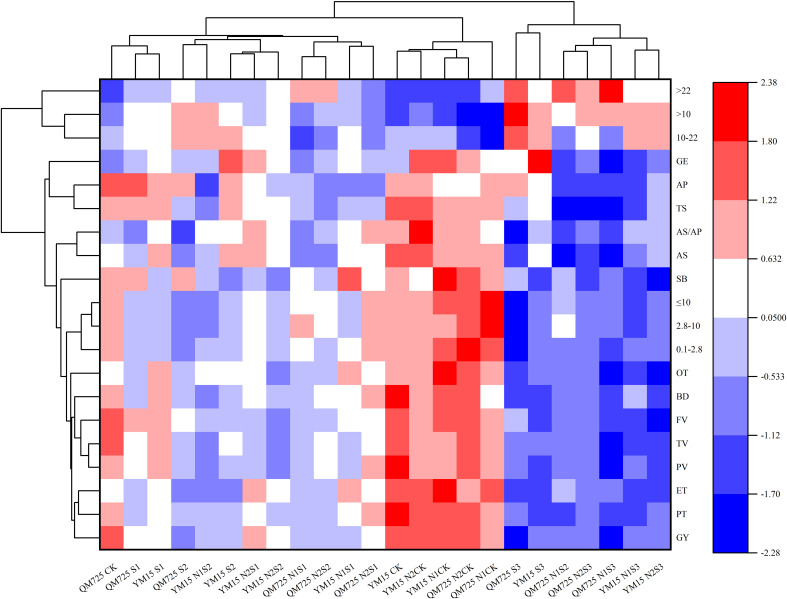
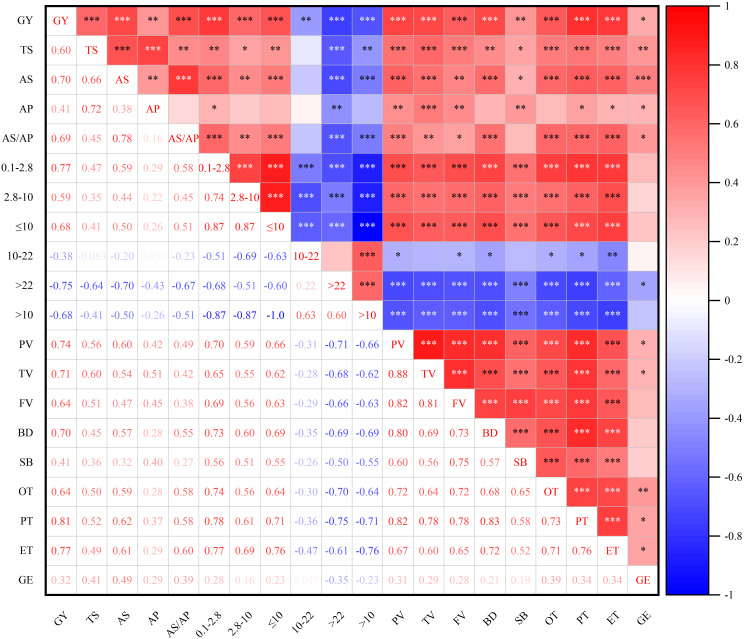
This study examined the effects of nitrogen (N) application rates and weak light treatment post anthesis on the grain yield and starch physicochemical characteristics of soft wheat. The soft wheat varieties Quanmai 725 (QM725) and Yangmai 15 (YM15) were used as study materials under field conditions, and the experiments were conducted during 2022-2023. During the grain filling stage (7-35 days post anthesis), three shading levels were set: 10% shading (S1), 20% shading (S2) and 30% shading (S3), with natural light conditions used as the control (CK). In 2023-2024, two N application rates (120 kg/hm2 [N1] and 180 kg/hm2 [N2]) and the abovementioned three shading treatments for each N application rate were set during the filling stage. The effects of weak light treatment post anthesis on the grain yield and yield components of soft wheat were analyzed. Moreover, the mitigation effects of different N application rates on the grain yield and starch physicochemical characteristics of wheat were examined. The results showed that N application increased wheat yield and yield components as well as the content of starch and its components, whereas weak light treatment decreased these parameters under the same N application rate. Under N1 and N2 conditions, weak light treatment post anthesis significantly reduced the volume, surface area percentage and number of B-type starch granules (particle size ≤10 μm) and increased those of A-type starch granules (particle size >10 μm). Enhanced N application rates significantly improved the gelatinization characteristics and thermodynamic characteristics of wheat starch. Under the same conditions of N1 and N2, weak light treatment significantly reduced the gelatinization characteristics of wheat starch, such as peak viscosity, trough viscosity and final viscosity. Although the enthalpy of wheat starch was increased, its onset temperature, peak temperature and end temperature were significantly reduced, which affected the quality of wheat grains and eventually led to a decrease in wheat yield. However, enhanced N application rates increased the grain yield and starch physicochemical characteristics of wheat. Under the same N application rate, weak light treatment post anthesis reduced the content of starch and its components in wheat grains, which in turn affected the wheat grain weight. The effect was more pronounced in wheat B-type starch granules than in A-type starch granules.
期刊介绍:
In an ever changing world, plant science is of the utmost importance for securing the future well-being of humankind. Plants provide oxygen, food, feed, fibers, and building materials. In addition, they are a diverse source of industrial and pharmaceutical chemicals. Plants are centrally important to the health of ecosystems, and their understanding is critical for learning how to manage and maintain a sustainable biosphere. Plant science is extremely interdisciplinary, reaching from agricultural science to paleobotany, and molecular physiology to ecology. It uses the latest developments in computer science, optics, molecular biology and genomics to address challenges in model systems, agricultural crops, and ecosystems. Plant science research inquires into the form, function, development, diversity, reproduction, evolution and uses of both higher and lower plants and their interactions with other organisms throughout the biosphere. Frontiers in Plant Science welcomes outstanding contributions in any field of plant science from basic to applied research, from organismal to molecular studies, from single plant analysis to studies of populations and whole ecosystems, and from molecular to biophysical to computational approaches.
Frontiers in Plant Science publishes articles on the most outstanding discoveries across a wide research spectrum of Plant Science. The mission of Frontiers in Plant Science is to bring all relevant Plant Science areas together on a single platform.




 京公网安备 11010802042870号
京ICP备2023020795号-1
京公网安备 11010802042870号
京ICP备2023020795号-1

 分享
分享
 求助内容:
求助内容: 应助结果提醒方式:
 扫码关注我们
