Luwei Liu, Jinwei Qin, Yongchu Pan, Hua Wang, Xiaoqing Lu, Fengqing Chu, Lin Wang, Aimin Hao, Bin Yan, Siyang Yuan
{"title":"Evaluating a preclinical orthodontic training using haptic-enhanced VR simulation system: a longitudinal study.","authors":"Luwei Liu, Jinwei Qin, Yongchu Pan, Hua Wang, Xiaoqing Lu, Fengqing Chu, Lin Wang, Aimin Hao, Bin Yan, Siyang Yuan","doi":"10.1186/s12909-025-07036-7","DOIUrl":null,"url":null,"abstract":"<p><strong>Background: </strong>Virtual medical education has been used in the preclinical training of dentistry. The study aimed to evaluate the effectiveness of orthodontic bracket bonding training using the haptic-enhanced virtual reality simulation system.</p><p><strong>Methods: </strong>Twenty-six orthodontic postgraduates were recruited to attend the preclinical training using the virtual training system, consisting of the Virtual Learning Network Platform (VLNP) and the Virtual Simulation Training and Evaluation System (VSTES). Students were asked to perform the online training on VLNP within one week and the offline section on VSTES once each week for 6 consecutive weeks. Students' training outcomes were assessed using the 3D scanning data of the fixed bracket position before and after the training. Students were asked to provide feedback through a survey to identify their perceived benefits or drawbacks of this system. Student's t-tests or Wilcoxon signed-rank tests were used to compare differences in the outcomes, including the total score and each tooth score, between the pre- and post-training and among each online or offline virtual training session. The level of significance was P < 0.05.</p><p><strong>Results: </strong>The final online test scores of 'etching', 'rinsing', 'positioning bracket position', and total items in the online interactive virtual practicing using VLNP were 3-17% higher than those in the formative test (P < 0.05). Seven items of 'cleaning', 'coating acid etchant', 'etching time', 'rinsing off acid etchant', 'rinsing time', 'coating adhesive', 'positioning bracket position' and the total scores were significantly different among six offline results (P < 0.05). With the increased number of practices, the performance gradually improved. All post-training scores of bracket bonding demonstrated significant improvement, showing an increase of approximately 50% compared to pre-training scores (P < 0.05). Most students agreed that this system helped familiarize them with the clinical procedure due to its simulation of the real clinical environment (88.46%) and the availability of time and space for practice without limitation (76.92%). The majority agreed that their improved skills benefited from the offline system, which allowed them to adjust three-dimensional bracket position and receive the real-time feedback.</p><p><strong>Conclusions: </strong>A virtual orthodontic training system with VLNP and VSTES could help students improve their clinical skills of orthodontic bracket bonding during preclinical training.</p>","PeriodicalId":51234,"journal":{"name":"BMC Medical Education","volume":"25 1","pages":"497"},"PeriodicalIF":3.2000,"publicationDate":"2025-04-08","publicationTypes":"Journal Article","fieldsOfStudy":null,"isOpenAccess":false,"openAccessPdf":"https://www.ncbi.nlm.nih.gov/pmc/articles/PMC11977912/pdf/","citationCount":"0","resultStr":null,"platform":"Semanticscholar","paperid":null,"PeriodicalName":"BMC Medical Education","FirstCategoryId":"3","ListUrlMain":"https://doi.org/10.1186/s12909-025-07036-7","RegionNum":2,"RegionCategory":"医学","ArticlePicture":[],"TitleCN":null,"AbstractTextCN":null,"PMCID":null,"EPubDate":"","PubModel":"","JCR":"Q1","JCRName":"EDUCATION & EDUCATIONAL RESEARCH","Score":null,"Total":0}
引用次数: 0
Abstract
Background: Virtual medical education has been used in the preclinical training of dentistry. The study aimed to evaluate the effectiveness of orthodontic bracket bonding training using the haptic-enhanced virtual reality simulation system.
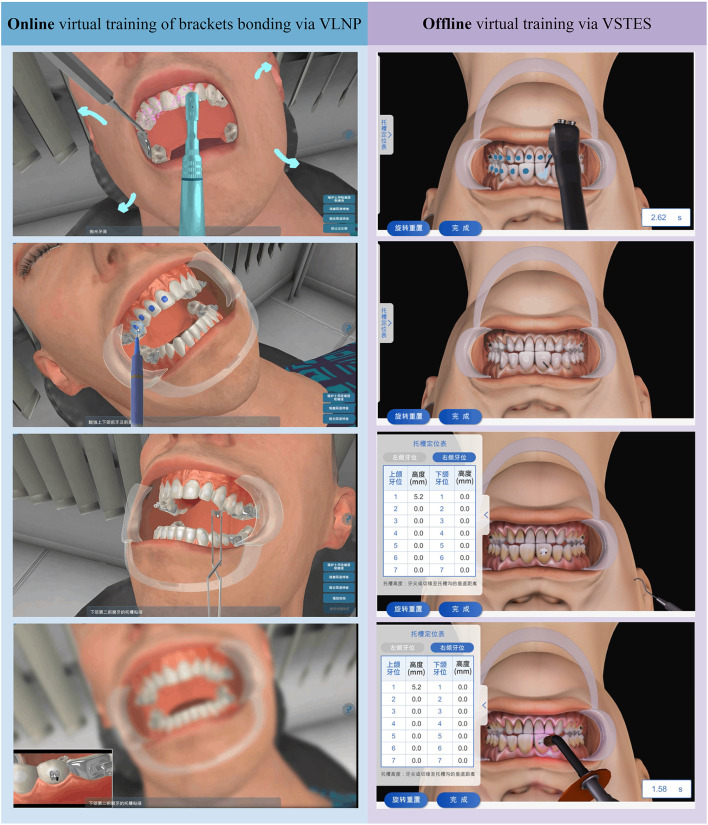
Methods: Twenty-six orthodontic postgraduates were recruited to attend the preclinical training using the virtual training system, consisting of the Virtual Learning Network Platform (VLNP) and the Virtual Simulation Training and Evaluation System (VSTES). Students were asked to perform the online training on VLNP within one week and the offline section on VSTES once each week for 6 consecutive weeks. Students' training outcomes were assessed using the 3D scanning data of the fixed bracket position before and after the training. Students were asked to provide feedback through a survey to identify their perceived benefits or drawbacks of this system. Student's t-tests or Wilcoxon signed-rank tests were used to compare differences in the outcomes, including the total score and each tooth score, between the pre- and post-training and among each online or offline virtual training session. The level of significance was P < 0.05.
Results: The final online test scores of 'etching', 'rinsing', 'positioning bracket position', and total items in the online interactive virtual practicing using VLNP were 3-17% higher than those in the formative test (P < 0.05). Seven items of 'cleaning', 'coating acid etchant', 'etching time', 'rinsing off acid etchant', 'rinsing time', 'coating adhesive', 'positioning bracket position' and the total scores were significantly different among six offline results (P < 0.05). With the increased number of practices, the performance gradually improved. All post-training scores of bracket bonding demonstrated significant improvement, showing an increase of approximately 50% compared to pre-training scores (P < 0.05). Most students agreed that this system helped familiarize them with the clinical procedure due to its simulation of the real clinical environment (88.46%) and the availability of time and space for practice without limitation (76.92%). The majority agreed that their improved skills benefited from the offline system, which allowed them to adjust three-dimensional bracket position and receive the real-time feedback.
Conclusions: A virtual orthodontic training system with VLNP and VSTES could help students improve their clinical skills of orthodontic bracket bonding during preclinical training.
期刊介绍:
BMC Medical Education is an open access journal publishing original peer-reviewed research articles in relation to the training of healthcare professionals, including undergraduate, postgraduate, and continuing education. The journal has a special focus on curriculum development, evaluations of performance, assessment of training needs and evidence-based medicine.






 京公网安备 11010802042870号
京ICP备2023020795号-1
京公网安备 11010802042870号
京ICP备2023020795号-1

 分享
分享
 求助内容:
求助内容: 应助结果提醒方式:
 扫码关注我们
