Christian Münz, Grant R Campbell, Audrey Esclatine, Mathias Faure, Patrick Labonte, Marion Lussignol, Anthony Orvedahl, Nihal Altan-Bonnet, Ralf Bartenschlager, Rupert Beale, Mara Cirone, Lucile Espert, Jae Jung, David Leib, Fulvio Reggiori, Sumana Sanyal, Stephen A Spector, Volker Thiel, Christophe Viret, Yu Wei, Thomas Wileman, Harald Wodrich
{"title":"Autophagy machinery as exploited by viruses.","authors":"Christian Münz, Grant R Campbell, Audrey Esclatine, Mathias Faure, Patrick Labonte, Marion Lussignol, Anthony Orvedahl, Nihal Altan-Bonnet, Ralf Bartenschlager, Rupert Beale, Mara Cirone, Lucile Espert, Jae Jung, David Leib, Fulvio Reggiori, Sumana Sanyal, Stephen A Spector, Volker Thiel, Christophe Viret, Yu Wei, Thomas Wileman, Harald Wodrich","doi":"10.1080/27694127.2025.2464986","DOIUrl":null,"url":null,"abstract":"<p><p>Viruses adapt and modulate cellular pathways to allow their replication in host cells. The catabolic pathway of macroautophagy, for simplicity referred to as autophagy, is no exception. In this review, we discuss anti-viral functions of both autophagy and select components of the autophagy machinery, and how viruses have evaded them. Some viruses use the membrane remodeling ability of the autophagy machinery to build their replication compartments in the cytosol or efficiently egress from cells in a non-lytic fashion. Some of the autophagy machinery components and their remodeled membranes can even be found in viral particles as envelopes or single membranes around virus packages that protect them during spreading and transmission. Therefore, studies on autophagy regulation by viral infections can reveal functions of the autophagy machinery beyond lysosomal degradation of cytosolic constituents. Furthermore, they can also pinpoint molecular interactions with which the autophagy machinery can most efficiently be manipulated, and this may be relevant to develop effective disease treatments based on autophagy modulation.</p>","PeriodicalId":72341,"journal":{"name":"Autophagy reports","volume":"4 1","pages":""},"PeriodicalIF":0.0000,"publicationDate":"2025-03-18","publicationTypes":"Journal Article","fieldsOfStudy":null,"isOpenAccess":false,"openAccessPdf":"https://www.ncbi.nlm.nih.gov/pmc/articles/PMC11921968/pdf/","citationCount":"0","resultStr":null,"platform":"Semanticscholar","paperid":null,"PeriodicalName":"Autophagy reports","FirstCategoryId":"1085","ListUrlMain":"https://doi.org/10.1080/27694127.2025.2464986","RegionNum":0,"RegionCategory":null,"ArticlePicture":[],"TitleCN":null,"AbstractTextCN":null,"PMCID":null,"EPubDate":"2025/12/31 0:00:00","PubModel":"eCollection","JCR":"","JCRName":"","Score":null,"Total":0}
引用次数: 0
Abstract
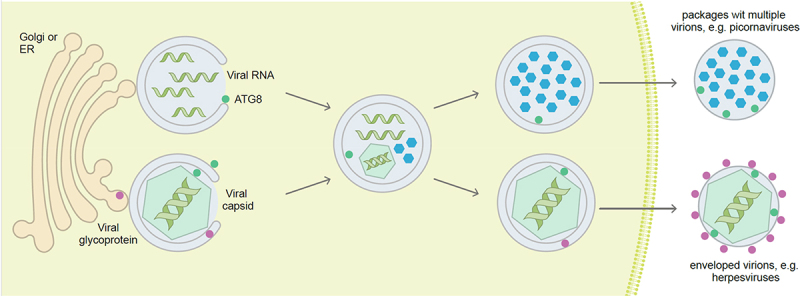
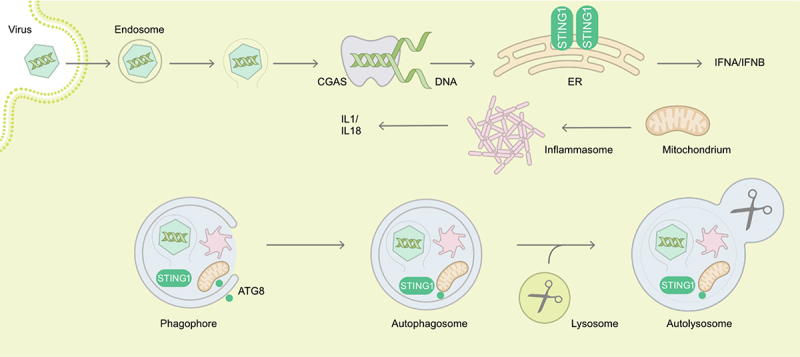
Viruses adapt and modulate cellular pathways to allow their replication in host cells. The catabolic pathway of macroautophagy, for simplicity referred to as autophagy, is no exception. In this review, we discuss anti-viral functions of both autophagy and select components of the autophagy machinery, and how viruses have evaded them. Some viruses use the membrane remodeling ability of the autophagy machinery to build their replication compartments in the cytosol or efficiently egress from cells in a non-lytic fashion. Some of the autophagy machinery components and their remodeled membranes can even be found in viral particles as envelopes or single membranes around virus packages that protect them during spreading and transmission. Therefore, studies on autophagy regulation by viral infections can reveal functions of the autophagy machinery beyond lysosomal degradation of cytosolic constituents. Furthermore, they can also pinpoint molecular interactions with which the autophagy machinery can most efficiently be manipulated, and this may be relevant to develop effective disease treatments based on autophagy modulation.




 京公网安备 11010802042870号
京ICP备2023020795号-1
京公网安备 11010802042870号
京ICP备2023020795号-1

 分享
分享

 求助内容:
求助内容: 应助结果提醒方式:
 扫码关注我们
