Real-World Effectiveness and Safety of Mirikizumab Induction Therapy in Patients With Ulcerative Colitis: A Multicentre Retrospective Observational Study
{"title":"Real-World Effectiveness and Safety of Mirikizumab Induction Therapy in Patients With Ulcerative Colitis: A Multicentre Retrospective Observational Study","authors":"Yasuhiro Takagi, Toshiyuki Sato, Takanori Nishiguchi, Akira Nogami, Masataka Igeta, Soichi Yagi, Maiko Ikenouchi, Mikio Kawai, Koji Kamikozuru, Yoko Yokoyama, Toshihiko Tomita, Hirokazu Fukui, Masayuki Fukata, Taku Kobayashi, Shinichiro Shinzaki","doi":"10.1111/apt.70140","DOIUrl":null,"url":null,"abstract":"<div>\n \n \n <section>\n \n <h3> Background</h3>\n \n <p>In randomised controlled trials, mirikizumab achieved clinical remission and improved outcomes of patients with moderate to severe ulcerative colitis (UC). However, there is currently no real-world evidence for mirikizumab.</p>\n </section>\n \n <section>\n \n <h3> Aim</h3>\n \n <p>To evaluate the real-world effectiveness and safety of mirikizumab.</p>\n </section>\n \n <section>\n \n <h3> Methods</h3>\n \n <p>In a retrospective cohort study among three facilities, we included patients with UC who first received mirikizumab between June 2023 and April 2024. The primary outcome was the change in the partial Mayo score (PMS) from week 0 to 12. Secondary outcomes included changes in serum C-reactive protein (CRP) and leucine-rich α2-glycoprotein (LRG) levels from week 0 to 12; clinical remission rate (PMS < 2 with rectal bleeding subscore of 0), CRP remission rate (< 3.0 mg/L), and LRG remission rate (< 12.7 μg/mL) at week 12; and adverse events during induction therapy.</p>\n </section>\n \n <section>\n \n <h3> Results</h3>\n \n <p>We included 52 patients. Median (interquartile range) PMS decreased from week 0 to 12 (5 [3–6] to 2 [0–3], <i>p</i> < 0.001). CRP and LRG levels also decreased (CRP: 3.8 [0.9–7.3] to 1.8 [0.5–4.0] mg/L, <i>p</i> = 0.015; LRG: 20.1 [16.3–23.2] to 15.9 [12.8–23.2] μg/mL, <i>p</i> = 0.014). Rates of clinical remission, CRP remission, and LRG remission at week 12 were 44.2%, 67.3%, and 27.3%, respectively. There were no adverse events leading to permanent discontinuation of mirikizumab or death.</p>\n </section>\n \n <section>\n \n <h3> Conclusion</h3>\n \n <p>This real-world study demonstrated the short-term effectiveness and safety of mirikizumab in patients with UC.</p>\n </section>\n </div>","PeriodicalId":121,"journal":{"name":"Alimentary Pharmacology & Therapeutics","volume":"61 12","pages":"1923-1934"},"PeriodicalIF":6.7000,"publicationDate":"2025-04-09","publicationTypes":"Journal Article","fieldsOfStudy":null,"isOpenAccess":false,"openAccessPdf":"https://onlinelibrary.wiley.com/doi/epdf/10.1111/apt.70140","citationCount":"0","resultStr":null,"platform":"Semanticscholar","paperid":null,"PeriodicalName":"Alimentary Pharmacology & Therapeutics","FirstCategoryId":"3","ListUrlMain":"https://onlinelibrary.wiley.com/doi/10.1111/apt.70140","RegionNum":1,"RegionCategory":"医学","ArticlePicture":[],"TitleCN":null,"AbstractTextCN":null,"PMCID":null,"EPubDate":"","PubModel":"","JCR":"Q1","JCRName":"GASTROENTEROLOGY & HEPATOLOGY","Score":null,"Total":0}
引用次数: 0
Abstract
Background
In randomised controlled trials, mirikizumab achieved clinical remission and improved outcomes of patients with moderate to severe ulcerative colitis (UC). However, there is currently no real-world evidence for mirikizumab.
Aim
To evaluate the real-world effectiveness and safety of mirikizumab.
Methods
In a retrospective cohort study among three facilities, we included patients with UC who first received mirikizumab between June 2023 and April 2024. The primary outcome was the change in the partial Mayo score (PMS) from week 0 to 12. Secondary outcomes included changes in serum C-reactive protein (CRP) and leucine-rich α2-glycoprotein (LRG) levels from week 0 to 12; clinical remission rate (PMS < 2 with rectal bleeding subscore of 0), CRP remission rate (< 3.0 mg/L), and LRG remission rate (< 12.7 μg/mL) at week 12; and adverse events during induction therapy.
Results
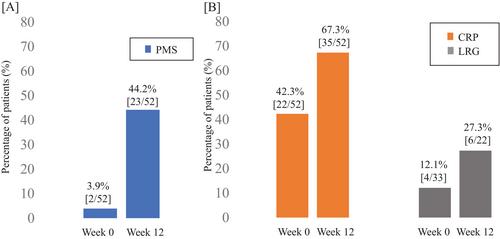
We included 52 patients. Median (interquartile range) PMS decreased from week 0 to 12 (5 [3–6] to 2 [0–3], p < 0.001). CRP and LRG levels also decreased (CRP: 3.8 [0.9–7.3] to 1.8 [0.5–4.0] mg/L, p = 0.015; LRG: 20.1 [16.3–23.2] to 15.9 [12.8–23.2] μg/mL, p = 0.014). Rates of clinical remission, CRP remission, and LRG remission at week 12 were 44.2%, 67.3%, and 27.3%, respectively. There were no adverse events leading to permanent discontinuation of mirikizumab or death.
Conclusion
This real-world study demonstrated the short-term effectiveness and safety of mirikizumab in patients with UC.
期刊介绍:
Alimentary Pharmacology & Therapeutics is a global pharmacology journal focused on the impact of drugs on the human gastrointestinal and hepato-biliary systems. It covers a diverse range of topics, often with immediate clinical relevance to its readership.



 京公网安备 11010802042870号
京ICP备2023020795号-1
京公网安备 11010802042870号
京ICP备2023020795号-1

 分享
分享
 求助内容:
求助内容: 应助结果提醒方式:
 扫码关注我们
