Vigneswara Chellam Ravisankar, Balasubramaniam Selvakumaran, Tamilarasan Ajaykamal and Mariappan Murali
{"title":"Functional biomimetics for copper oxidases: interesting catalytic promiscuity of novel monocopper(ii) complexes†","authors":"Vigneswara Chellam Ravisankar, Balasubramaniam Selvakumaran, Tamilarasan Ajaykamal and Mariappan Murali","doi":"10.1039/D5DT00077G","DOIUrl":null,"url":null,"abstract":"<p >Employing H(L<small><sup>1</sup></small>) [2-((pyridine-2-ylmethyl)imino)methylphenol] or H(L<small><sup>2</sup></small>) [2-((pyridine-2-ylethyl)imino)methylphenol] and phen (1,10-phenanthroline), two novel monocopper(<small>II</small>) complexes, [Cu(L<small><sup>1</sup></small>/L<small><sup>2</sup></small>)(phen)](ClO<small><sub>4</sub></small>) (<strong>1</strong> or <strong>2</strong>), have been produced and studied. The single-crystal structure of the complex ion in <strong>2</strong>, as determined by X-ray structure analysis, shows a trigonal bipyramidal geometry with distortion (<em>τ</em>, 0.65). DFT calculations were used to investigate the molecular geometry of copper(<small>II</small>) complexes in solution as well as their electronic characteristics. The electronic and EPR spectra in the solid-state of <strong>1</strong> and <strong>2</strong> reveal a trigonal bipyramidal geometry, whereas the geometry in solution is square pyramidal. The positive and reversible nature of the redox pair (Cu<small><sup>II</sup></small>/Cu<small><sup>I</sup></small>) makes redox states easily interconvertible. The catalysts in methanol and/or the buffer induced three separate chemical changes: (i) ascorbic acid → dehydroascorbic acid, (ii) benzylamine → benzaldehyde, and (iii) 3,5-di-<em>tert</em>-butylcatechol → 3,5-di-<em>tert</em>-butylquinone. Their <em>k</em><small><sub>cat</sub></small> results show higher activities of amine oxidase (10<small><sup>5</sup></small> h<small><sup>−1</sup></small>). Ascorbate oxidase (10<small><sup>7</sup></small> h<small><sup>−1</sup></small>) and catechol oxidase (10<small><sup>6</sup></small> h<small><sup>−1</sup></small>) activity in the buffer yields <em>k</em><small><sub>cat</sub></small> values that are closer to those of the natural enzyme. This is due to the presence of ligand flexibility, structural distortion, an appropriate chelate ring size, a labile donor, a positive redox potential, and a persistent catalyst–substrate interaction. Therefore, the two monocopper(<small>II</small>) complexes serve as the most efficient promiscuous catalysts, acting as complementary agents to the activity of copper oxidase enzymes and superior models for oxidation processes.</p>","PeriodicalId":71,"journal":{"name":"Dalton Transactions","volume":" 18","pages":" 7221-7239"},"PeriodicalIF":3.3000,"publicationDate":"2025-04-10","publicationTypes":"Journal Article","fieldsOfStudy":null,"isOpenAccess":false,"openAccessPdf":"","citationCount":"0","resultStr":null,"platform":"Semanticscholar","paperid":null,"PeriodicalName":"Dalton Transactions","FirstCategoryId":"92","ListUrlMain":"https://pubs.rsc.org/en/content/articlelanding/2025/dt/d5dt00077g","RegionNum":3,"RegionCategory":"化学","ArticlePicture":[],"TitleCN":null,"AbstractTextCN":null,"PMCID":null,"EPubDate":"","PubModel":"","JCR":"Q2","JCRName":"CHEMISTRY, INORGANIC & NUCLEAR","Score":null,"Total":0}
引用次数: 0
Abstract
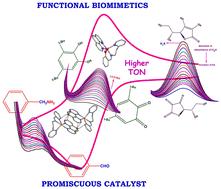
Employing H(L1) [2-((pyridine-2-ylmethyl)imino)methylphenol] or H(L2) [2-((pyridine-2-ylethyl)imino)methylphenol] and phen (1,10-phenanthroline), two novel monocopper(II) complexes, [Cu(L1/L2)(phen)](ClO4) (1 or 2), have been produced and studied. The single-crystal structure of the complex ion in 2, as determined by X-ray structure analysis, shows a trigonal bipyramidal geometry with distortion (τ, 0.65). DFT calculations were used to investigate the molecular geometry of copper(II) complexes in solution as well as their electronic characteristics. The electronic and EPR spectra in the solid-state of 1 and 2 reveal a trigonal bipyramidal geometry, whereas the geometry in solution is square pyramidal. The positive and reversible nature of the redox pair (CuII/CuI) makes redox states easily interconvertible. The catalysts in methanol and/or the buffer induced three separate chemical changes: (i) ascorbic acid → dehydroascorbic acid, (ii) benzylamine → benzaldehyde, and (iii) 3,5-di-tert-butylcatechol → 3,5-di-tert-butylquinone. Their kcat results show higher activities of amine oxidase (105 h−1). Ascorbate oxidase (107 h−1) and catechol oxidase (106 h−1) activity in the buffer yields kcat values that are closer to those of the natural enzyme. This is due to the presence of ligand flexibility, structural distortion, an appropriate chelate ring size, a labile donor, a positive redox potential, and a persistent catalyst–substrate interaction. Therefore, the two monocopper(II) complexes serve as the most efficient promiscuous catalysts, acting as complementary agents to the activity of copper oxidase enzymes and superior models for oxidation processes.
期刊介绍:
Dalton Transactions is a journal for all areas of inorganic chemistry, which encompasses the organometallic, bioinorganic and materials chemistry of the elements, with applications including synthesis, catalysis, energy conversion/storage, electrical devices and medicine. Dalton Transactions welcomes high-quality, original submissions in all of these areas and more, where the advancement of knowledge in inorganic chemistry is significant.




 京公网安备 11010802042870号
京ICP备2023020795号-1
京公网安备 11010802042870号
京ICP备2023020795号-1

 分享
分享
 求助内容:
求助内容: 应助结果提醒方式:
 扫码关注我们
