Ting Zhou , Yajun Zhu , Xiaofei Huang , Tianli Han , Jinyun Liu
{"title":"High-performance rechargeable monovalent- and bivalent-ion batteries: from emerging nanomaterials to in-depth mechanisms","authors":"Ting Zhou , Yajun Zhu , Xiaofei Huang , Tianli Han , Jinyun Liu","doi":"10.1039/d5cc01573a","DOIUrl":null,"url":null,"abstract":"<div><div>Conventional fossil fuels are facing the risk of exhaustion and issues of environmental pollution in many places around the world, making sustainable new energies more important than ever before. Thus, efficient energy-storage systems are receiving broad attention. Among them, research into and application of rechargeable batteries have been quite attractive since the end of the last century. To improve the cycling performance of rechargeable batteries, a great variety of electrode nanomaterials and electrolyte systems have been developed; while enhancement mechanisms are being studied intensively. Here, we provide a comprehensive review of some representative rechargeable monovalent- and bivalent-ion batteries, including lithium-ion batteries (LIBs), sodium-ion batteries (SIBs), lithium–sulfur batteries (LSBs), and bivalent-ion batteries, such as zinc-ion batteries (ZIBs) and magnesium-ion batteries (MIBs). Some hybrid-ion batteries like magnesium/lithium hybrid batteries (MLHBs) and magnesium/sodium hybrid batteries (MNHBs) are also introduced, with a focus on emerging active nanomaterials and deep insights into their enhancement mechanisms. It is expected that the summaries and the proposed outlook presented here will be valuable for a broad range of researchers who are working on energy-storage materials and battery systems.</div></div>","PeriodicalId":67,"journal":{"name":"Chemical Communications","volume":"61 39","pages":"Pages 7035-7056"},"PeriodicalIF":4.2000,"publicationDate":"2025-04-14","publicationTypes":"Journal Article","fieldsOfStudy":null,"isOpenAccess":false,"openAccessPdf":"","citationCount":"0","resultStr":null,"platform":"Semanticscholar","paperid":null,"PeriodicalName":"Chemical Communications","FirstCategoryId":"92","ListUrlMain":"https://www.sciencedirect.com/org/science/article/pii/S1359734525007761","RegionNum":2,"RegionCategory":"化学","ArticlePicture":[],"TitleCN":null,"AbstractTextCN":null,"PMCID":null,"EPubDate":"2025/4/9 0:00:00","PubModel":"Epub","JCR":"Q2","JCRName":"CHEMISTRY, MULTIDISCIPLINARY","Score":null,"Total":0}
引用次数: 0
Abstract
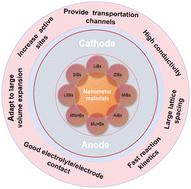
Conventional fossil fuels are facing the risk of exhaustion and issues of environmental pollution in many places around the world, making sustainable new energies more important than ever before. Thus, efficient energy-storage systems are receiving broad attention. Among them, research into and application of rechargeable batteries have been quite attractive since the end of the last century. To improve the cycling performance of rechargeable batteries, a great variety of electrode nanomaterials and electrolyte systems have been developed; while enhancement mechanisms are being studied intensively. Here, we provide a comprehensive review of some representative rechargeable monovalent- and bivalent-ion batteries, including lithium-ion batteries (LIBs), sodium-ion batteries (SIBs), lithium–sulfur batteries (LSBs), and bivalent-ion batteries, such as zinc-ion batteries (ZIBs) and magnesium-ion batteries (MIBs). Some hybrid-ion batteries like magnesium/lithium hybrid batteries (MLHBs) and magnesium/sodium hybrid batteries (MNHBs) are also introduced, with a focus on emerging active nanomaterials and deep insights into their enhancement mechanisms. It is expected that the summaries and the proposed outlook presented here will be valuable for a broad range of researchers who are working on energy-storage materials and battery systems.
期刊介绍:
ChemComm (Chemical Communications) is renowned as the fastest publisher of articles providing information on new avenues of research, drawn from all the world''s major areas of chemical research.



 京公网安备 11010802042870号
京ICP备2023020795号-1
京公网安备 11010802042870号
京ICP备2023020795号-1

 分享
分享
 求助内容:
求助内容: 应助结果提醒方式:
 扫码关注我们
