{"title":"Enhancing the Inherently Limited Electrochromic Redox Reactions via Integration with a Transparent Planar Heater","authors":"Jaewoo Park, Chankyoung Lee, Dooho Choi","doi":"10.1002/smll.202411929","DOIUrl":null,"url":null,"abstract":"<p>Electrochromic devices (ECDs), offering dynamic control over light transmission, are widely adopted in various applications such as displays, automotive systems, and smart windows. However, the commercialization of ECDs is hindered by their slow electrochromic switching rates, particularly in low-temperature environments where reduced ion mobility severely limits ECD performance. This study addresses these limitations by combining a highly transparent ZnO/Ag/ZnO transparent heater (TH) with ECDs, creating integrated electrochromic devices (IECDs). The IECDs demonstrate marked improvements in response efficiency for both bleaching and coloring processes, particularly under sub-zero temperature conditions. For instance, at ≈17.9 °C, the heated IECDs achieve remarkable performance enhancements, with reaction rates increasing by 235.8% for bleaching and 54.7% for coloring compared to the unheated counterparts. In addition, the IECDs exhibit broader optical transmittance ranges compared to unheated ECDs, further emphasizing the superior performance and versatility. These findings highlight the capability of IECDs to maintain robust functionality across a wide range of environmental conditions, including sub-zero temperatures. By efficiently addressing the long-standing issue of slow electrochromic response rates, the proposed IECD approach offers a reliable solution, paving the way for high-performance ECDs in diverse applications such as automotive displays, smart windows, and energy-efficient building systems.</p>","PeriodicalId":228,"journal":{"name":"Small","volume":"21 20","pages":""},"PeriodicalIF":12.1000,"publicationDate":"2025-04-10","publicationTypes":"Journal Article","fieldsOfStudy":null,"isOpenAccess":false,"openAccessPdf":"","citationCount":"0","resultStr":null,"platform":"Semanticscholar","paperid":null,"PeriodicalName":"Small","FirstCategoryId":"88","ListUrlMain":"https://onlinelibrary.wiley.com/doi/10.1002/smll.202411929","RegionNum":2,"RegionCategory":"材料科学","ArticlePicture":[],"TitleCN":null,"AbstractTextCN":null,"PMCID":null,"EPubDate":"","PubModel":"","JCR":"Q1","JCRName":"CHEMISTRY, MULTIDISCIPLINARY","Score":null,"Total":0}
引用次数: 0
Abstract
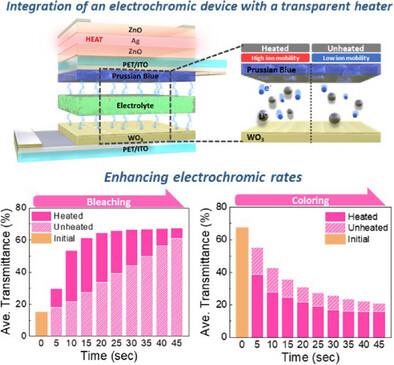
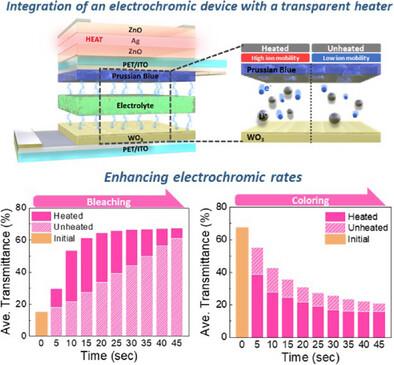
Electrochromic devices (ECDs), offering dynamic control over light transmission, are widely adopted in various applications such as displays, automotive systems, and smart windows. However, the commercialization of ECDs is hindered by their slow electrochromic switching rates, particularly in low-temperature environments where reduced ion mobility severely limits ECD performance. This study addresses these limitations by combining a highly transparent ZnO/Ag/ZnO transparent heater (TH) with ECDs, creating integrated electrochromic devices (IECDs). The IECDs demonstrate marked improvements in response efficiency for both bleaching and coloring processes, particularly under sub-zero temperature conditions. For instance, at ≈17.9 °C, the heated IECDs achieve remarkable performance enhancements, with reaction rates increasing by 235.8% for bleaching and 54.7% for coloring compared to the unheated counterparts. In addition, the IECDs exhibit broader optical transmittance ranges compared to unheated ECDs, further emphasizing the superior performance and versatility. These findings highlight the capability of IECDs to maintain robust functionality across a wide range of environmental conditions, including sub-zero temperatures. By efficiently addressing the long-standing issue of slow electrochromic response rates, the proposed IECD approach offers a reliable solution, paving the way for high-performance ECDs in diverse applications such as automotive displays, smart windows, and energy-efficient building systems.
期刊介绍:
Small serves as an exceptional platform for both experimental and theoretical studies in fundamental and applied interdisciplinary research at the nano- and microscale. The journal offers a compelling mix of peer-reviewed Research Articles, Reviews, Perspectives, and Comments.
With a remarkable 2022 Journal Impact Factor of 13.3 (Journal Citation Reports from Clarivate Analytics, 2023), Small remains among the top multidisciplinary journals, covering a wide range of topics at the interface of materials science, chemistry, physics, engineering, medicine, and biology.
Small's readership includes biochemists, biologists, biomedical scientists, chemists, engineers, information technologists, materials scientists, physicists, and theoreticians alike.



 京公网安备 11010802042870号
京ICP备2023020795号-1
京公网安备 11010802042870号
京ICP备2023020795号-1

 分享
分享
 求助内容:
求助内容: 应助结果提醒方式:
 扫码关注我们
