Yuan-Fan Yang , Zi-Hao Liu , Li-Jun Tang , Zhi-Wei Gao , Meng Yang , Zong-Yin Song , Pei-Hua Li , Shi-Hua Chen , Xing-Jiu Huang
{"title":"Accurate voltammetric analysis of As(III) in cooked rice: A true reflection of actual human intake","authors":"Yuan-Fan Yang , Zi-Hao Liu , Li-Jun Tang , Zhi-Wei Gao , Meng Yang , Zong-Yin Song , Pei-Hua Li , Shi-Hua Chen , Xing-Jiu Huang","doi":"10.1016/j.snb.2025.137783","DOIUrl":null,"url":null,"abstract":"<div><div>Rice is one of the significant sources through which the human body absorbs arsenic(As) from the environment over extended periods in Asia, in addition to drinking water. In addition, owing to its distinct biological characteristics, rice has a notable capacity to absorb As from contaminated soil and water. Current detection methods often necessitate strong acid and high-temperature pretreatment of rice, which may lead to the oxidation of As(III) to As(V), thereby failing to accurately represent the actual intake of As(III) by humans. In this study, we employed a commonly used cooking method in daily life and directly analyzed rice soup via electrochemical techniques to most accurately reflect the actual intake of As(III) by humans. We developed a sensor based on P doped Fe-Co nanobox modified glassy carbon electrodes for precise and highly sensitive detection of As(III) in rice. This sensor demonstrated a sensitivity of 2.39 µA/ppb and achieved a detection limit as low as 0.06 ppb. Furthermore, it exhibited excellent stability and reproducibility. Additionally, through X-ray photoelectron spectroscopy (XPS) and X-ray absorption fine structure (XAFS) studies, we have demonstrated that electrons are transferred from Fe/Co sites to As(III) via the \"electron bridge\" formed by P atoms, enabling highly sensitive detection of As(III) in rice. Our findings present a novel approach for the development of a sensor at the accurate electrochemical detection of heavy metal ions in agricultural products and hold significant potential for future applications in engineering detection.</div></div>","PeriodicalId":425,"journal":{"name":"Sensors and Actuators B: Chemical","volume":"438 ","pages":"Article 137783"},"PeriodicalIF":3.7000,"publicationDate":"2025-09-01","publicationTypes":"Journal Article","fieldsOfStudy":null,"isOpenAccess":false,"openAccessPdf":"","citationCount":"0","resultStr":null,"platform":"Semanticscholar","paperid":null,"PeriodicalName":"Sensors and Actuators B: Chemical","FirstCategoryId":"92","ListUrlMain":"https://www.sciencedirect.com/science/article/pii/S0925400525005581","RegionNum":1,"RegionCategory":"化学","ArticlePicture":[],"TitleCN":null,"AbstractTextCN":null,"PMCID":null,"EPubDate":"2025/4/10 0:00:00","PubModel":"Epub","JCR":"Q1","JCRName":"CHEMISTRY, ANALYTICAL","Score":null,"Total":0}
引用次数: 0
Abstract
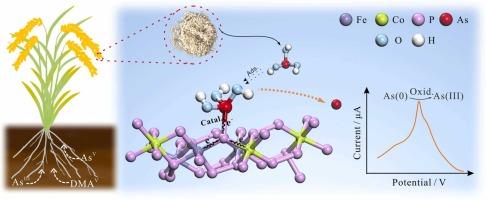
Rice is one of the significant sources through which the human body absorbs arsenic(As) from the environment over extended periods in Asia, in addition to drinking water. In addition, owing to its distinct biological characteristics, rice has a notable capacity to absorb As from contaminated soil and water. Current detection methods often necessitate strong acid and high-temperature pretreatment of rice, which may lead to the oxidation of As(III) to As(V), thereby failing to accurately represent the actual intake of As(III) by humans. In this study, we employed a commonly used cooking method in daily life and directly analyzed rice soup via electrochemical techniques to most accurately reflect the actual intake of As(III) by humans. We developed a sensor based on P doped Fe-Co nanobox modified glassy carbon electrodes for precise and highly sensitive detection of As(III) in rice. This sensor demonstrated a sensitivity of 2.39 µA/ppb and achieved a detection limit as low as 0.06 ppb. Furthermore, it exhibited excellent stability and reproducibility. Additionally, through X-ray photoelectron spectroscopy (XPS) and X-ray absorption fine structure (XAFS) studies, we have demonstrated that electrons are transferred from Fe/Co sites to As(III) via the "electron bridge" formed by P atoms, enabling highly sensitive detection of As(III) in rice. Our findings present a novel approach for the development of a sensor at the accurate electrochemical detection of heavy metal ions in agricultural products and hold significant potential for future applications in engineering detection.
在亚洲,除了饮用水之外,大米是人体长期从环境中吸收砷的重要来源之一。此外,由于其独特的生物学特性,水稻从污染土壤和水中吸收砷的能力显著。目前的检测方法往往需要对大米进行强酸和高温预处理,这可能导致As(III)氧化为As(V),无法准确代表人体实际摄入的As(III)。在本研究中,我们采用日常生活中常用的烹饪方法,通过电化学技术直接对米汤进行分析,以最准确地反映人类对As(III)的实际摄入量。我们开发了一种基于P掺杂Fe-Co纳米盒修饰的玻碳电极的传感器,用于精确和高灵敏度地检测大米中的As(III)。该传感器的灵敏度为2.39 μ a /ppb,检测限低至0.06 ppb。该方法具有良好的稳定性和重复性。此外,通过x射线光电子能谱(XPS)和x射线吸收精细结构(XAFS)研究,我们证明了电子通过P原子形成的“电子桥”从Fe/Co位点转移到As(III)上,从而实现了对大米中As(III)的高灵敏度检测。我们的研究结果为开发一种精确电化学检测农产品中重金属离子的传感器提供了一种新方法,并在未来的工程检测中具有重要的应用潜力。
期刊介绍:
Sensors & Actuators, B: Chemical is an international journal focused on the research and development of chemical transducers. It covers chemical sensors and biosensors, chemical actuators, and analytical microsystems. The journal is interdisciplinary, aiming to publish original works showcasing substantial advancements beyond the current state of the art in these fields, with practical applicability to solving meaningful analytical problems. Review articles are accepted by invitation from an Editor of the journal.



 京公网安备 11010802042870号
京ICP备2023020795号-1
京公网安备 11010802042870号
京ICP备2023020795号-1

 分享
分享
 求助内容:
求助内容: 应助结果提醒方式:
 扫码关注我们
